Imagine you are choosing past projects for a bid to run an IT service desk for a regional transport agency. You have four candidates. One is your company's most famous contract: a national system eight years ago, ten times larger, delivered by another division. One is a service desk for a different transport agency, about the same size, finished last year. One is ongoing but had a rough quarter. One is a small pilot you ran for this same agency. Which do you put forward? Most teams instinctively lead with the famous one. Usually that is the wrong choice.

Relevant past performance is evidence, drawn from contracts you have already delivered, that you can do the work the customer is now buying and do it well. In the APMP Body of Knowledge it combines two things customers look for: relevant experience, meaning work comparable in goals, scope, size, magnitude and complexity, and past performance, meaning a record of success on that work. Chosen well, it lowers the customer's sense of risk. Chosen badly, it reads as a brochure.
This series works through the APMP Body of Knowledge as summarized in the APMP Foundation Study Guide. Past performance builds on two earlier topics: proof points (episode 10), the evidence behind each claim, and the compliance matrix (episode 12), which tracks every requirement the proposal must answer.
Experience and performance are not the same thing
The two terms are often used interchangeably, but they answer different questions. A team can have plenty of experience and a mediocre record, or an excellent record on work that doesn't resemble this contract. The customer wants both.
| Relevant experience | Past performance | |
|---|---|---|
| Question it answers | Have you done work like this before? | Did you do it well? |
| What makes it strong | Comparable goals, scope, size, magnitude and complexity | Measured results, satisfied customers, problems handled |
| How the customer checks it | Reads your descriptions and compares them to the scope of work | Calls references, sends questionnaires, looks up performance records |
| Typical weakness | Projects that are impressive but don't match this work | Claims of success with no numbers and no reachable reference |
How much weight past performance carries varies from one customer to another; some score it as a major factor, others treat it as a pass-or-fail check. In every case, clear descriptions make your solution easier to believe, because they show the approach you propose has worked before.
Two risks the evaluator is weighing
The Study Guide draws a distinction that explains why past performance gets its own section, and often its own evaluators.
| Proposal risk | Performance risk | |
|---|---|---|
| The doubt | Will the approach you propose meet the requirements? | Will you actually deliver, judging by how you did on similar contracts? |
| Direction | Looks forward, at your plan | Looks back, at your record |
| Where it is judged | Technical and management volumes | Past performance volume or section, references, performance records |
| Who usually judges it | Technical and management evaluators | Often contracts specialists, who check what earlier contracts required and how you met those requirements |
| How you lower it | A clear, compliant, well-reasoned solution | Relevant projects, strong references, measured results |
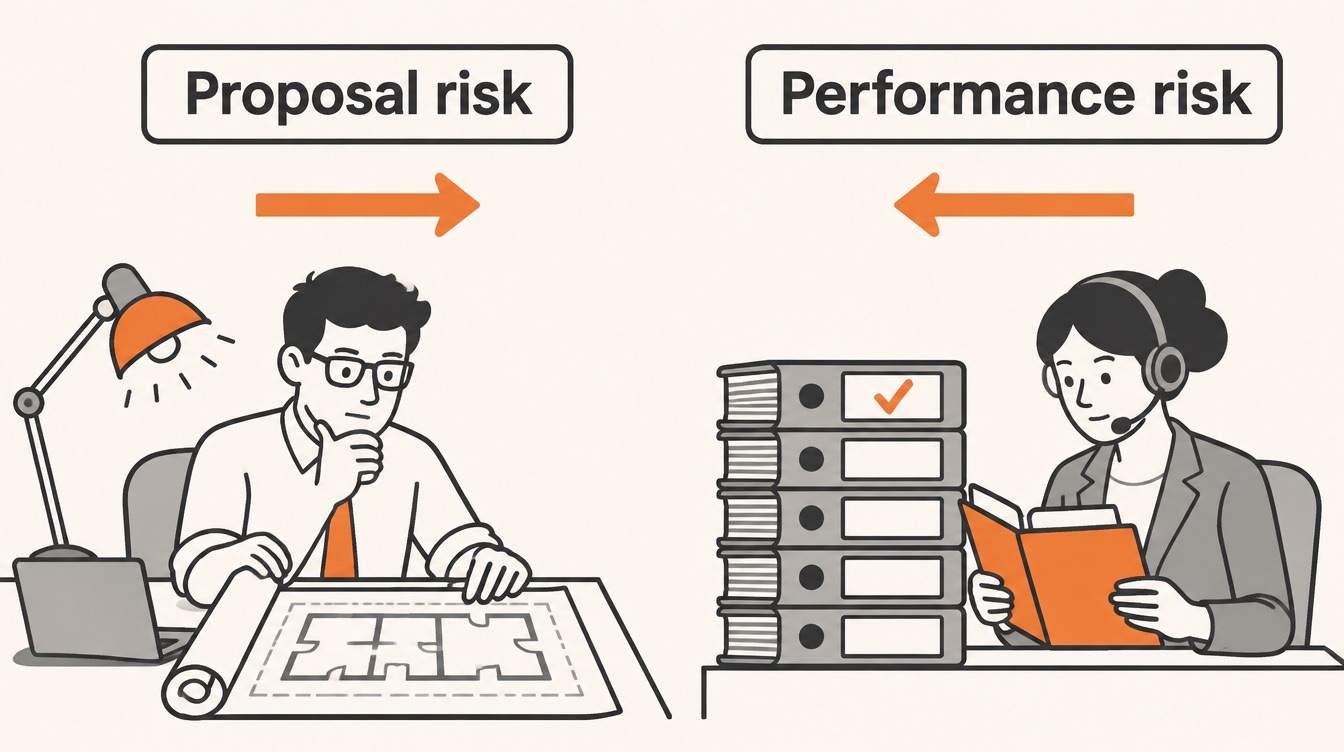
The practical lesson: a brilliant technical volume does not lower performance risk, and a strong record does not rescue a weak solution. Each needs its own evidence.
Read the whole RFP before you pick anything
Past performance requirements are rarely confined to the section that carries their name. Before anyone starts writing, read the whole solicitation and learn:
- The purpose of the contract and what work the contractor will actually do.
- Whether it is new or a recompete, and, if there is an incumbent, how satisfied the customer is with them. You learn that from conversations with the customer, not from the RFP.
- The format: a separate past performance volume focused on performance risk, or a capabilities section inside the technical or management volume.
- Whether teammates and subcontractors must also supply past performance or capability descriptions.
- How many descriptions are required, often with a minimum, a maximum, or both, and what headings the instructions prescribe.
Then go beyond the past performance instructions and evaluation criteria to the customer's description of the work itself, usually called the statement of work (SOW), or in some solicitations the performance work statement (PWS). That is where the customer's vocabulary lives, and those keywords should appear in your descriptions. Your descriptions should also speak to what the customer considers critical to success, which is often visible in the SOW's emphasis and in your capture intelligence (episode 5).
Finally, size the workload. If the RFP asks for six detailed descriptions plus questionnaires for each reference, that is a real writing task. Check it against the proposal schedule, bring in extra writers early if needed, and agree on resources and budget with the bid or proposal manager.
Choose candidates on relevance, reference quality and recency
Most organizations have more possible projects than slots. The Study Guide gives three tests, in order of importance.
1. Relevance
A relevant project is tied to the stated requirements and to the customer's conditions, standards and processes. Check four dimensions:
- Scope: how close is the technical work to the new contract? Some large bidders aim for every area of the SOW to be covered by at least one of the projects they submit.
- Size and complexity: duration, contract value, number of staff, number of tasks, and the size of the organization and user community served. A project far smaller than the new one invites doubt.
- Goals and results: did the project aim at the same outcomes the customer now wants?
- Business unit: will the unit that did the project do this work too? Borrowing a sister division's record is a common trap, and many customers, especially public ones, only count the record of the unit that will perform.
If you hold the predecessor contract, the one this procurement replaces, it belongs in your set. Nothing can be more relevant. After that, look for contracts of essentially the same magnitude and complexity.
2. Quality of the reference
A relevant project is only useful if the person who answers the phone will speak well of it. Confirm the likely reference for every candidate. On an ongoing contract, things may have changed since you last used it as a reference: a new manager, a missed milestone, a dispute.
Expect the customer to check. Some RFPs include a formal questionnaire that each reference must complete; others ask for each contact's name and title with a phone number and email. Even if nothing formal is required, assume someone will call or write.

And if a relevant contract went badly, don't hide it. Public customers can often see contractor performance assessments from other contracts. A proposal that names the problem, explains what you changed and shows why it won't recur is far stronger than one the evaluator catches leaving it out.
3. Recency
Prefer ongoing contracts or ones completed recently. Many RFPs exclude work finished more than a set period ago, commonly about three years. A perfect match from a decade ago may not count at all.
Here is how the four projects from the opening might score (the projects and figures are invented for this article):
| Candidate | Scope | Size and complexity | Same unit? | Reference | Recency | Verdict |
|---|---|---|---|---|---|---|
| A. National system rollout | Partly: build, not support | About 10 times larger | No, another division | Positive, but the contact has retired | Ended 8 years ago | Leave out |
| B. Service desk, another transport agency | Close match | Similar: 3 years, about 35 staff | Yes | Strong, contact confirmed | Ended 14 months ago | Lead with it |
| C. Hospital group service desk | Close match | Somewhat smaller: about 25 staff | Yes | At risk: a missed service level last quarter | Ongoing | Include, and address the dip |
| D. Pilot for this same agency | Narrow | Small: 6 months, 5 staff | Yes | Strong, and knows the customer's processes | Ended last year | Include for its fit with this customer's conditions |
Map your candidates against the scope
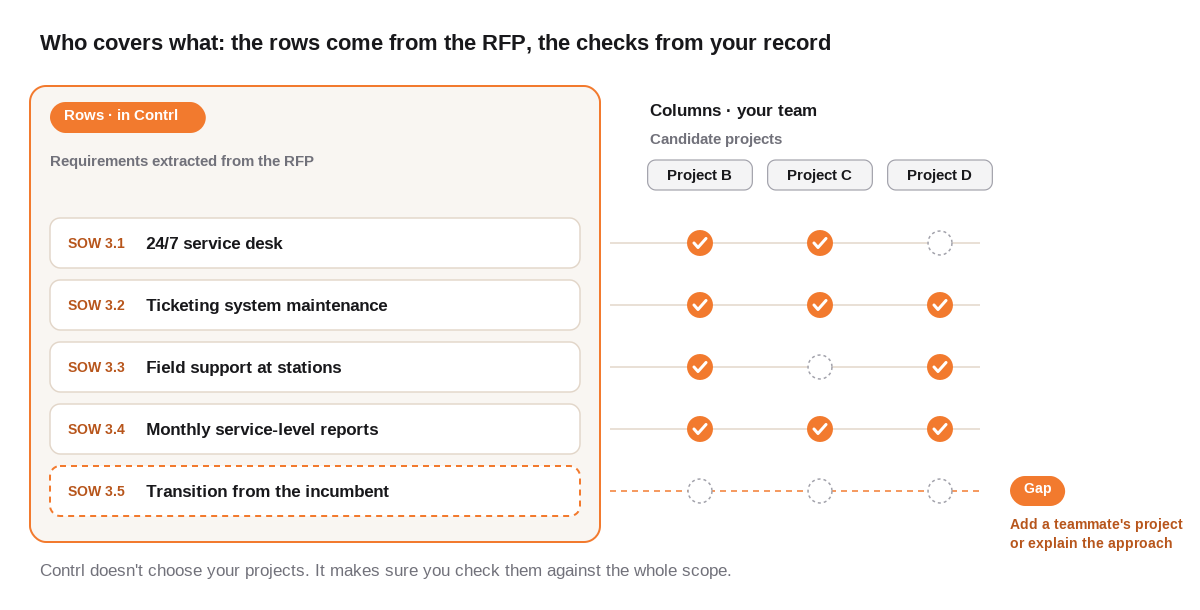
Once relevance and references are checked, build a simple chart: candidate projects across the top, the areas of the SOW or PWS down the side, a mark wherever a project covers an area. Gaps jump out. You may need a teammate's project, or an honest explanation of how you will cover the area. After you make the final selection, the same chart can open the past performance section, showing the evaluator at a glance that your projects together cover the scope.
| SOW area (invented example) | B | C | D |
|---|---|---|---|
| 3.1 Service desk, 24/7 | ✓ | ✓ | |
| 3.2 Ticketing system maintenance | ✓ | ✓ | ✓ |
| 3.3 Field support at stations | ✓ | ✓ | |
| 3.4 Monthly service-level reporting | ✓ | ✓ | ✓ |
| 3.5 Transition from the incumbent |
Row 3.5 is the kind of gap the chart exists to reveal. Before the proposal is final, the team should either find a project that covers it or explain the approach and why it is credible.

Write for the skimmer and the search box
Don't assume anyone will read a past performance description from start to finish. On paper, the evaluator may skim only the first page of each one. In an electronic submission, they may search for the solicitation's keywords and then check the reference. So:
- Put the essentials up front: customer, contract value, period, size, and scope in the new RFP's own terms.
- Use the SOW's keywords, the same nouns the customer used, so a search finds you.
- Follow the RFP's headings for each description, so evaluators find each item where they expect it (episode 18 covers headings).
- Lead with measured results, not activities.
- Add a graphic or table where it saves reading (episode 19), and keep the layout easy to scan (episode 20).
- Make the reference block complete and current: name, title, phone and email, checked with the person.
Activity list
"We provided comprehensive IT support services to a major public-sector client, leveraging industry best practices and a highly skilled team."
No size, no scope match, no results, no customer keywords.
Evidence in the customer's terms
"Regional transport agency · 3 years · 35 staff. Ran the 24/7 service desk and maintained the ticketing system across 42 stations (SOW 3.1, 3.2, 3.4). First-call resolution rose from 61% to 78%; every monthly service-level report was delivered on time."
Size, scope mapped to this SOW and measured results, all on the first lines.

Use past performance outside its own section
Even when the RFP confines past performance to one section, its value doesn't stop there. Wherever the proposal makes a claim, a relevant, successful project can back it up, which is exactly what a proof point does. Introduce these examples with a short phrase that tells the reader evidence is coming, such as "We used this approach at…" or "On a similar contract, this reduced…". The technical volume addresses proposal risk; well-placed past performance there quietly addresses performance risk at the same time.
Common mistakes
- Leading with the most famous project instead of the most relevant one.
- Borrowing another business unit's record when that unit won't do the work.
- Not calling the reference first, and learning about a new manager or a recent problem from the evaluator.
- Hiding a poor result the customer can find anyway.
- Submitting projects outside the allowed period or more descriptions than the RFP permits.
- Writing in your own vocabulary instead of the SOW's, so keyword searches miss you.
- Burying the facts on page three of a description the evaluator only skims.
- Starting late: descriptions, reference checks and approvals take longer than teams expect.
Checklist for your next RFP
- List every past performance requirement across the RFP: instructions, evaluation criteria, the SOW or PWS, and teammate and subcontractor rules.
- Note the format, the number of descriptions, the headings and the time limit on eligible projects.
- Size the writing workload against the schedule, and add writers early if needed.
- List all candidate projects and score each on relevance (scope, size and complexity, goals, business unit), reference quality and recency.
- Include the predecessor contract if you hold it.
- Call every reference before you commit, and confirm current contact details.
- Decide how to address any weak performance the customer could find.
- Build the coverage chart against the SOW areas, and close or explain each gap.
- Write each description for skimming, with the SOW's keywords, the RFP's headings and measured results up front.
- Reuse the strongest results as proof points throughout the proposal.
Where Contrl fits
The coverage chart is only as good as its rows, and the Body of Knowledge is clear that past performance requirements are spread across the whole RFP, not just the section that names them. When you upload an RFP to Contrl, it extracts the requirements, the required outline and the evaluation criteria into one list and maps each requirement to a proposal section. That list can serve as the rows of your chart, in the customer's own words, so your team spends its time on the judgment Contrl can't make: which of your projects truly cover each requirement, which references will hold up, and where the gaps are. Contrl doesn't choose your projects; it makes sure you are checking them against the whole scope.
Next in the series
Past performance proves your organization has done the work; the customer also wants to know who will do it this time. Episode 23 covers Resumes: how to present key personnel so their experience answers this RFP's requirements instead of reading as a career history.
This article is an independent study companion based on the APMP Foundation Study Guide, version 4.2 (© 2025 APMP), which summarizes the APMP Body of Knowledge. It paraphrases and comments on that material and is not endorsed by APMP. The opening scenario, the four candidate projects and their scoring table, the coverage chart, the example descriptions, the common mistakes list and the illustrations were written for this article, and their figures are illustrative; no customer is named. For the authoritative text and certification information, see apmp.org.