Here is this episode's question: your proposal says you can do it, but can you prove it?
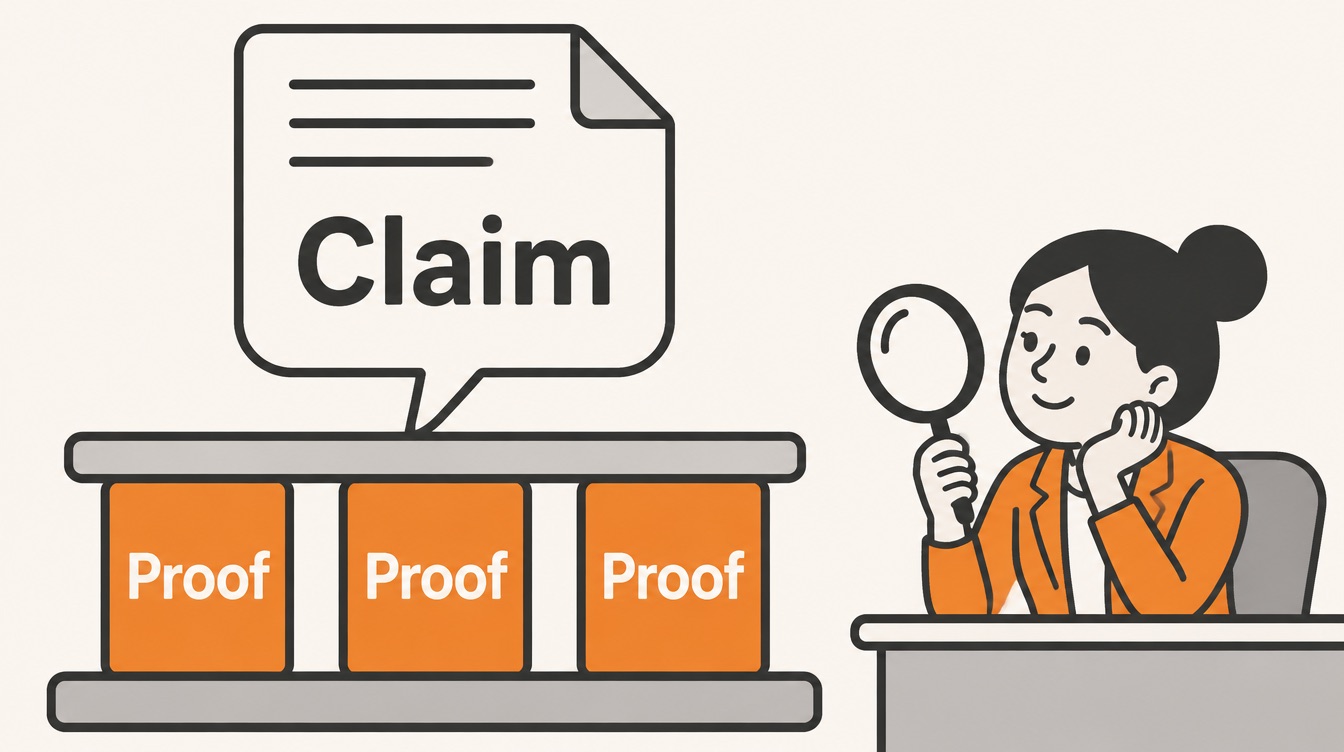
Every proposal promises lower risk, faster delivery, better quality or lower cost. Evaluators read those promises all day, from every bidder, and they have learned not to take them at face value. What changes their mind is evidence. That evidence has a name in the APMP Body of Knowledge: proof points, the verifiable facts that show your features will work and your benefits are achievable. In one line: features and benefits are claims, and proof points are the reason to believe them.
This series works through the APMP Body of Knowledge as summarized in the APMP Foundation Study Guide. Episode 9 covered how a feature becomes a benefit and a benefit becomes a discriminator. This episode supplies the last piece those claims need.
What a proof point is
The Body of Knowledge defines proof points as facts that give verifiable evidence for the features and benefits of your solution. Two words carry the definition. They must be facts, not adjectives or slogans. And they must be verifiable: an evaluator who wanted to check them could.
Proof points don't stand alone. They hold up your win themes and discriminators. When you tell the customer why it should choose you, every reason you give is a claim until something independent backs it. Without that backing, the Study Guide warns, evaluators start to doubt that the features are proven and that the benefits can be achieved, and doubt turns into a perceived risk, which turns into lost points.
| Element | What it says | Example (an IT service transition) |
|---|---|---|
| Feature | What you will do or provide | A staged cutover, one site at a time, with a rollback plan for each step |
| Benefit | What the customer gains | Services stay up while the new system goes live |
| Proof point | Why the customer should believe it | 14 site cutovers for public agencies since 2021, none with downtime outside the agreed window, confirmed by each customer's acceptance report |
The first two rows are something any bidder can write. The third is something only a company that has done the work can write. That is exactly why proof points discriminate.
Features and benefits ask the evaluator to trust you. Proof points give the evaluator a reason to.
Proof points complete the win theme
The Body of Knowledge puts it plainly: an effective win theme contains a benefit, a feature and one or more proof points. If the third part is missing, the evaluator has to take your word for the first two, and the Study Guide expects that evaluators will instead note weaknesses in your solution and see risks to performance.
That is why collecting proof is a strategy task, not an admin task. The bid or proposal manager should sit down with the capture manager, agree on the win strategy and decide which proof it calls for. The order matters:
- Where do we intend to win? The customer's priorities and our edge on them.
- What win themes should the evaluator remember?
- What would make each theme believable? The specific facts an evaluator would need to see.
- Where will those facts come from, and who has them?
Teams that skip to step 4 collect every case study they own and try to fit them in afterwards. The result is a proposal crowded with evidence that doesn't support any particular message. Proof should be worked backwards from the strategy.
The Study Guide singles out two kinds of evidence as often the most valuable, especially for a customer you already serve or hope to: praise from customers and formal contractor performance assessments. Both come from the customer's side of the table, which is what makes them hard to dismiss.
Where proof points come from
Most proof points describe how you performed on similar work. The Body of Knowledge lists a wide range of forms. Here they are grouped by what they prove:
| Type | Examples | Best for proving |
|---|---|---|
| Performance data | Project metrics, service levels met, delivery dates, quality measures on similar contracts | That a feature works and a benefit is achievable |
| Stories | Case studies, success stories, lessons learned | That you understand problems like this customer's |
| Customer voice | Quotes, testimonials, letters of thanks, performance assessments | That someone like the evaluator was satisfied |
| Independent recognition | Awards, industry ratings, certifications, outside appraisals | Experience and quality judged by an unbiased party |
| Scale | Data aggregated across divisions, locations, subsidiaries and programs | Size and strength to deliver |
| Benchmarks | Results compared with industry standards | That you exceed the norm, which quietly ghosts competitors who only meet it |
| Recovery | A problem you fixed, with the customer's confirmation | That you can be trusted when things go wrong |
The ideal source, according to the Study Guide, is a similar solution successfully delivered to a similar customer. The closer the match, the less the evaluator has to imagine.
Problems handled well are proof too
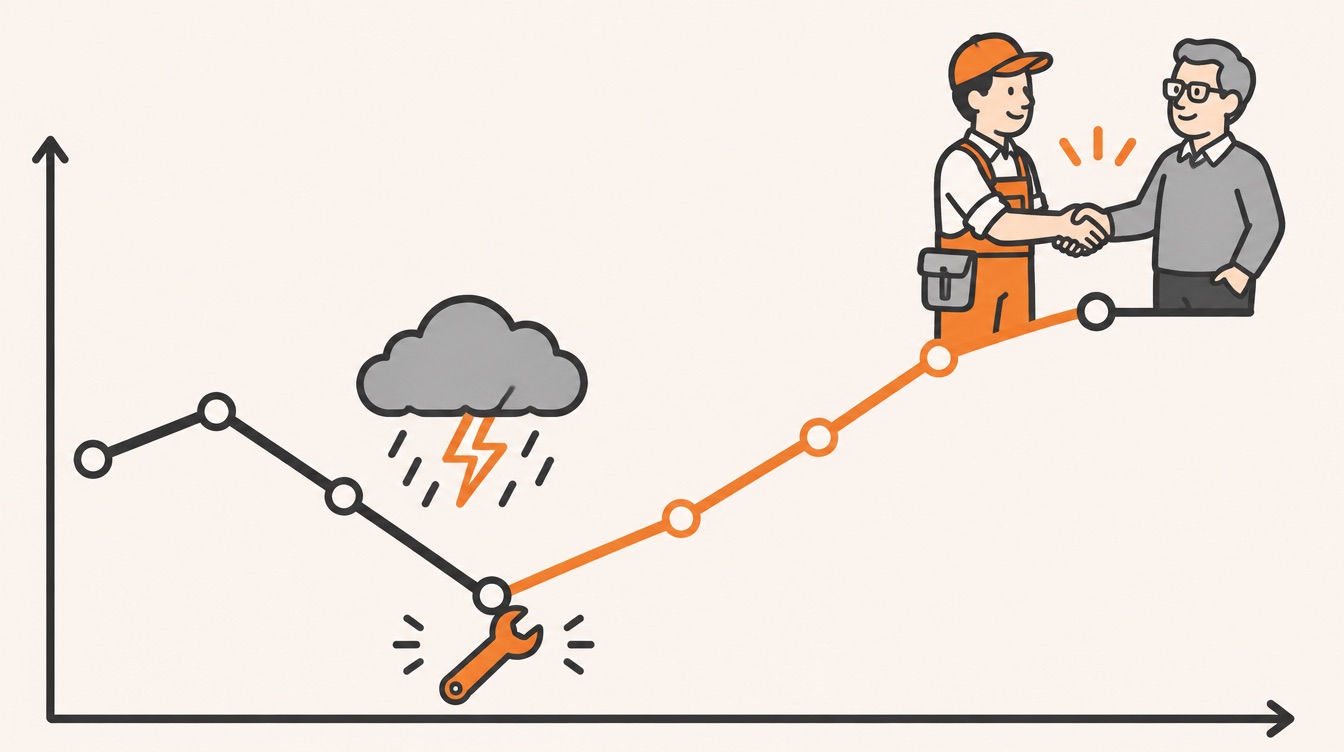
The last row surprises many teams. Proof points are not only successes. The Body of Knowledge points out that a story of facing an issue directly and turning an unhappy customer into a lasting relationship can be very persuasive.
Its reasoning is practical. Every contractor has bad outcomes now and then. When it happens, what evaluators care about is the response, not the fact that something went wrong. A fast fix that solved the problem, plus a statement from the customer agreeing that it was solved, can reflect better on you than a clean record with nothing to show how you behave under pressure.
For example, imagine a cutover that slipped by a weekend because a legacy interface failed. If your team restored service within four hours, rewrote the remaining cutover plan with the customer, and that customer later renewed the contract and wrote you a reference, that story proves something no success story can: evaluators aren't looking for a company that never has problems, but for one that takes ownership when it does.
Start before the RFP
Once the RFP is released, the team is analyzing requirements, building the outline, writing, reviewing and revising, all at once. Asking "do we have a similar case?" at that point usually gets a late answer or a vague one. The Body of Knowledge's advice is to build a store of proof points as soon as you understand the win strategy, well before the customer releases its RFP.
Three habits make early collection work:
- Balance the types. Don't gather ten testimonials and nothing else. Ask which kind of proof best supports each part of your story.
- Read the customer's past solicitations. A customer's procurement office often asks for the same or similar information in every bid. Collect its earlier solicitations, note what they repeatedly require (references, metrics, staff qualifications), and start gathering that evidence now. The pattern itself is customer intelligence.
- Look for gaps. If a feature you plan to offer has no proof behind it, finding out early lets the capture manager do something about it, for example by adding a teaming partner who has done the work.
Collection then continues after the RFP drops, when the requirements are final and the win strategy is sharper. Those later data calls fill in what the RFP specifically asks for, for credibility, persuasion and compliance.
Data calls that get specifics
Proof comes from data, and data comes from people: project managers, delivery staff, finance and your teaming partners. The Body of Knowledge calls the request a data call, and the quality of the proof depends on the quality of the request.
"Send me any good success stories" gets little back, because the people answering don't know what you need. A useful data call names four things:
- A point of contact responsible for answering.
- The exact data you need: which project, which metric, which period.
- Detailed instructions for how to provide it, such as a template, units and the source document.
- A clear due date.
Here is an example written for this article:
Data call: service desk transition, Regional Health Agency bid
POC: delivery lead for the 2024 municipal service desk contract. Please send by Thursday 5 p.m.:
1. Number of tickets handled in the first 90 days after go-live, and median time to first response (from the monthly SLA report; attach the report).
2. Any service outage during cutover: date, duration, cause and how it was fixed.
3. Customer satisfaction score for 2024 and 2025 (survey name, scale and number of respondents).
4. Whether the customer's project manager would agree to be named as a reference, and whether we may quote the thank-you email of 12 March.
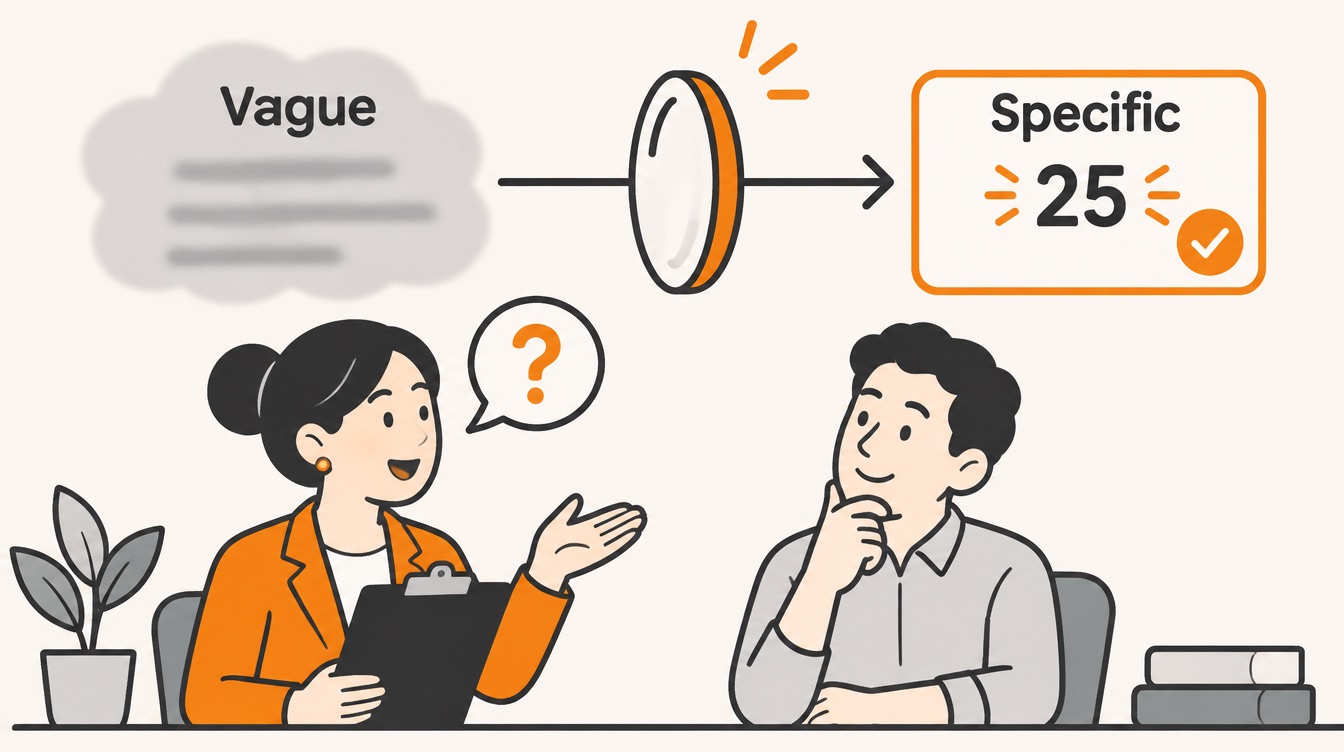
Even a good request often comes back too general. The Study Guide's advice is to keep asking until the answer is specific: "a lot" needs a count, and "big savings" needs an amount. A good working relationship with each POC makes a large difference, because they are the ones who have to dig.
| What the POC first says | What it becomes after one more question |
|---|---|
| "We've done lots of migrations." | 14 site cutovers since 2021, none outside the agreed downtime window |
| "We respond quickly." | Median first response of 38 minutes across 6,200 tickets in 2025, from the customer's SLA report |
| "Customers are very happy." | 4.6 out of 5 in the customer's annual survey, three years running (410 respondents) |
| "We cut their costs a lot." | Licence spend down 31%, about $1.2 million a year, after consolidation, per the customer's budget report |
The test: persuasive, tangible, credible
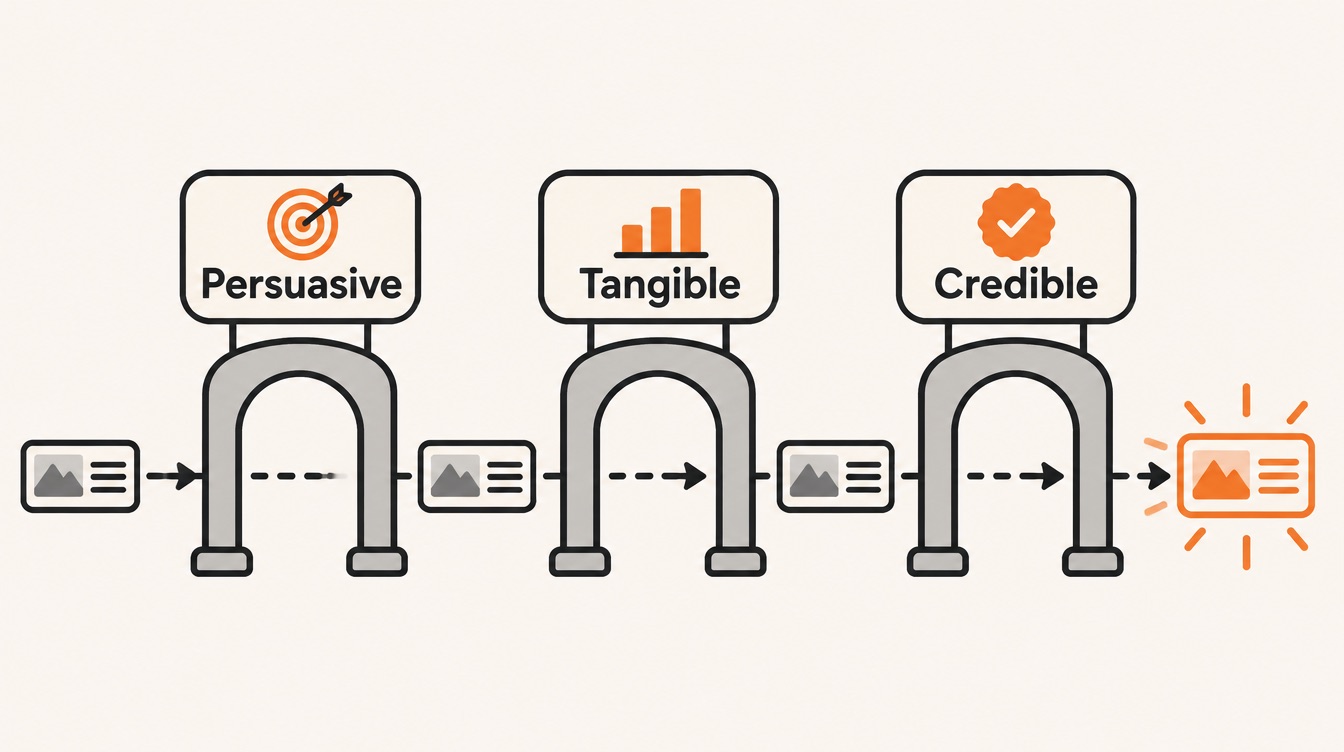
The Body of Knowledge gives three qualities every proof point needs. A proud achievement that fails any of them will be weak in a proposal.
| Quality | What it means | Question to ask |
|---|---|---|
| Persuasive | It supports features and benefits that meet or beat this customer's objectives and requirements | "So what does this have to do with our project?" Can you answer that? |
| Tangible | It is quantified with facts and figures | How much, how many, how fast, over what period? |
| Credible | It is backed by evidence the customer can verify | Who or what could confirm this if the evaluator asked? |
Make it accurate and checkable
Use exact numbers rather than rounded ones: "38 minutes" is more believable than "under an hour". Because the customer must be able to verify a proof point, the proposal should say where each one comes from and give specific customer references and quotes. Always get the customer's permission before quoting them directly. Sources the Body of Knowledge suggests include:
- Named projects, case studies and the lessons you took from them.
- Reporting tools the customer can check.
- Independent third parties such as industry appraisals, awards and ratings.
- Aggregated data that shows the size and strength of the company.
- Comparisons showing you meet or beat industry standards.
- Results tied to specific achievements.
When you aggregate, say what you counted. Combining results across divisions, locations, subsidiaries and programs is a fair way to show scale, as long as the total is substantiated.
Explain what the number means
A figure on its own is information. The Study Guide asks you to explain what it means and to focus the data on achievements, such as money saved, prices reduced, efficiency gained, awards won, satisfaction raised or waiting times cut. Compare two sentences:
Number only
"Invoice processing time fell 20%."
Number with meaning
"Invoice processing time fell 20%, so the finance team closed the month two days earlier and stopped paying late-payment penalties."
The evaluator is not really asking how well you did. They are asking what your result would mean for their own risk, cost, schedule and quality. Answer that, and the number becomes a benefit with proof attached.
Keep a proof library, and keep it current
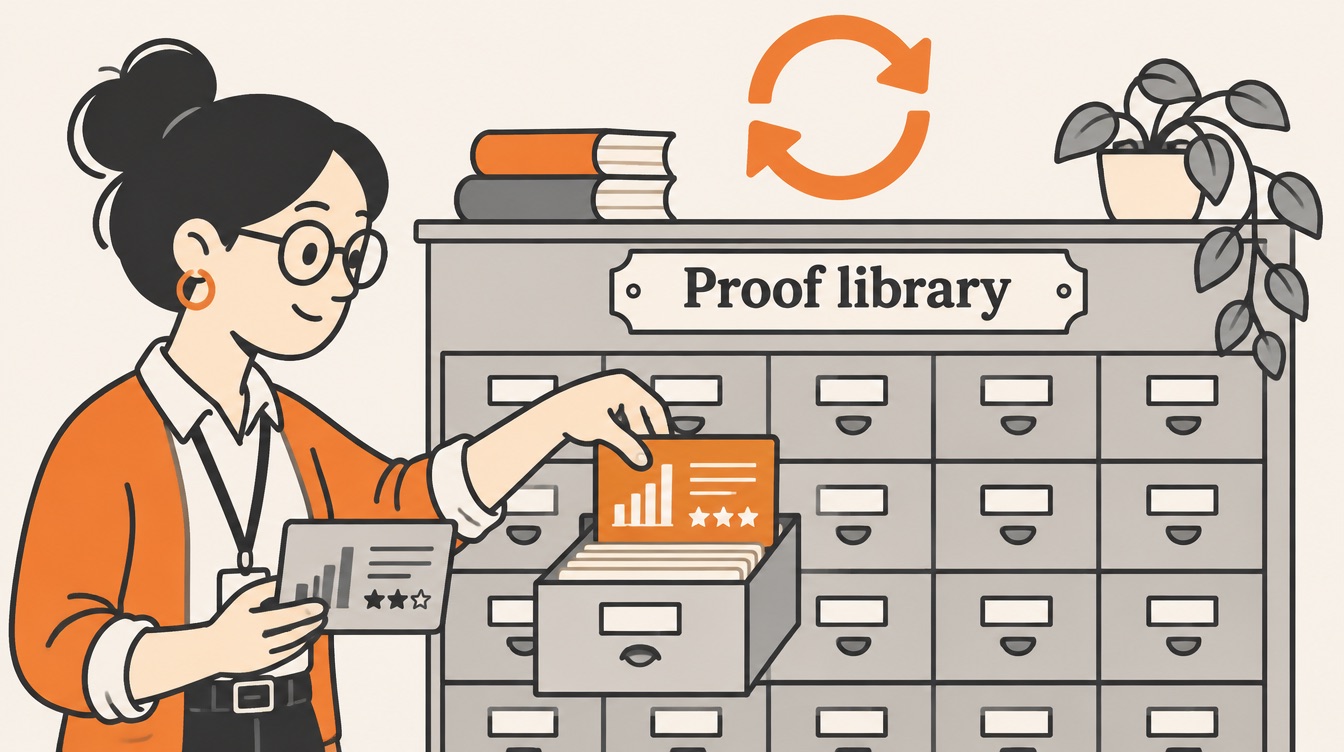
Many proof points can be reused across bids, which is why teams that rebuild them from scratch each time waste so much effort and still miss the best evidence. The Body of Knowledge recommends a repository of proof point data, with one condition: refresh it regularly and whenever something changes. Figures go stale, contacts move on, and permission to quote a customer may need to be confirmed again.
For each entry, record at least the project, the customer, the scope, the measured result, the period, the source document, who can verify it and whether a quote or name may be used. Some organizations appoint a knowledge manager whose only job is to keep reusable content current. That person can also feed back lessons from customer debriefs: which proof points evaluators found convincing and which they didn't. That turns a filing cabinet into something that makes each proposal more persuasive than the last.
Five mistakes to avoid
- Waiting for the RFP. By then there is no time to find gaps, let alone fill them. Run detailed data calls for your own company and your teaming partners before release.
- Letting features do the selling. Many proposals are full of features and short of evidence that they work. Verified achievements are what build confidence.
- Thinking benefits are enough. Customers may not believe a benefit will happen unless you show it has happened before. The strongest proof points show your benefits are better than your competitors'.
- Accepting generic statements. "We have high customer satisfaction" invites the question "how high?" "We can staff up quickly" invites "prove it." If the evaluator can ask "says who?", it isn't a proof point yet.
- Locking proof in callout boxes. Highlight your best proof in callouts, but don't leave it there.
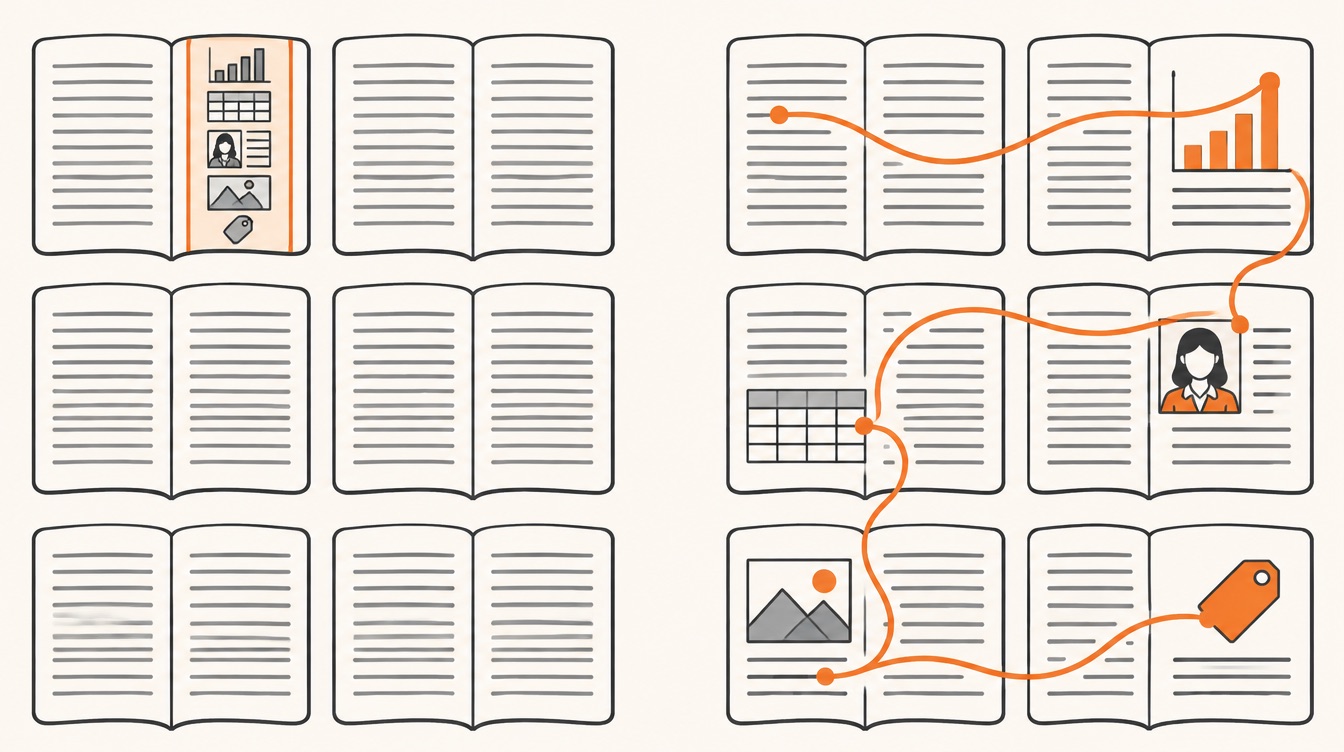
The last mistake is common in proposals that have a separate "References" or "Track record" section while the rest of the text makes unsupported claims. The Body of Knowledge asks for proof points to run through the whole document: feature and benefit tables, the technical narrative, action captions, graphics, résumés, past performance and even the pricing narrative.
Proof kept apart
"Our proven methodology minimizes transition risk." (Three sections later, a reference table lists past projects.)
Proof woven in
"Our staged cutover keeps your services running during transition: in 14 site cutovers since 2021, none ran outside the agreed downtime window. The project manager of our 2024 municipal contract is available as a reference."
Checklist for your next proposal
- List the claims in your win themes and discriminators, and next to each, the fact that would make an evaluator believe it.
- Work with the capture manager to decide which proof the win strategy needs, before the RFP.
- Review the customer's past solicitations and start gathering the evidence it usually asks for.
- Balance proof types: performance data, customer voice, independent recognition, scale, benchmarks and recovery stories.
- Send data calls with a POC, the exact data, instructions and a due date, to your own staff and teaming partners, and follow up until vague answers become numbers.
- Test each proof point: persuasive, tangible, credible. Use exact figures, name the source, and get permission before quoting a customer.
- Explain what each number means for this customer's risk, cost, schedule or quality.
- Weave proof through every section, then highlight the best in callouts.
- Update your proof library after each bid and debrief.
Where Contrl fits
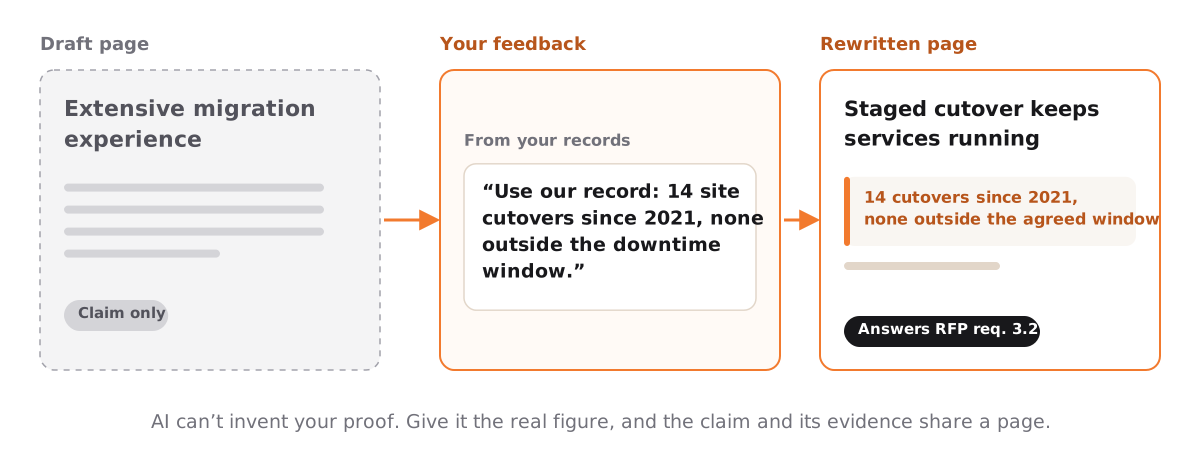
AI can write a confident sentence about your experience, but it cannot invent the facts that prove it; those have to come from your records. In Contrl, the numbers you give in the strategy interview about your company become the edge in the win theme, and when a page still says something generic like "extensive experience", one line of chat feedback with the real figure rewrites that page. Each page also cites the RFP requirements it answers, so you can see which claims sit where and check that every one of them has its proof next to it.
Next in the series
Proof makes evaluators believe you can deliver; price decides whether they can afford to choose you. Episode 11 covers Competitive Price to Win: are you setting a price, or working out the price that can win?
This article is an independent study companion based on the APMP Foundation Study Guide, version 4.2 (© 2025 APMP), which summarizes the APMP Body of Knowledge. It paraphrases and comments on that material and is not endorsed by APMP. The feature-benefit-proof example, the source-type grouping, the recovery scenario, the sample data call, the vague-to-specific table, the invoice example and the before-and-after paragraphs were written for this article, and their figures are illustrative. For the authoritative text and certification information, see apmp.org.