Episode 10 ended with a question: are you setting a price, or working out the price that can win?
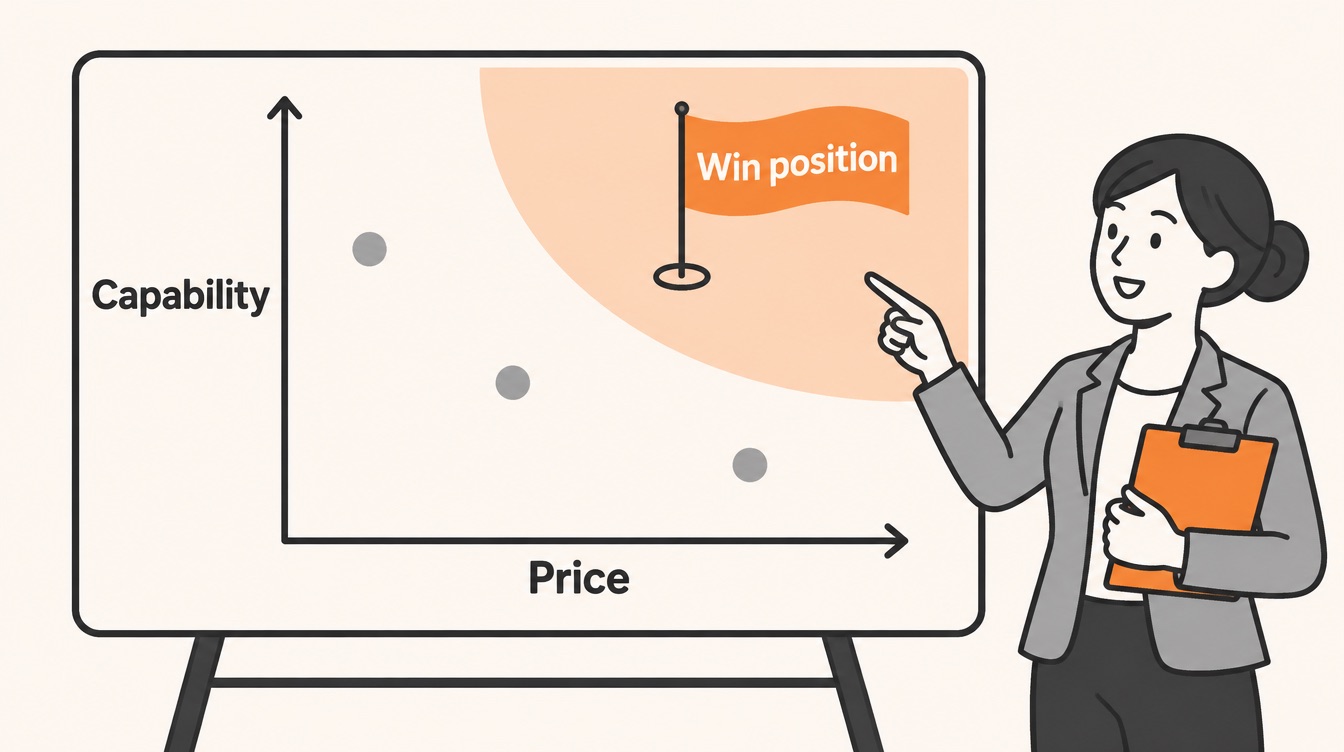
Most teams do the first. They cost their solution, add a margin, look at the total, and then wonder whether it is low enough. The APMP Body of Knowledge describes a different discipline called Competitive Price to Win (cPTW). It starts from the outside: what the customer values, what each competitor is likely to offer, and how the customer will weigh capability against cost. Its answer is a position, a combination of price and capability that would beat the field, not a number. And the result is sometimes uncomfortable: the winning position may not be one your business can accept.
This series works through the APMP Body of Knowledge as summarized in the APMP Foundation Study Guide. Episodes 4 to 10 covered how to make the customer choose you for reasons beyond price. This episode deals with price itself, and shows that even here, price is never the whole story.
What Competitive Price to Win is
In the Body of Knowledge, cPTW is the process of working out how competitors are likely to answer the customer's requirements. It draws on two kinds of intelligence: what the customer cares about, and what each rival will probably propose to deliver it. Its output shows the tradeoff between capability and cost that each competitor offers, as the buying customer would evaluate it. Your team then uses that picture to shape a solution that raises its chance of winning while still meeting its business goals.
The practice goes by several names: Price to Win (PTW), pricing to win, and in some companies "deal to win" or "position to win". The Study Guide prefers Competitive Price to Win for a reason. The word "price" leads people to expect a single output, the lowest evaluated price you should offer. The word "competitive" is a reminder that the analysis cannot be done without competitive intelligence.
The Study Guide also places cPTW in a maturity sequence. In markets with complex sales, organizations tend to professionalize in this order:
- Sales techniques, first tactical, then strategic.
- Proposal planning and management.
- Formal capture planning and management.
- A formal cPTW process.
In other words, cPTW is what organizations add once the earlier disciplines are in place. The idea traces back to the 1980s, when a large defense contractor studied how its best business developers won. They gathered data with a consistent purpose, understood each customer early (needs, people, funding, evaluation and buying history), and kept assessing likely competitors, including how those competitors turn cost into a bid price. The company set up competitive intelligence and Price to Win units that served pursuit teams as independent clients. According to the Study Guide, win rates and revenue rose and bid budgets were spent more wisely.
cPTW is not pricing
This is the most important distinction in the episode. The Body of Knowledge defines a few terms carefully:
| Term | What it means | Inside or outside view |
|---|---|---|
| Cost | The resources needed to deliver the solution: direct costs like staff time, materials and travel, plus indirect costs such as overhead | Inside |
| Price | The amount you charge the customer in the bid. Higher cost usually means higher price, but in a tight market price also expresses your strategy | Inside |
| Costing and pricing | The team's own processes for working out its costs and converting them into a bid price | Inside |
| Business intelligence | Analysis of your own company's data and performance | Inside |
| Competitive Price to Win | Analysis of what the customer requires and values, and how competitors are likely to meet it | Outside |
The two activities ask different questions. Pricing asks, "What will we charge?" cPTW asks, "Where do we need to be to win?" The Study Guide's division of labor is clear: cPTW sets the target; pricing is how the team tries to hit it, or decides, for its own business reasons, not to.
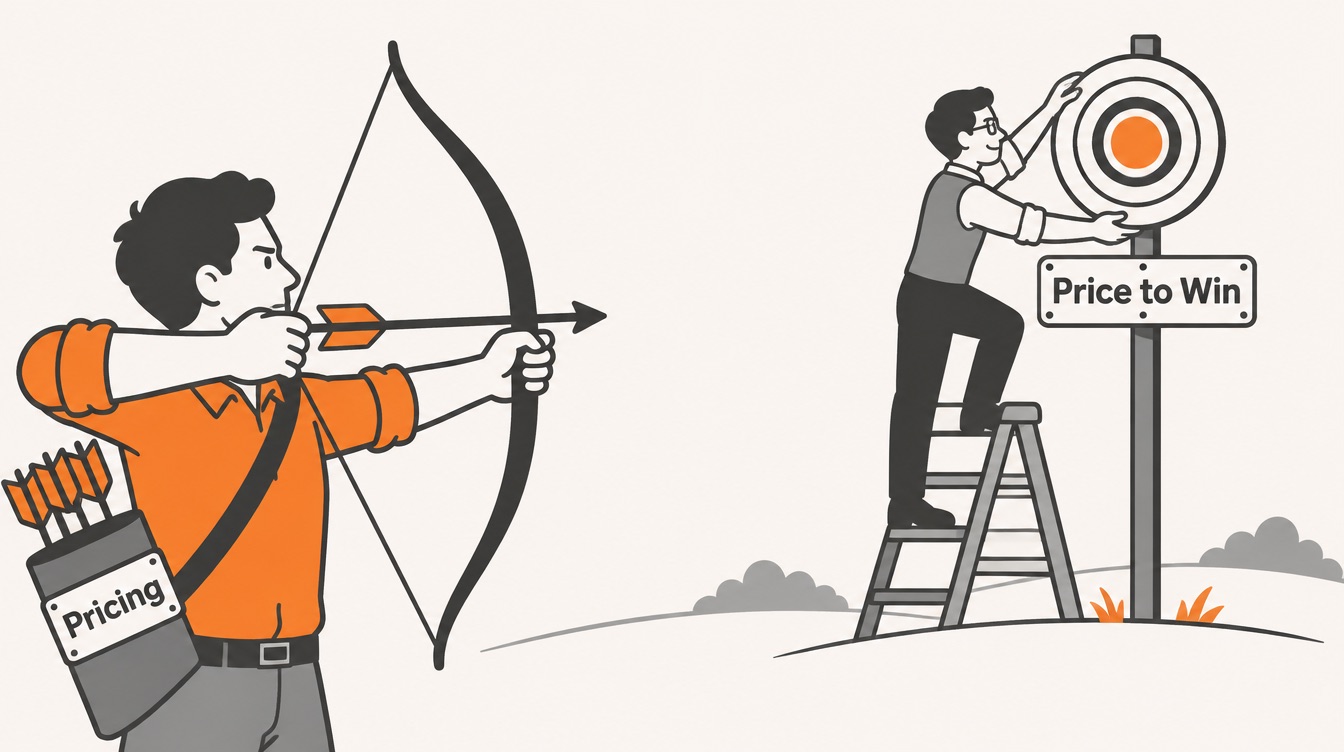
Mixing them up is risky. If you start from your own costs and ask whether the total "feels competitive", you are looking at the deal only from inside. The customer and the competitors are setting the terms of the game, and an internal cost build cannot see them.
The "Big S" solution
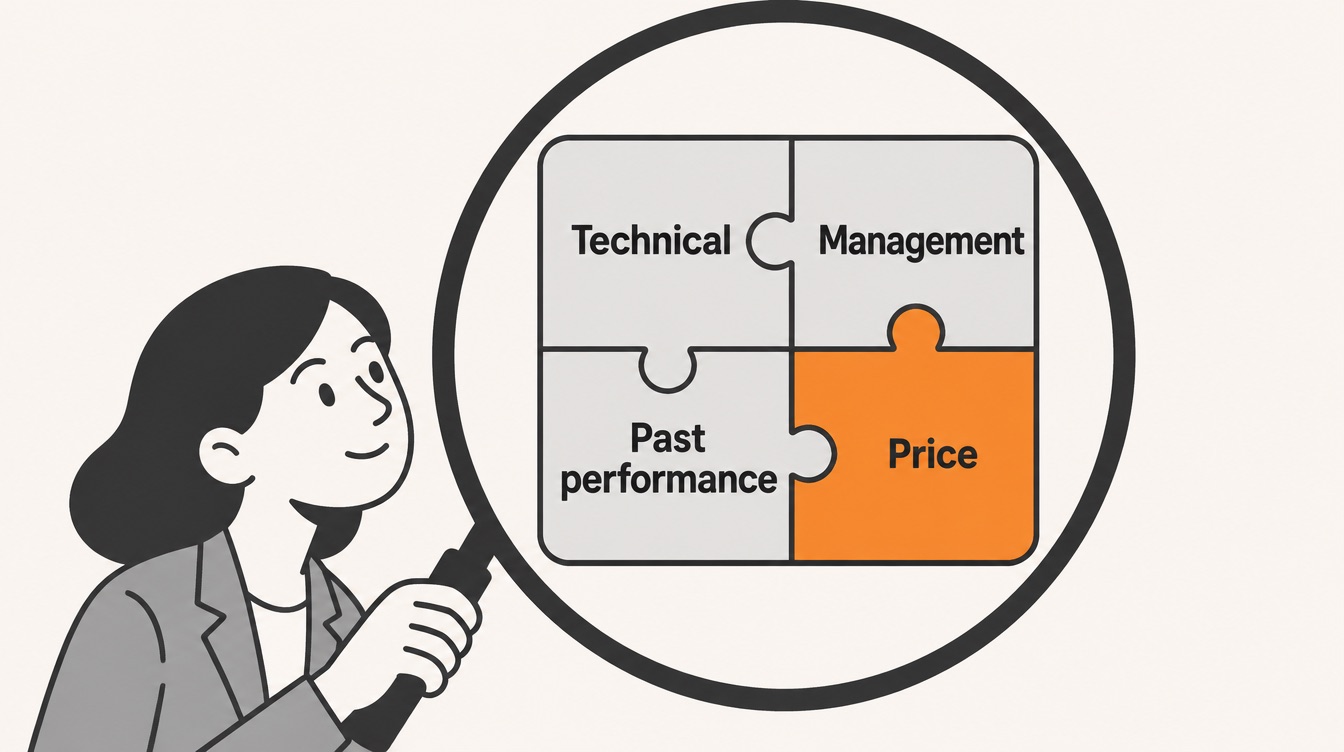
cPTW doesn't model only competitors' prices. It looks at their whole offer, which the Study Guide calls the "Big S" solution:
- Technical: the approach and what it includes.
- Management: how the work will be run, staffed and kept under control.
- Past performance: what the bidder has delivered before and can prove.
- Cost/price: what the whole package will cost the customer, as evaluated.
These parts move together. Cutting scope lowers price but also lowers the value the customer sees. Adding a dedicated transition manager raises price but lowers the risk an evaluator worries about. A strong record on very similar work can make a higher price easier to accept. That is why the Study Guide says price isn't simply cost with profit added: it reflects the strategy behind the whole offer.
Here is an example written for this article. Imagine a five-year IT operations contract evaluated on best value, with three likely rivals:
| Competitor | Likely solution | Likely price position | How the customer may see it |
|---|---|---|---|
| A, low-cost operator | Offshore-heavy staffing, minimal transition team | Lowest | Attractive price, but a risky handover |
| B, the incumbent | Same team as today, no new tooling | Highest | Safe, but little improvement for the money |
| C, large integrator | New platform and a large senior team | High | Strong technically, more than the customer asked for |
A cPTW result here would not be a number. It might read: to win, offer a transition risk close to B's, at a price within a few percent of A's; don't match C's platform, because the evaluation doesn't reward it. That is a position. Whether your company can reach it at an acceptable margin is a pricing and leadership question that comes afterwards.
Pricing tells you what you want to charge. Price to Win tells you where you need to stand.
Intelligence, not intuition
"They'll probably come in around here" is a guess. The Study Guide says a defensible result rests on intelligence that is gathered ethically and analyzed rigorously, with every assumption written down before any model is built. If the data is complete, the assumptions are clear and the model is sound, the result can be defended, even when leadership dislikes it.
Customer intelligence
Before researching, decide what the analysis actually needs, check what your knowledge base already holds, and plan how to collect the rest. The Study Guide's warning is useful: collect information you can act on, not material to fill a binder. Typical questions:
- The opportunity: what is the customer trying to achieve, and why now? What are the stated and unstated requirements, deliverables, locations and dates?
- Funding: where does the money come from, how much is available in total, when, and how likely is it to be cut? What else must it pay for? What remains after those other uses is the addressable funding, the most the winning bidder can actually receive.
- People and roles: who decides, who influences, who writes the requirements, who evaluates, who funds, and are the requirement writers the same people as the end users? For each group, what do they value, what are their biases and pain points?
- Acquisition and evaluation: how will the purchase be run, and will the award lean toward lowest price, highest value, or somewhere between?
For example, a program with 10 million in total funding may spend 1.5 million on its own project office and an independent oversight contract. A bid model that assumes the full 10 million is available starts from the wrong ceiling.
Competitor intelligence
Identify the competitors that matter for this opportunity, then gather what you need from public sources and from conversations. The Body of Knowledge notes that many analysts prefer face-to-face elicitation, learning through professional networks and industry contacts. The line is firm: no deception, no false identities, no phishing, no impersonation and no access to confidential or proprietary data. Those practices are unethical, sometimes illegal, and can do lasting damage to your reputation. Internal colleagues can be a source too, as long as the analyst stays independent of the pursuit team.
From data to actionable intelligence
Data becomes useful when it supports a decision. The Study Guide outlines a simple loop: organize and categorize what you have; build a visual of the competitive landscape showing each rival's strengths, weaknesses, pricing, value proposition and positioning; play out scenarios of how competitors might respond; then keep collecting and refining. The point is a recommendation leadership can act on: pursue, adjust or stop. (EP05, Customer and Competitor Intelligence, covers the gathering side in more depth.)
Two analyses: Price to Compete and Price to Win
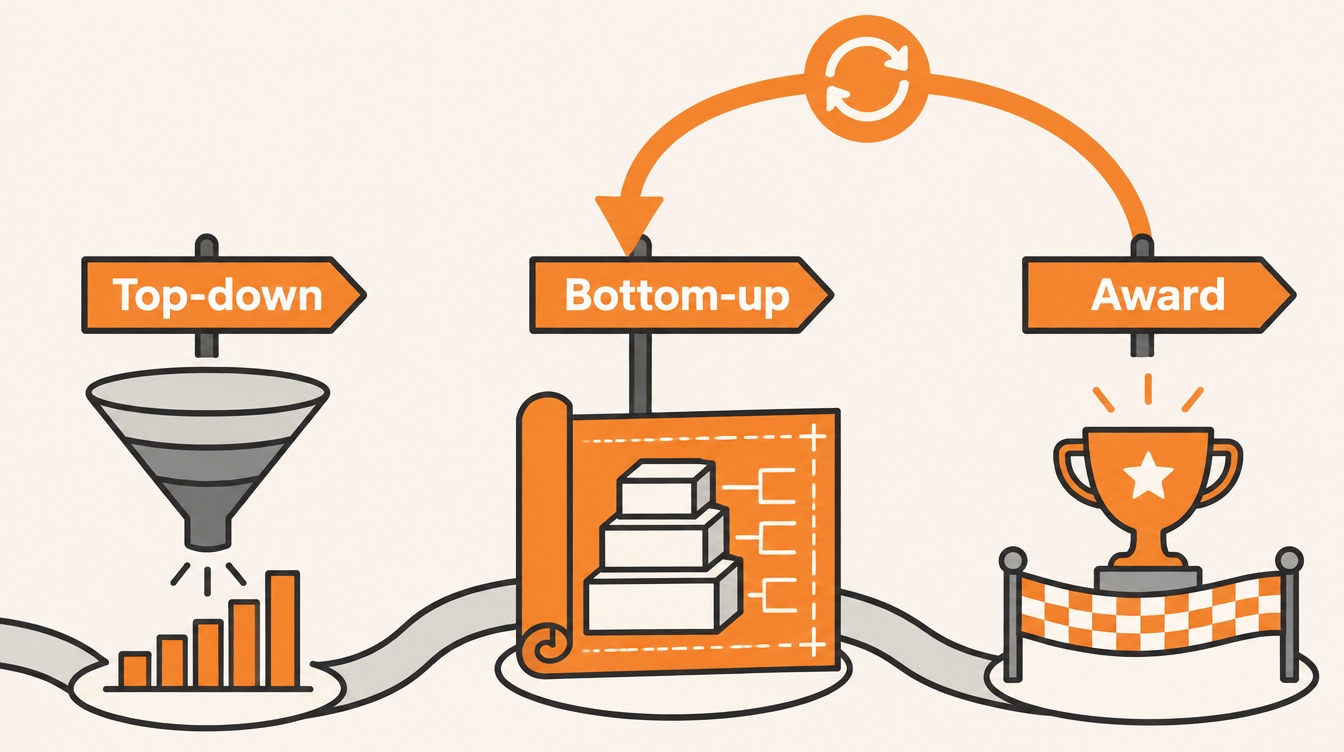
The Body of Knowledge splits competitive analysis into two levels. Strategic competitor analysis looks broadly at competitors' capabilities and strategies across a market, usually to find gaps worth exploiting, and is not tied to one pursuit. Tactical competitive analysis focuses on what each competitor will offer for one specific opportunity, along with the people and process behind the customer's requirements and award decision. That intelligence feeds two cPTW analyses:
| Price to Compete | Price to Win | |
|---|---|---|
| When | Before detailed requirements are known | Once requirements, acquisition approach and evaluation are known |
| Direction | Top-down | Bottom-up |
| Main input | History: the customer's past awards and competitors' past wins, relative to budget | A modeled solution and cost build for each competitor |
| Output | Comfort zones where the customer tends to award and competitors tend to bid | The optimum position of price and capability to win |
| Used for | Deciding whether to pursue and shaping an early solution | Fine-tuning the solution, or justifying a walk-away |
Price to Compete: top-down
- Gather funding data from the same customer's earlier acquisitions to see where money came from and what it was spent on.
- For each of those acquisitions, record who won, the full value of the contract and the price as evaluated. The last two are usually different.
- Do the same for each target competitor: which awards they won, from which customers, at what contract value and evaluated price.
- Project the tendencies of the customer and of each competitor. Show them as ranges on a chart, never as single points, so decision makers can see each party's comfort zone.
Price to Win: bottom-up
Once the solicitation is clear, model each competitor's solution from the cost elements up, along with the strategy and tactics they will probably use to reach a bid price. The Study Guide recommends a templated "notional" solution built on one well-defined work breakdown structure, so no cost element is missed and every competitor model is built the same way. Then score each modeled solution with the customer's own evaluation criteria, including the non-cost parts: technical, management and past performance. Combine those scores with the price models, and the position with the highest win probability emerges.
Start early, update until award
cPTW is a process, not a report. The Study Guide describes stages that disciplined organizations follow:
- Market assessment: match customers' unmet needs in a market against competitors' broad capabilities to find gaps.
- Early competitive analysis and Price to Compete: qualify an identified opportunity against business goals before large bid budgets are spent.
- Early bottom-up Price to Win: once you decide to pursue, learn what the customer values and what rivals will likely offer. Marginal pursuits show up here as no-bids, which saves money.
- Iterate: refine the results as the solicitation changes or the field changes, and keep going through award. Record data, assumptions and model results in the knowledge base.
- After award: compare your Price to Win result with the winning price and what made the difference to the customer.
When an amended solicitation comes out, the Study Guide suggests one question for every change: who benefits? A new requirement for on-site staff may favor the incumbent; a relaxed experience requirement may let a new entrant in. The field changes too. If a bidder drops out, its subcontractors become available, and a rival may pick them up and get stronger. Good analysts plan "what if" cases for every likely scenario and stay flexible for the surprises they couldn't foresee.
Independence, roles and an honest answer
The Body of Knowledge names two roles. The competitive analysis (CA) analyst ethically gathers and analyzes competitive intelligence. The PTW (or cPTW) analyst uses that intelligence to produce Price to Win results. On smaller pursuits one person may do both, and either may be an employee or an outside consultant.
What matters is that they work independently of the capture and proposal teams. A capture team needs conviction to win, and the Study Guide treats that "we're the best" belief as a necessary part of capture. But conviction is exactly what distorts an outside view. cPTW is separate from your own solutioning, costing, pricing and proposal work so that its answer reflects how the customer and competitors actually see the deal.

The Study Guide lists critical success factors for a cPTW capability, whether it is in-house or hired:
- A senior executive who champions it and overcomes objections.
- Realistic expectations from the start.
- A clear understanding of what decision makers need to know.
- Independence from the capture effort.
- A culture that values the truth, even when it is uncomfortable.
- Adequate, appropriate resources, and information sharing at every level.
The analyst's job ends in recommendations: strategies that play to your strengths, neutralize competitors' strengths and exploit their weaknesses, developed with tools such as SWOT or Five Forces. Every strategy must match the customer's definition of value. The decision to follow them belongs to leadership. Sometimes the best recommendation is to walk away: if the winning position doesn't meet the company's goals, the cPTW result is what justifies a no-bid.
Learn after the award
Once awards are announced, review the cPTW work itself: how close the target came to the winning price, which assumptions held, which competitor moves you missed and what the customer actually rewarded. A review only helps if its findings change the next analysis, so feed them into the process and keep the process current as markets shift.
Five misconceptions
| Misconception | What the Body of Knowledge says instead |
|---|---|
| "Price to Win is a number." | It is a position between evaluated price and evaluated capability, as the customer sees it. |
| "Price to Win reviews our solution and costs." | It never assesses your own team's solution, costs or pricing ability. It is built from customer and competitor facts and behavior. |
| "Price to Win is the lowest price we can reach from our own cost build." | It is the target you must meet in price and capability to win. If that target doesn't meet your goals, you may walk away. |
| "We can do Price to Win without separate competitive analysis." | Without accurate customer and competitor intelligence, the result can't be defended or acted on. |
| "Once is enough." | Even small opportunities change. Keep analyzing until award and send updated results to the team. |
One more, which the Study Guide treats separately: forgetting that cPTW involves judgment, not precision. Data is rarely complete, assumptions reflect what the analyst knows, and models involve judgment. Winning teams treat the result as one important input to their solution. Losing teams blame a "bad" Price to Win number instead of looking at everything that contributed to the loss.
Checklist for your next pursuit
- Separate the roles: name who does competitive analysis and Price to Win, and keep them independent of the capture and pricing team.
- Define the information you need before collecting anything, and check your knowledge base first.
- Work out addressable funding, not just the headline budget.
- Map the people who decide, influence, write requirements, evaluate and fund, and what each values.
- Run a top-down Price to Compete from past awards and competitors' past wins, shown as ranges, to decide whether to pursue.
- Build bottom-up competitor models on one common work breakdown structure, then score them with the customer's evaluation criteria.
- State the result as a position: what price and capability you need, and what not to over-invest in.
- Ask "who benefits?" at every amendment and every change in the field, and update the models.
- Write down your assumptions and store data and results in the knowledge base.
- Compare with the winning price after award, and feed the lessons into the next analysis.
Where Contrl fits
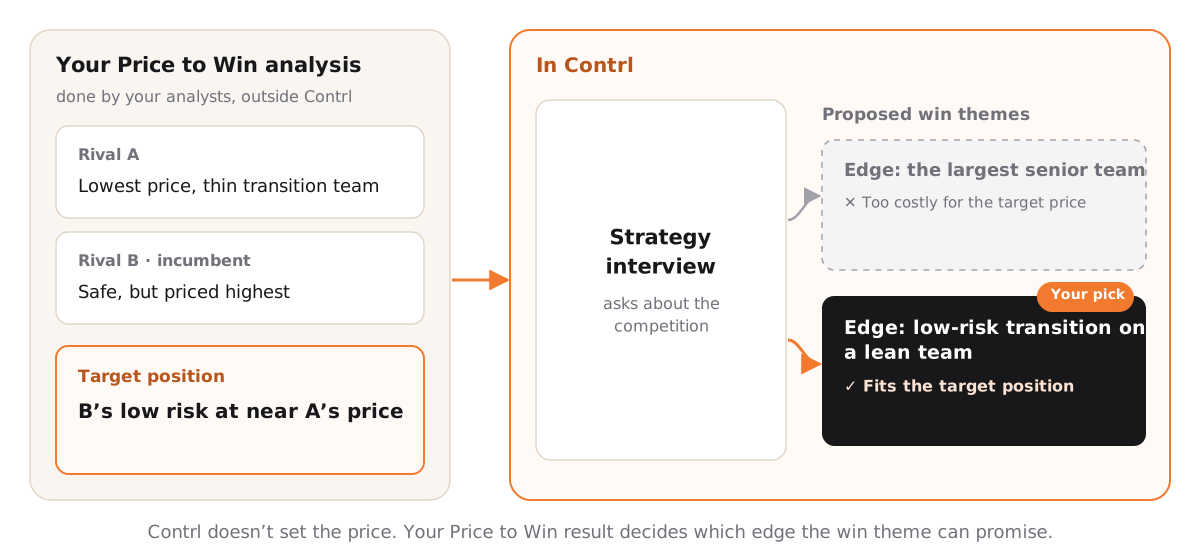
Contrl doesn't price your bid or run a Price to Win analysis; that work belongs to your analysts and needs independent intelligence. What it can do is keep the proposal consistent with the result. The strategy interview asks about the competition, so you can bring in what your cPTW concluded about each rival's tradeoffs and the position you are aiming for. When Contrl proposes win themes, each stating a client need, your edge and the benefit, you can then choose the one whose edge you can afford at your target price, and pass over one that promises more than the price can carry.
Next in the series
This episode closes the "focus on the customer" part of the series. Next we move to turning strategy into deliverables, starting with Episode 12, the Compliance Matrix: how do you make sure every requirement is answered and nothing gets lost between the RFP and the final page?
This article is an independent study companion based on the APMP Foundation Study Guide, version 4.2 (© 2025 APMP), which summarizes the APMP Body of Knowledge. It paraphrases and comments on that material and is not endorsed by APMP. The three-competitor IT operations example, the addressable funding figures, the amendment examples and the comparison tables were written for this article, and their figures are illustrative. For the authoritative text and certification information, see apmp.org.