Imagine an RFP that asks the winning vendor to migrate "full historical data" into a new system. Your technical lead reads that as the records in today's database. Your finance lead reads it as twenty years of archives, some on paper. The difference could double the price. You have nine days before the question deadline. Who asks, how, and when?

Managing questions to the customer means running the RFP's question-and-answer period deliberately: one point of contact, early and well-cited questions, wording that protects your strategy, and a log of every question and answer. In the APMP Body of Knowledge, the purpose of asking is mainly to be sure you can submit a fully compliant proposal. The answers to everyone's questions are a second prize: they show how the customer thinks, what competitors are worried about, and sometimes where the whole industry is heading.
This series works through the APMP Body of Knowledge as summarized in the APMP Foundation Study Guide. This topic doesn't appear in the guide's table of contents, but it is listed as a competency in its own right, and it sits between two things this series has covered: reading the RFP for compliance (episode 1 and the compliance matrix in episode 12) and writing the proposal itself.
What the Q&A period is for
Many procurements open a fixed window when the solicitation is released, during which bidders can submit questions about the documents. The solicitation itself, plus the norms of the market, decides how formal that window is: a written process with strict deadlines, a bidders' conference, or a phone call where vendors can ask without giving their names.
The Study Guide makes a point that experienced teams sometimes resist: expect to have questions even if you knew this customer well before the RFP came out. Capture work (episode 3) tells you what the customer needs. It can't tell you how a particular sentence in the final document will be scored, or what a vague term means to the person who wrote it.
Once the RFP is out, the questions should concentrate on compliance. Here is how the two jobs differ:
| Main purpose: compliance | Side benefit: insight | |
|---|---|---|
| What you're after | Exactly what a 100% compliant proposal must contain | How the customer thinks, what competitors are planning, wider industry trends |
| Where it comes from | Answers to your own questions | Answers to all bidders' questions, yours included |
| How you use it | Update the compliance matrix, outline and solution | Feed customer and competitor intelligence (episode 5) |
| Risk | Low, if the question is precise and neutral | Higher: fishing for strategy can reveal yours or annoy the customer |
The Study Guide's summary draws the line clearly: questions exist chiefly to get your proposal compliant, and using them to make it more responsive calls for caution. A question that tries to steer the customer toward your solution is visible to everyone, including the customer, who may read it as an attempt to change the requirement.
Seven practices for managing the question process
1. Give the customer one voice
Everything your organization says to the customer during a bid should be consistent. If an engineer emails one version of a question and a salesperson phones in another, the customer sees confusion, and you may get two answers that don't match. The Body of Knowledge's remedy is a primary point of contact (POC) who sends questions and receives answers, plus a secondary POC who can step in when the primary is unavailable, so customer messages still reach the team.
The primary POC does more than forward email. They drive the whole cycle: collecting questions, reviewing and editing them so they read consistently, submitting them, logging them and tracking the answers.
2. Work to the deadlines, and send important questions first
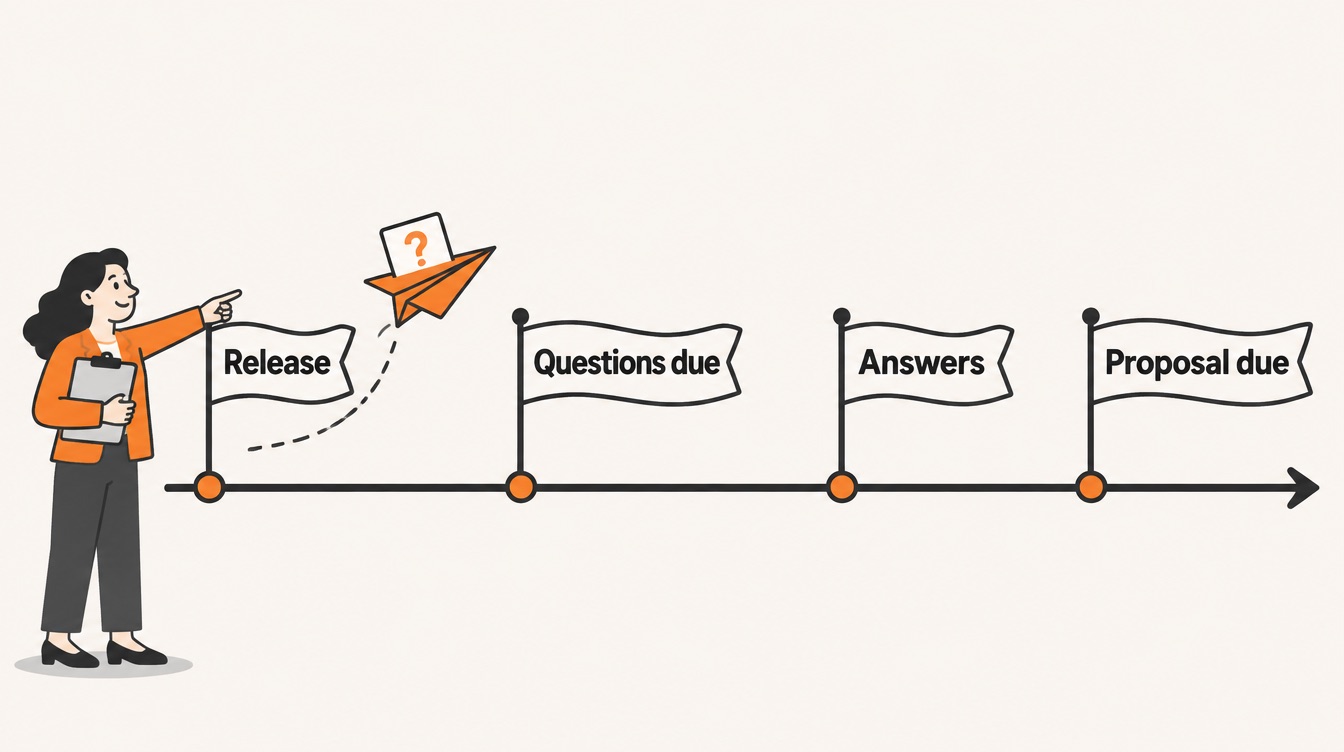
Most solicitations set a cut-off for vendor questions; after it, nothing more is accepted. Some also announce when answers will be released, and some hold Q&A calls. Put all of those dates into the proposal schedule and mention them in daily team meetings, so nobody discovers the deadline the day after it passed.
Because review, editing and logging take time, collect questions well ahead of the cut-off. There is a second reason not to wait. Customers often answer questions in batches, combining everyone's questions into one release. If your most important question goes in early, it may be answered in an earlier batch, and your team can make decisions on the solution, the price or the outline days sooner.
3. Let the whole organization read the RFP
Even a well-written solicitation needs clarification somewhere, and different specialists notice different problems. Technical staff spot ambiguous specifications; contracts staff notice terms and conditions; finance sees pricing instructions that don't add up; legal sees liability clauses. As soon as the documents arrive, give people on both the technical and business sides time to review them and propose questions. If the team is spread across locations, proposal leadership has to reach out more actively, because remote colleagues are the first to be forgotten.
4. Cite the section and quote the words
A question the customer has to hunt for is a question that gets a vague answer, or a late one. For every question, give the section number and the exact wording you need clarified. Here is the migration question from the opening, written two ways:
Hard to answer
"What does 'full historical data' mean?"
The customer has to search the RFP to find where the phrase appears, and may answer in general terms.
Easy to answer
"Section 3.4, Data Migration, item b, requires migration of 'full historical data.' Does this include records archived before the current system went live, or only records held in the current system?"
The customer can go straight to the line and choose between two clear options.
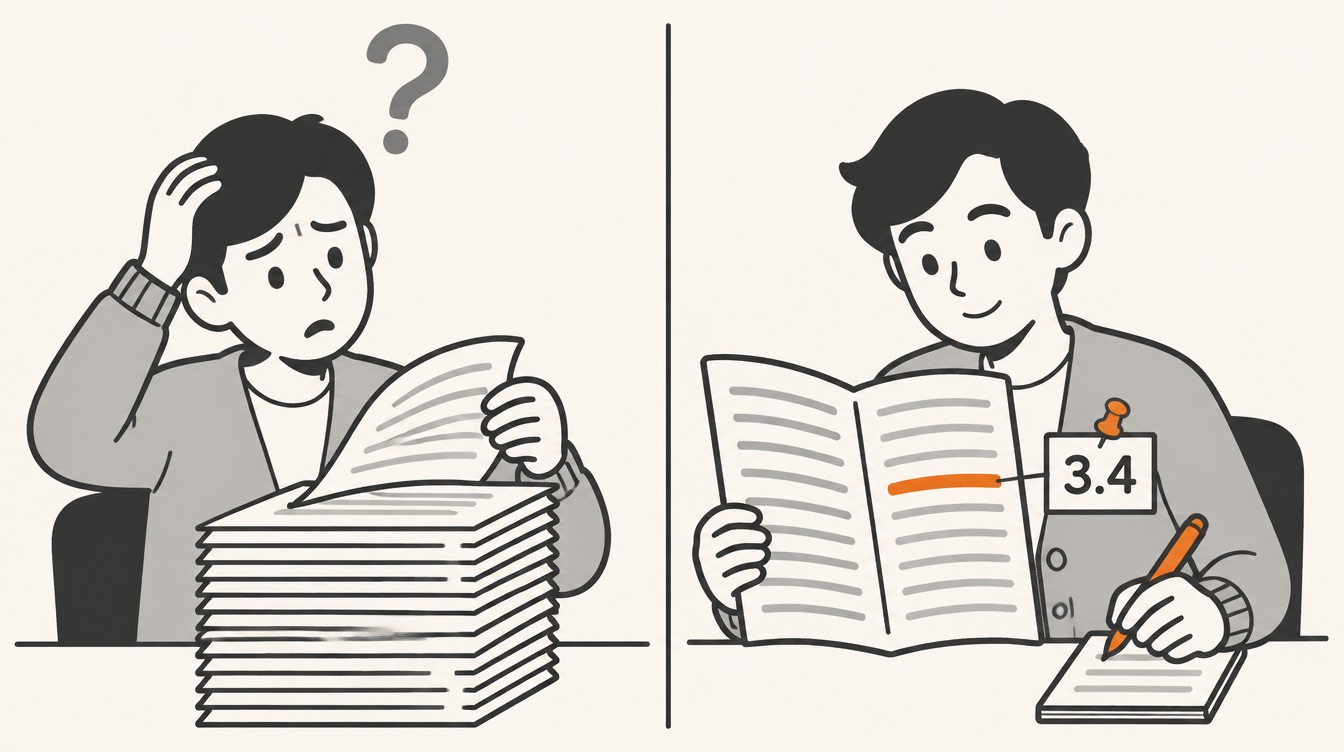
The second version also shows the kind of attention to the customer's document that the proposal itself should show. The Study Guide notes that careful citation sets a precedent: the customer's first impression of your team may be a question, not a proposal.
5. Use the customer's words, or neutral ones
Phrase questions in the customer's own terminology. It lets them answer in the language they're comfortable with, and it shows you have read their document closely. Where their term won't do, use generic wording rather than your own product names.
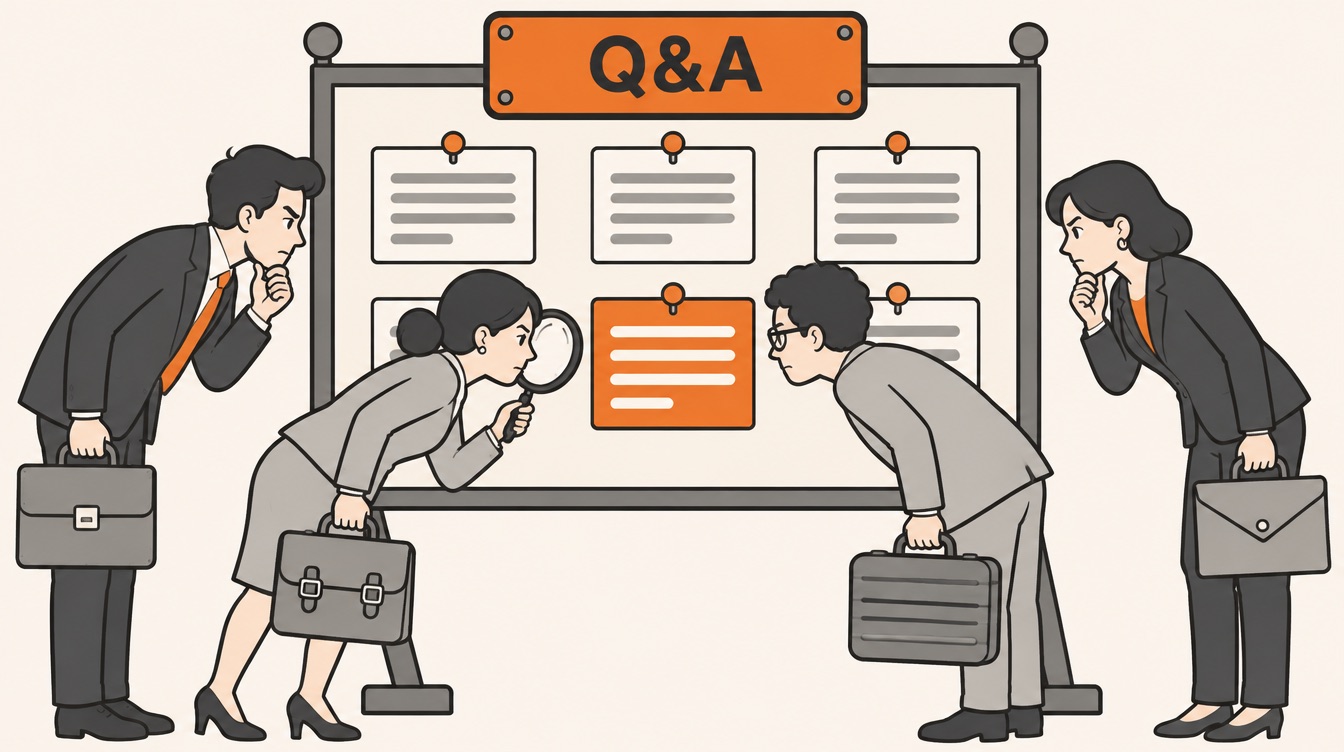
There is a defensive reason too. Assume that anything you send the customer will be shared with the other bidders, because fairness usually requires it. If a question mentions your company, your division, a teaming partner or a new technology, that information may end up in front of your competitors. Neutral wording helps you stay as anonymous as the process allows and keeps a discriminator from being revealed early.
6. Ask one short thing at a time, or nothing
Each question should be short and pointed, aimed at what you need to know to comply. Avoid stacking follow-ups into one question. A question in three or four parts can look as if you don't understand the customer's needs, or as if you're trying to reshape a requirement; neither impression helps.
And if you have no questions, don't ask any. Every question is work for the customer's team. The guide suggests telling the customer before the question deadline that you have none, which lets them focus elsewhere and quietly signals that you understood the document.
7. Log every question and every answer
Track your questions and the customer's answers in a spreadsheet or table. Track the other bidders' questions and answers too: what they ask about can hint at their approach and their worries. A simple log might look like this (the entries are invented for this article):
| # | Question (with RFP reference) | Ours? | Owner | Reviewed | Submitted | Answer and impact |
|---|---|---|---|---|---|---|
| 1 | Sec. 3.4(b): does "full historical data" include archived records? | Yes | Technical lead | Day 2 | Day 3 | Current system only. Migration scope and price updated |
| 2 | Sec. 5.1: may résumés go in an appendix outside the page limit? | Yes | Proposal manager | Day 4 | Day 5 | Yes. Outline and compliance matrix updated |
| 3 | Sec. 2.2: is on-site support required outside business hours? | No (other bidder) | — | — | — | No. Note: a competitor may be pricing 24-hour cover |
The last column is the one teams forget. An answer only helps if someone turns it into a change: a row in the compliance matrix, a line in the outline, a revised assumption in the price.

Government and commercial bids handle questions differently
The process varies with the setting. The Study Guide contrasts the two:
| Government solicitations | Commercial proposals | |
|---|---|---|
| Formality | Usually formal and structured, with fixed channels and dates | Often less defined |
| Who sees the answers | Typically published to all bidders | May be shared with all, or answered privately; find out at the start |
| Other contacts | Usually restricted to the official channel | Teams often ask a coach inside the customer's organization, but only if contact outside the bid process is permitted |
| Safe assumption | Write as though every bidder will see every question and answer | |
A coach is a contact inside the customer's organization who helps you understand its needs, the kind of relationship episode 2 is about building before the RFP. Once a formal bid is underway, check the rules before you use it.
The tone line you should never cross
The Body of Knowledge names two common failures. The first is treating the Q&A process as paperwork: underestimating how much it matters and how much skill it takes. A poorly run question process lowers your chance of winning and weakens a strategy built on knowing the customer and the competition.
The second is a question that argues. Keep every message clear, positive and professional. Never use a question, openly or by implication, to dispute what the customer has chosen to buy or how it will decide the best offer. Compare:
Challenging
"Requiring five years of experience in this exact system excludes capable vendors. Will the customer reconsider?"
Clarifying
"Section 4.2 asks for 'five years of experience with the platform.' Does experience with earlier versions of the platform count toward the five years?"
The first questions the customer's decision. The second asks how to comply with it, and may well get you the same flexibility.
Common mistakes
- Several people contacting the customer with overlapping or conflicting questions.
- Waiting until the deadline, so the important answers arrive in the last batch, too late to change the solution or the price.
- Only the writers reading the RFP, so contract, pricing and legal issues surface after the question window has closed.
- Questions with no citation, which force the customer to search and invite a general answer.
- Revealing strategy in a question: naming your product, partner or a new technique that competitors will then read.
- Multi-part or leading questions that look like confusion or like an attempt to rewrite a requirement.
- Asking questions for the sake of it, adding work for the customer without improving compliance.
- Not acting on the answers: the log records them, but the compliance matrix, outline and price never change.
Checklist for your next RFP
- Name a primary and a secondary point of contact for all customer communication on this bid.
- Find the rules: question deadline, answer release dates, Q&A calls, the submission channel, and whether answers go to all bidders.
- Put every date on the proposal schedule and mention them in daily meetings.
- Send the documents to technical, contracts, finance and legal reviewers on the day they arrive, with a date for their questions.
- Edit each question: section number and quoted wording, one question only, customer terms or neutral language, nothing that identifies you or your strategy.
- Prioritize: submit the questions that affect the solution, price or outline first.
- If there are none, tell the customer before the deadline instead of inventing questions.
- Log every question and answer, including other bidders', with an owner and the change each answer requires.
- Update the compliance matrix and outline each time a batch of answers is released.
Where Contrl fits
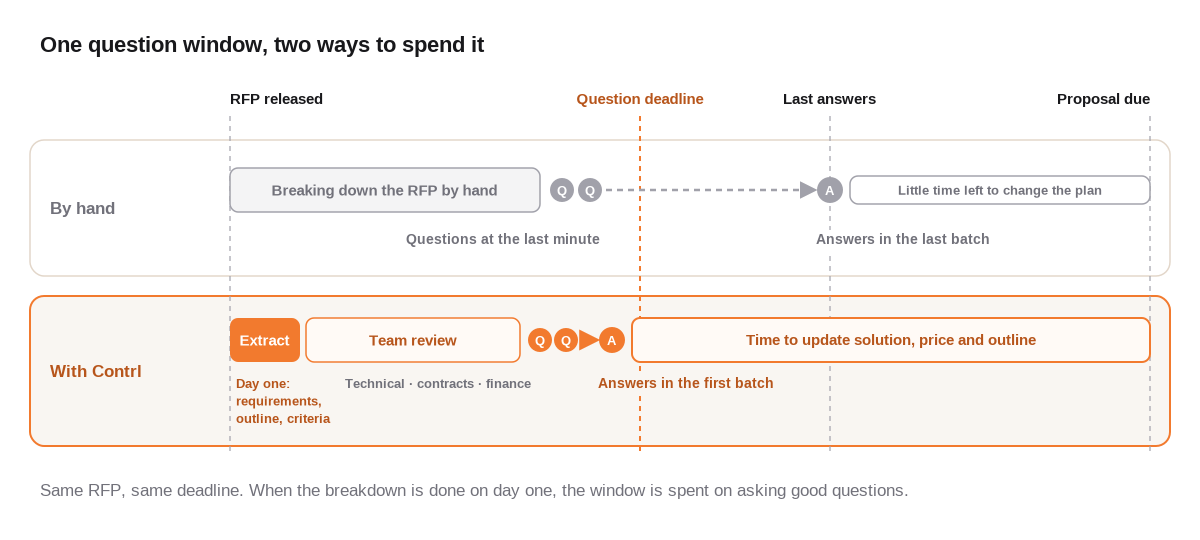
The hardest part of the Body of Knowledge's advice is timing: everyone should read the RFP the day it arrives, and the questions that matter should go in early, while answers can still change the solution. In Contrl, you upload the RFP and it extracts the requirements, the required outline and the evaluation criteria, so technical, contracts and finance reviewers can start on day one from the same structured list instead of waiting for someone to finish breaking the document down. Unclear wording therefore surfaces while the question window is still open, and your point of contact can write a precise, well-cited question about it. Contrl doesn't write or send the questions; it gives the people who do more of the window to work with.
Next in the series
Once the questions are answered and the requirements are clear, the customer will want proof that you have done this before. Episode 22 covers Relevant Past Performance: how to choose the projects that match this customer's needs and present them as evidence rather than as a list.
This article is an independent study companion based on the APMP Foundation Study Guide, version 4.2 (© 2025 APMP), which summarizes the APMP Body of Knowledge. It paraphrases and comments on that material and is not endorsed by APMP. The opening scenario, the data-migration and experience questions, the question log and its entries, the common mistakes list and the illustrations were written for this article, and their figures are illustrative; no customer is named. For the authoritative text and certification information, see apmp.org.