Here is this episode's question: can you explain what it means to do pre-RFP selling professionally?
In many markets, "meeting the customer before the bid" sounds a little suspicious. People picture favors, dinners and quiet deals. That image comes from teams that meet customers without a strategy. Professional capture is the opposite: a systematic analysis of where you stand, a deliberate plan to improve that position, and a written record the whole team can act on. The APMP Body of Knowledge calls this an opportunity/capture strategy: the plan to win one specific opportunity. You set the position you want to hold in the customer's mind, then use tactics to put that position in front of them, first in meetings and finally in the proposal.
This is the third competency under Focus on the Customer in the APMP Foundation Study Guide. Episode 1 covered compliance and responsiveness. Episode 2 covered winning the customer's trust. This episode covers what to do with that relationship once you have it.
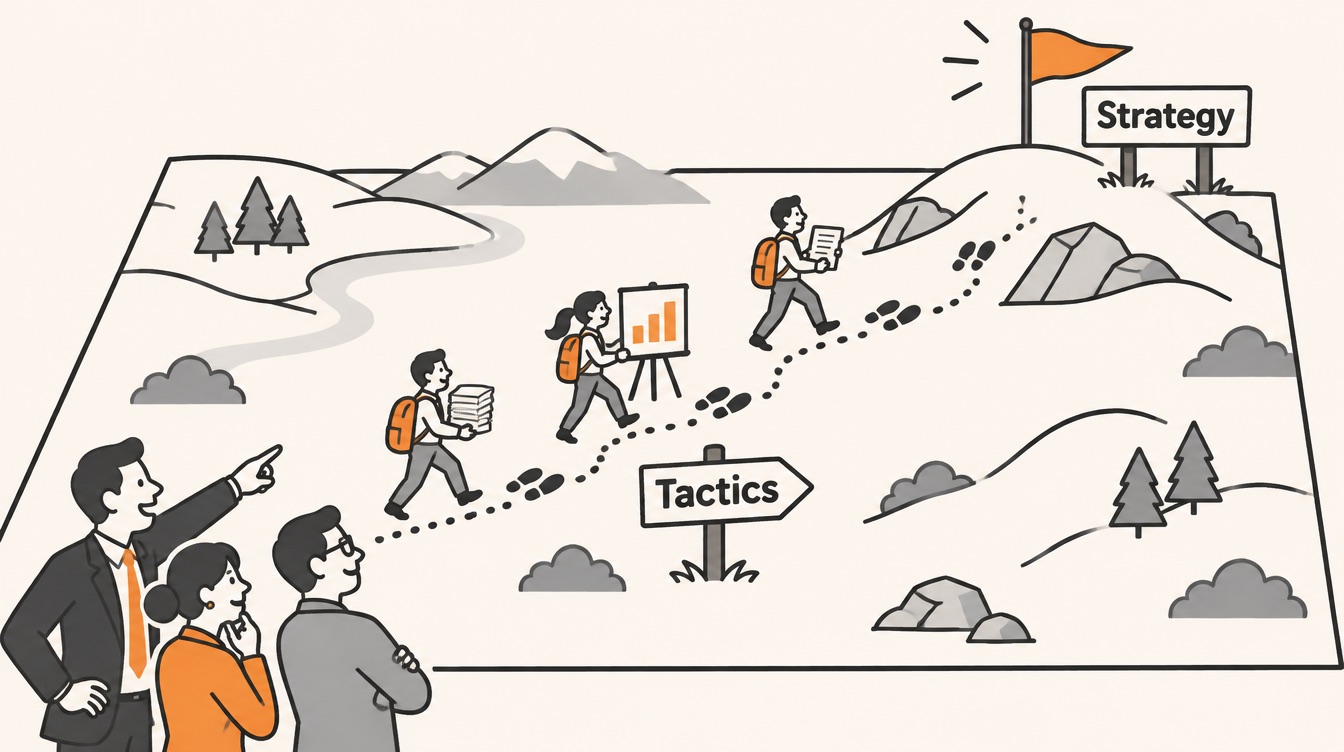
Strategy is a position, tactics are actions
The Body of Knowledge starts by separating two words that people often use as if they meant the same thing:
- Strategy is your position going into the engagement: how you want the customer to see you and your solution compared with the alternatives. "The lowest-risk choice for a first deployment" is a position.
- Tactics are what you do to put that position into practice and make it convincing: who you meet, what you demonstrate, which reference site you take them to, and what you write in the proposal.
You need both. A position nobody acts on stays in a slide deck. Actions without a position produce a busy sales team that sends five different messages to one customer.
One message, from business plan to proposal
The organizations that win most consistently keep their strategies aligned from top to bottom. Their business, market, capture, sales and proposal strategies tell the same story. To make that possible, the whole selling team needs a shared process and shared definitions. The Body of Knowledge distinguishes these levels:
| Term | Scope | What it means |
|---|---|---|
| Business strategy | The whole organization | How the organization will reach its overall business objectives |
| Market strategy | One market | How it will reach its objectives in a particular market, usually across many sales |
| Opportunity/capture strategy | One opportunity | The plan to win one specific, defined opportunity |
| Sales strategy | One opportunity | Should be identical to the capture strategy: specific to the opportunity |
| Win strategy | One opportunity | A common name for the overall actions needed to win; in practice the same thing as the capture strategy |
| Proposal strategy | One document | The plan for a persuasive, winning proposal. A subset of the capture strategy: same message, different tactics |
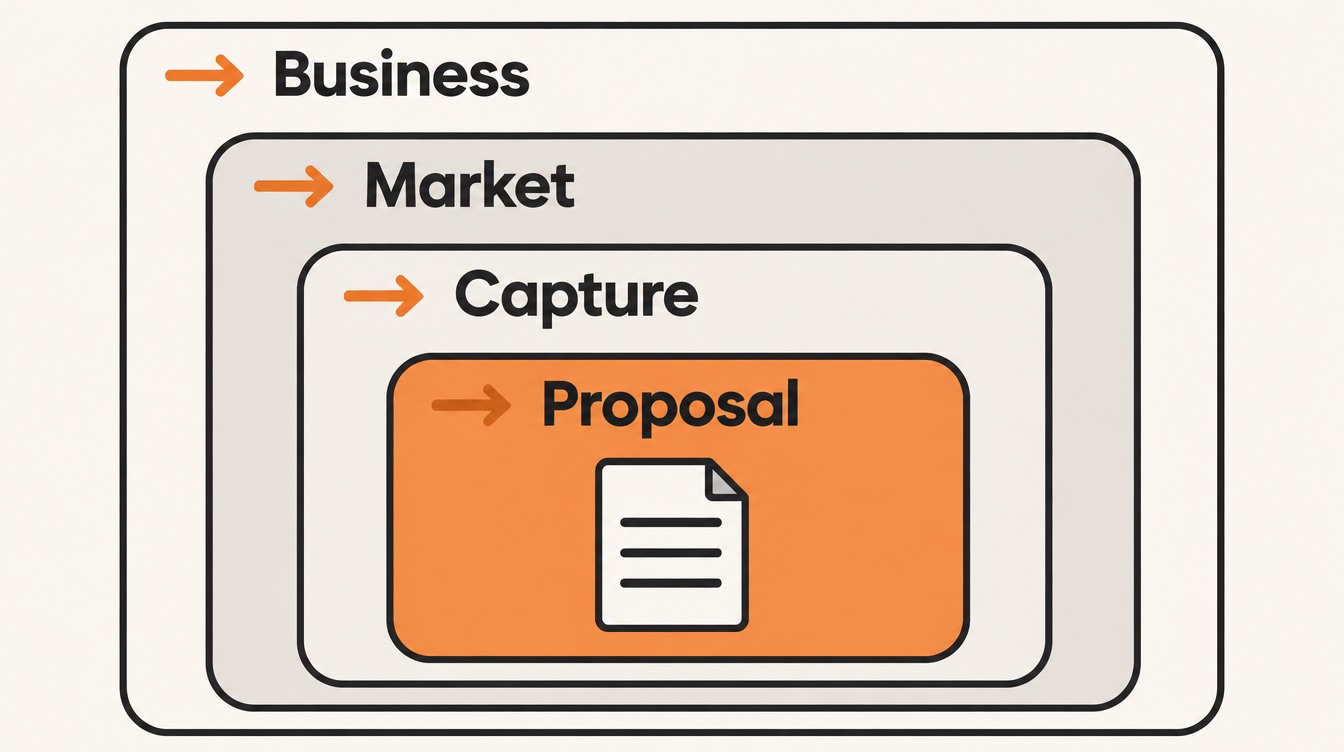
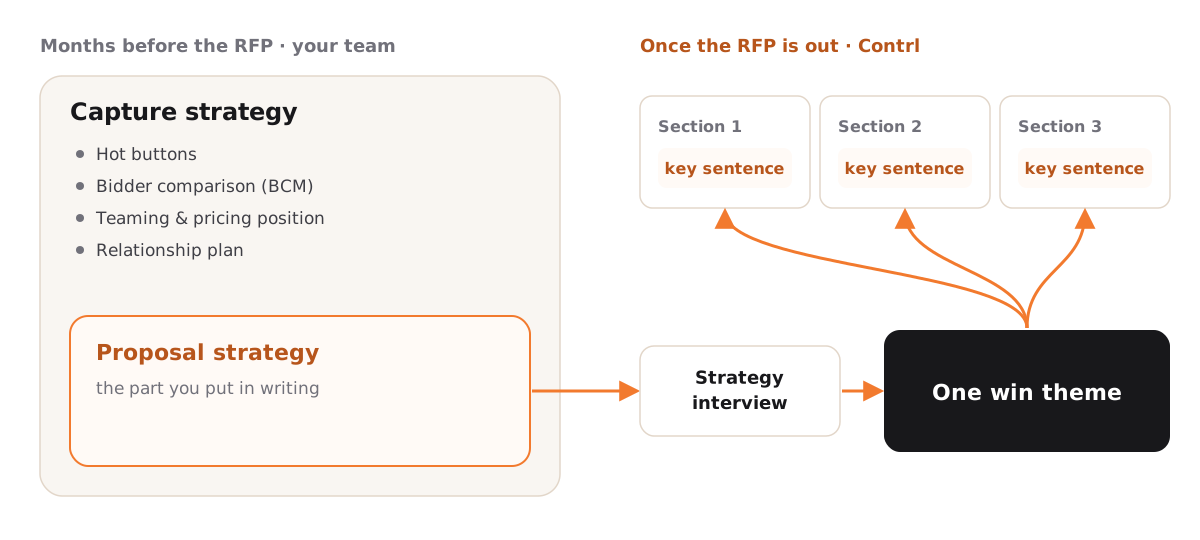
The last row is the most practical point in this episode. The proposal strategy is not a new idea invented when the RFP arrives. It is the capture strategy expressed in a document. During capture you carry your message through white papers, presentations, meetings, site visits, demonstrations and events, so that each customer prefers you, or at least regards you favorably. The proposal should then say the same thing in words, text and graphics. If the proposal argues something the customer has never heard from you, either the capture work didn't happen or the proposal team never heard about it.
Five traps of capture without a strategy
Before the tools, it helps to name what goes wrong. In my experience, pre-RFP selling earns a bad reputation when it relies on instinct and relationships instead of a system. Five patterns come up again and again, and each one has a direct answer in the Body of Knowledge:
| Trap | What it looks like | The Body of Knowledge answer |
|---|---|---|
| Guessing | The team decides what the customer cares about in an internal meeting | Record hot buttons in the customer's own words |
| One contact | Only the decision maker, or only the friendly user, gets attention | Identify economic buyers, users and technical buyers, and list each one's issues |
| No analysis | Competitors are discussed as rumors, not measured | Use a bidder comparison matrix or SWOT, and update it throughout the pursuit |
| Bad-mouthing | Competitors are attacked in sales conversations | Use tradeoffs and ghosting to show why your approach is better |
| Strategy in one head | The win strategy lives only in the sales director's memory | Write strategy statements with action plans and share them across the team |
Fixing these five is what "professional" means here. The rest of this article goes through the tools one at a time.
Start with where you stand
The Body of Knowledge makes a point that is easy to overlook: you always have a position in any sales situation, whether you know what it is or not. The customer already has some view of you, even if it is "never heard of them." Building a strategy therefore takes two steps:
- Determine your current position as the customer sees it.
- Improve it relative to your competitors' positions.
It also recommends standard tools and templates for this work. They improve the quality of the strategy and how it is carried out, save time, and help everyone on the capture team understand the plan in the same way.
Know the customer: issues, motivators and hot buttons
Good communication needs shared terms. Three terms are used widely and misunderstood almost as widely: issues, motivators and hot buttons.
- Issues are the customer's concerns: the things that worry them. "What if the production line stops during the switchover?" "What if the auditors flag this project?"
- Motivators are the objectives the customer is trying to reach, such as higher profits, more sales, lower costs, better safety, less risk or better quality.
- Hot buttons are the highest-priority issues and motivators for this particular opportunity, combined into one short list. It is usually five items or fewer.
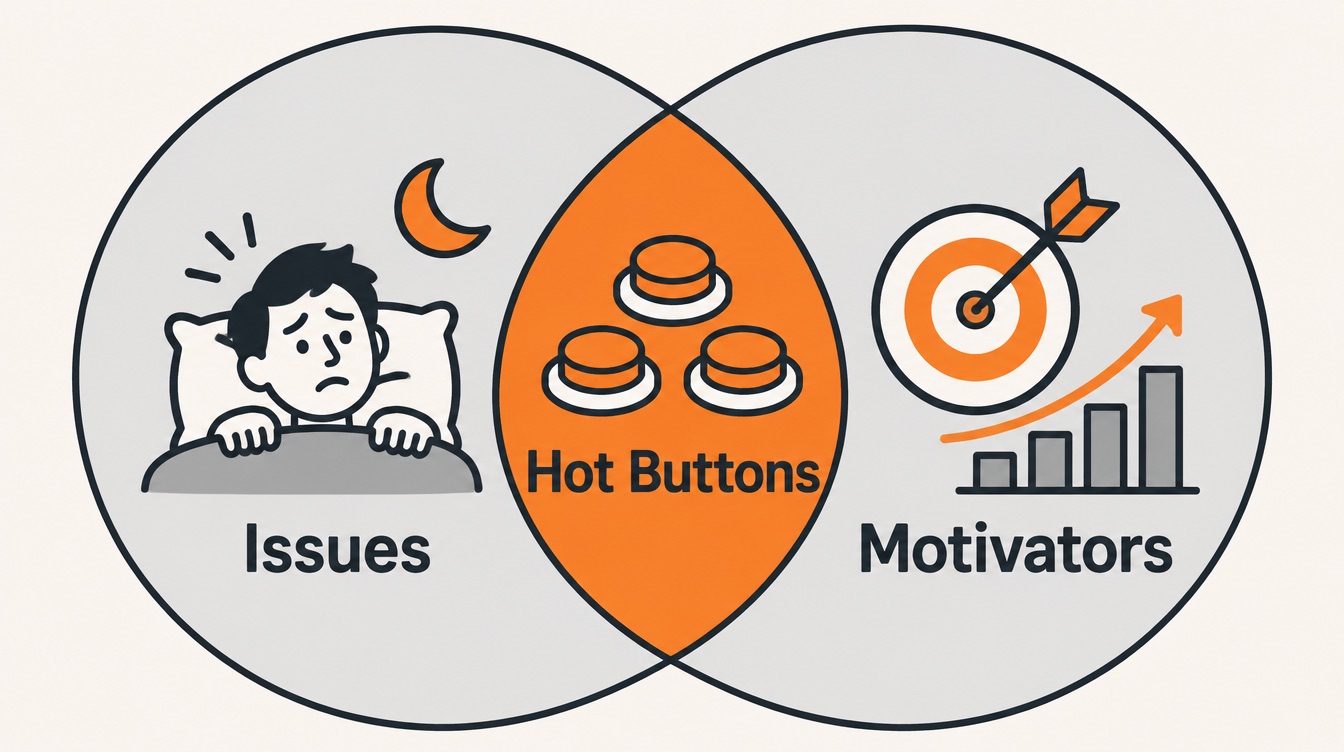
Two instructions in the Body of Knowledge turn this from a concept into a practice. First, record hot buttons in the customer's exact words during capture. Second, align your solution to them. The first one matters more than it looks:
Guessed in a team meeting
"The customer wants innovation and cost efficiency."
Every bidder will write this. It tells your writers nothing.
Written down in the customer's words
"We can't have the system go down during the tax-filing peak again."
This is specific, it shows a real past problem, and when the evaluator sees it echoed in your proposal, they will recognize their own words.
A professional capture conversation is not small talk. It is a structured effort to learn the customer's issues and motivators and to confirm them, ideally by agreeing on them with the customer, so that you don't have to guess.
Know every buyer, not just one
A customer organization rarely buys with a single voice. The Body of Knowledge identifies three kinds of buyer, and each one judges your offer differently:
| Economic buyer | User | Technical buyer | |
|---|---|---|---|
| Role | Gives final approval to purchase | Lives with the result in daily work | Gatekeeper: can't say the final yes, but can say the final no |
| Focus | Price versus performance; bottom-line impact | Reliability, support, ease of operation, maintenance, safety, morale and their own success | Features measured against objective specifications |
| Nature of concerns | Financial and organizational | Often personal, emotional and subjective | Formal and criteria-driven; often sets the shortlist |
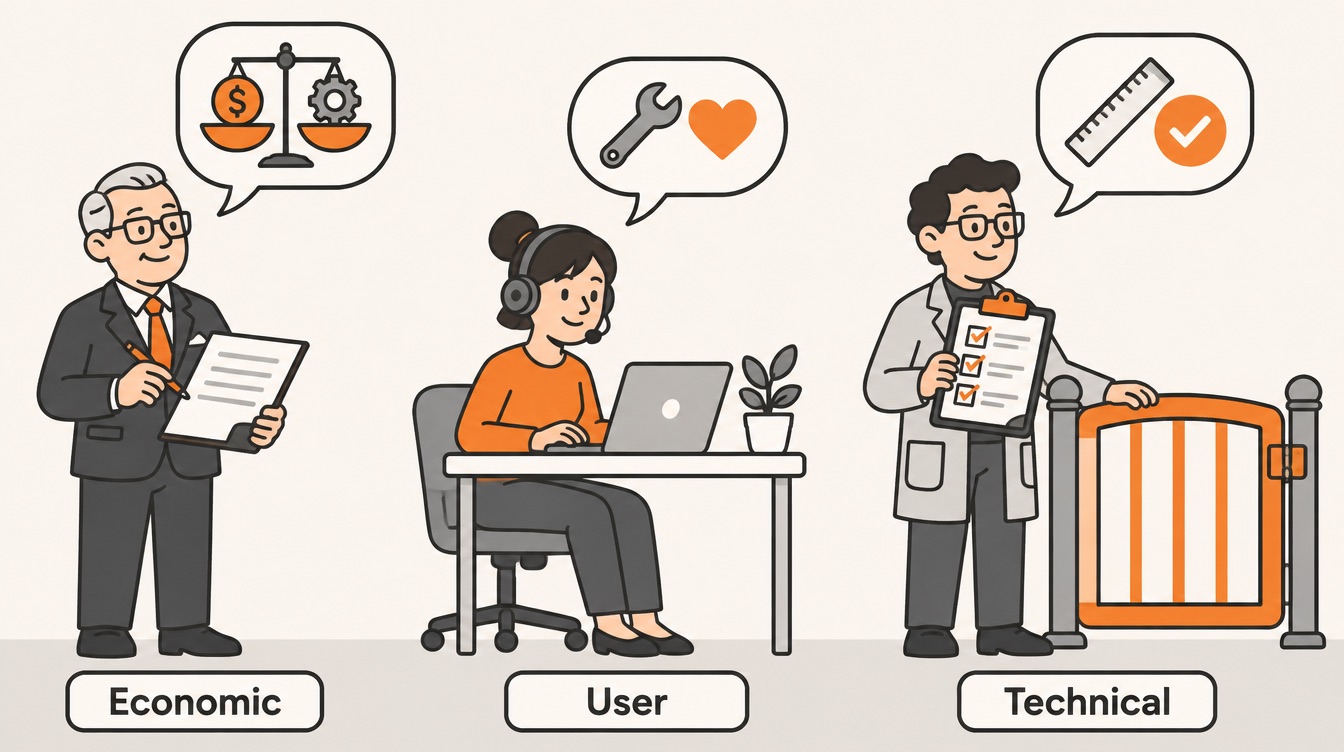
Here is what that looked like on a public-sector smart city project I worked on. Before the solicitation came out we heard from three people, and each wanted something different:
- The elected head of the city (the economic buyer) wanted a project with visible impact in their first term.
- The department manager responsible for the program wanted, above all, no risk. A troubled project would hurt their career.
- The working-level officer who would run it day to day was the only person assigned to it and wanted less work during implementation, not more.
Impact, safety and workload are three different messages. A strategy built only around the head's wish for impact would have worried the manager and overloaded the officer. The Body of Knowledge's instruction is simple: once you have identified all the buyers, list the issues of each individual, then make sure your strategy answers every list.
Know the competition: the bidder comparison matrix
Knowing the customer isn't enough. You also need to know how the customer sees you compared with everyone else. The Body of Knowledge's tool for this is the Bidder Comparison Matrix (BCM), or a SWOT analysis used the same way. Three points about it are worth noting:
- It is organized around customer issues, both stated and unstated, not around your product features.
- It measures perception. The question is how the customer currently sees your solution and organization next to each competitor's, not how you see yourselves.
- It is used repeatedly. Update it throughout capture to check whether your positioning actions are working. A BCM that is filled in once and filed away is just paperwork.
| Customer hot button | Us | Rival A | Rival B | Action to improve our position |
|---|---|---|---|---|
| No downtime during peak season | Strong | Medium | Medium | Bring the operations lead to a reference site with the same peak pattern |
| Fast on-site response | Medium | Weak | Strong | Commit to local staffing; show the support roster |
| Predictable total cost | Weak | Strong | Medium | Check our price realism; prepare a five-year cost comparison |
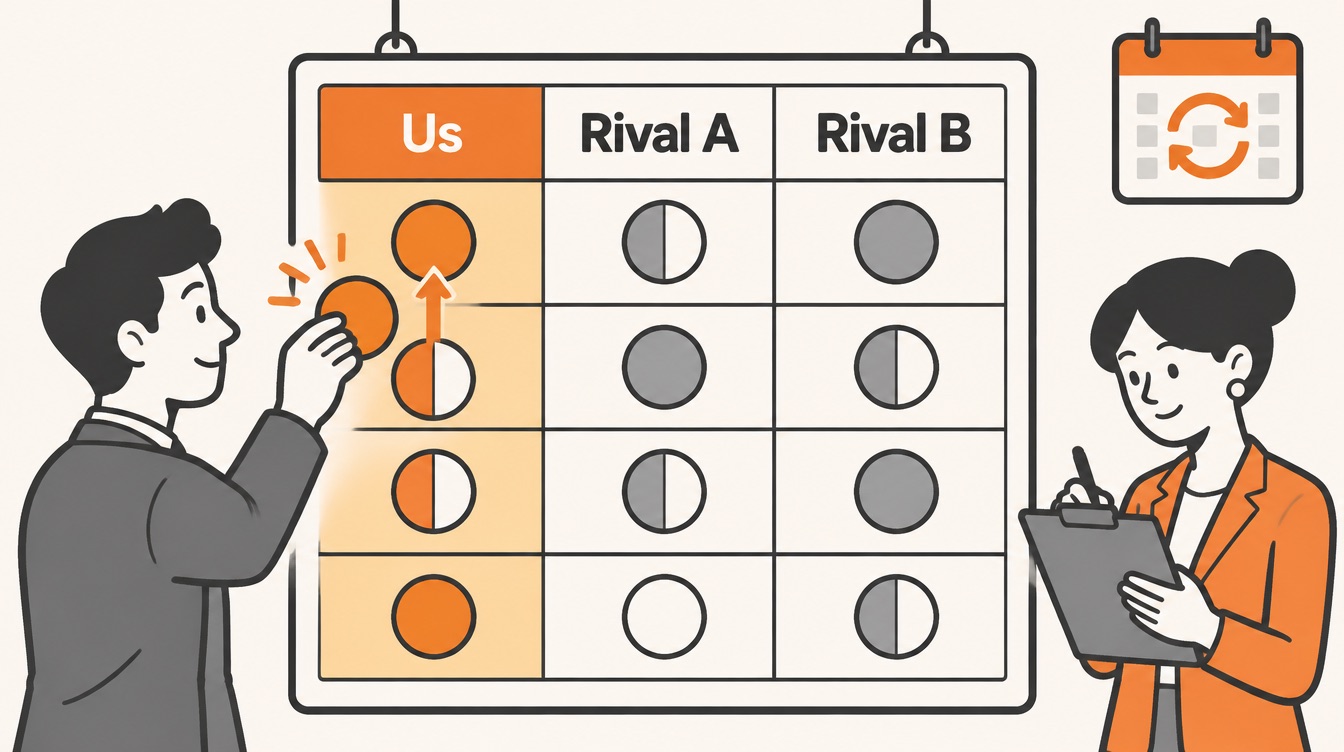
This is also where capture meetings earn their value. Two examples from my own work show how a single remark changes the matrix. Once, a customer mentioned that another vendor had just visited with a very attractive price, so we reviewed whether our own price was realistic. Another time, an overseas airport operator told us they were talking to bidders from several countries, not only local firms. Because we had a local office, we decided to make our in-country presence a central part of our offer. Neither fact appeared in any document. Both changed our strategy.
Write it down: strategy statements and action plans
The Body of Knowledge asks the capture team to draft specific strategy statements together, review them and share them across the team. Each statement then grows into one or more action plans in the capture plan. One statement may be carried out through several action plans.
An effective strategy statement has two halves:
- The strategic half sets the position: what you want the customer to believe.
- The tactical half says how you will get there: the concrete actions and steps.
| Strategic (position) | Tactical (actions) |
|---|---|
| Be seen as the lowest-risk choice for the department manager | Present a phased rollout with a pilot; share the risk register from a similar project; offer a named transition manager |
| Show the officer that our solution reduces their workload | Demonstrate the admin dashboard with their real tasks; propose on-site training for their team in the first month |
| Neutralize Rival A's price advantage | Build a five-year total cost model with the customer's finance team; validate it at the next meeting |
Honestly, few teams keep documentation this formal, and it is fair to ask how realistic it is. But there is a lightweight version most teams already half-do. Before each customer meeting, I prepare a short deck tailored to that customer's hot buttons. After each meeting, I save the next version: v1, v2, v3, v4. By the time the RFP arrives, that folder is the written strategy. It records what the customer said, what we changed and what landed, and much of it carries straight into the proposal.
Choose the solution, then prove it with tradeoffs
Value propositions for each buyer
Once you have settled on a solution approach, draft a value proposition for each type of buyer. Value propositions follow from your sales objective, but the strong ones are detailed, specific and quantified. The Body of Knowledge also recommends developing them together with the customer, because a customer who helped build the numbers is far more likely to accept them. Value propositions are the subject of the next episode.
Tradeoffs and ghosting
A tradeoff shows that you considered alternatives and chose the best one for this customer, instead of offering whatever was available or what you usually do. Discussing tradeoffs shows that you weighed the customer's needs, risks and budget and arrived at the best value at an acceptable risk.
Ghosting is a tradeoff in which one of the alternatives you rejected is what a competitor is offering. You explain why you didn't choose that option, and in doing so you point out the competitor's weakness without naming the competitor.
Bad-mouthing
"Company X uses cheaper display panels that fail in hot weather."
It names a rival, can't easily be proven, and makes you look defensive.
Ghosting through a tradeoff
"We compared two panel classes for outdoor use. The common lower-cost option is rated for a narrower temperature range. We chose panels rated for your summer peak, which adds 4% to hardware cost and removes the main cause of field failures."
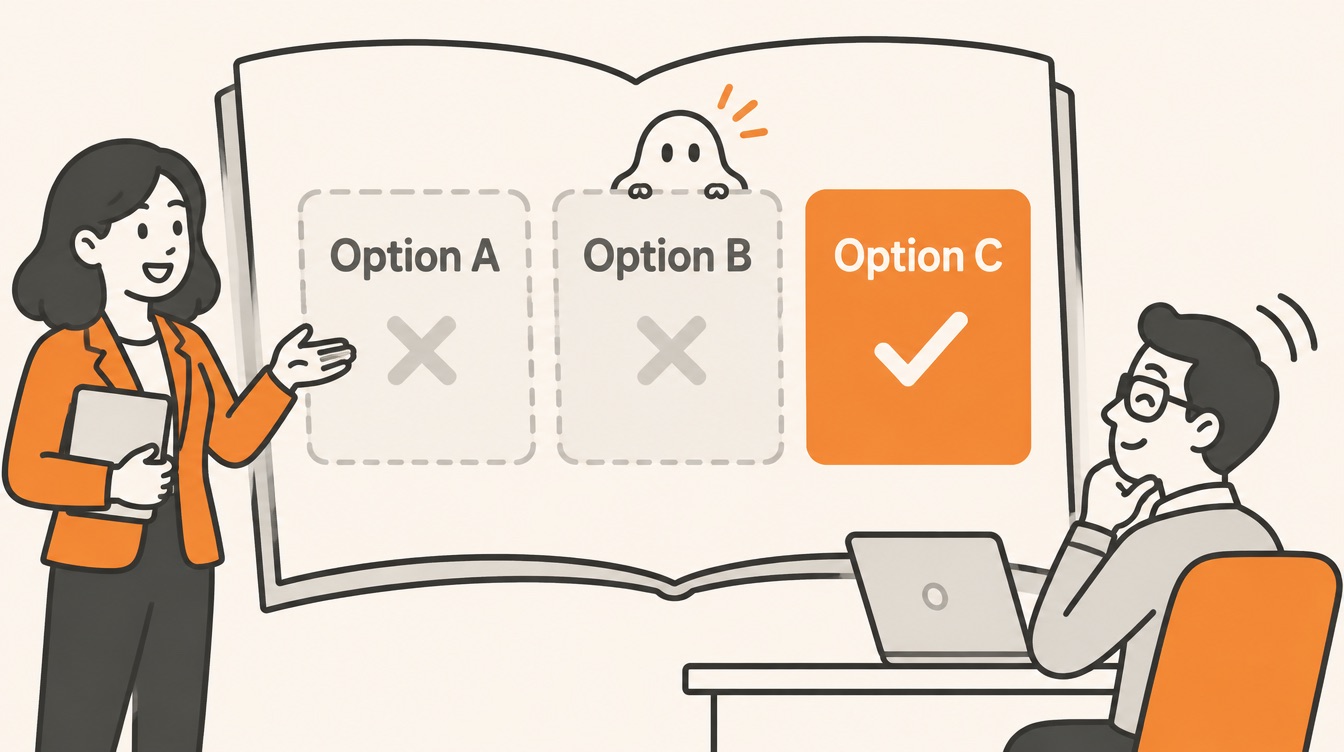
I used this on a bid where we knew from capture which panel brand a competitor planned to use. In the proposal we set the specifications of that panel class beside ours, without naming anyone. The evaluators could reach the conclusion themselves. That is ghosting done properly: it is fair, it can be checked, and the decision stays with the evaluator.
Then act on it
The Body of Knowledge ends this topic with a reminder that is easy to agree with and hard to follow: a modest strategy that gets carried out beats an excellent one that doesn't. Keep a balance between planning and doing. The customer is persuaded by what you do, not by what you planned.
Checklist: six habits of professional capture
- Separate strategy from tactics. Write the position you want first, then the actions that will put it in front of the customer.
- Get hot buttons from the customer. Combine issues and motivators into five or fewer, in the customer's own words. Don't guess them in a team meeting.
- Cover all three buyers. List the issues of each economic buyer, user and technical buyer, and give each one a message aimed at them.
- Keep the bidder comparison matrix current. Build it around customer issues and how the customer sees you, and update it after every significant contact.
- Compete on the merits. Don't bad-mouth competitors. Use tradeoffs and ghosting so evaluators can see the difference for themselves.
- Write it down and act on it. Turn the strategy into shared statements with action plans, carry them out, and bring the same message into the proposal.
Where Contrl fits
The key point this episode makes is that the proposal strategy is a subset of the capture strategy, not something reinvented from the RFP. Contrl starts when an RFP is in hand, so the capture work itself stays with your team. What Contrl does is ask for it: a chat strategy interview about the client, your company and the competition, where you put in the hot buttons and BCM findings, which then become win themes stating the client need, your edge and the benefit. You choose one, and every section inherits it.
Next in the series
Each of the three buyers in the smart city example will eventually ask the same question: why should we spend our money with you? The answer is a value proposition, specific, quantified and ideally built together with the customer. Episode 4 covers Value Propositions.
This article is an independent study companion based on the APMP Foundation Study Guide, version 4.2 (© 2025 APMP), which summarizes the APMP Body of Knowledge. It paraphrases and comments on that material and is not endorsed by APMP. The hot button quote, the bidder comparison matrix and strategy statement rows, the panel tradeoff wording and the project anecdotes (smart city, airport, display panels, versioned meeting decks) are the author's own illustrations written for this article. For the authoritative text and certification information, see apmp.org.