Here is a question worth answering before you write another proposal: can you explain, in plain words, what makes a proposal win?
Most experienced bid writers can feel the answer but find it hard to put into words. That used to be fine. It isn't anymore. AI can now produce a 100-page draft in minutes, and someone has to judge that draft and tell the AI what "good" means. You can't do either without stating the standard.
This series works through the standard proposal professionals already share: the APMP Body of Knowledge, as summarized in the APMP Foundation Study Guide. We start where the Foundation starts, under Focus on the Customer, with the competency called Identifying Requirements for Compliance and Responsiveness.
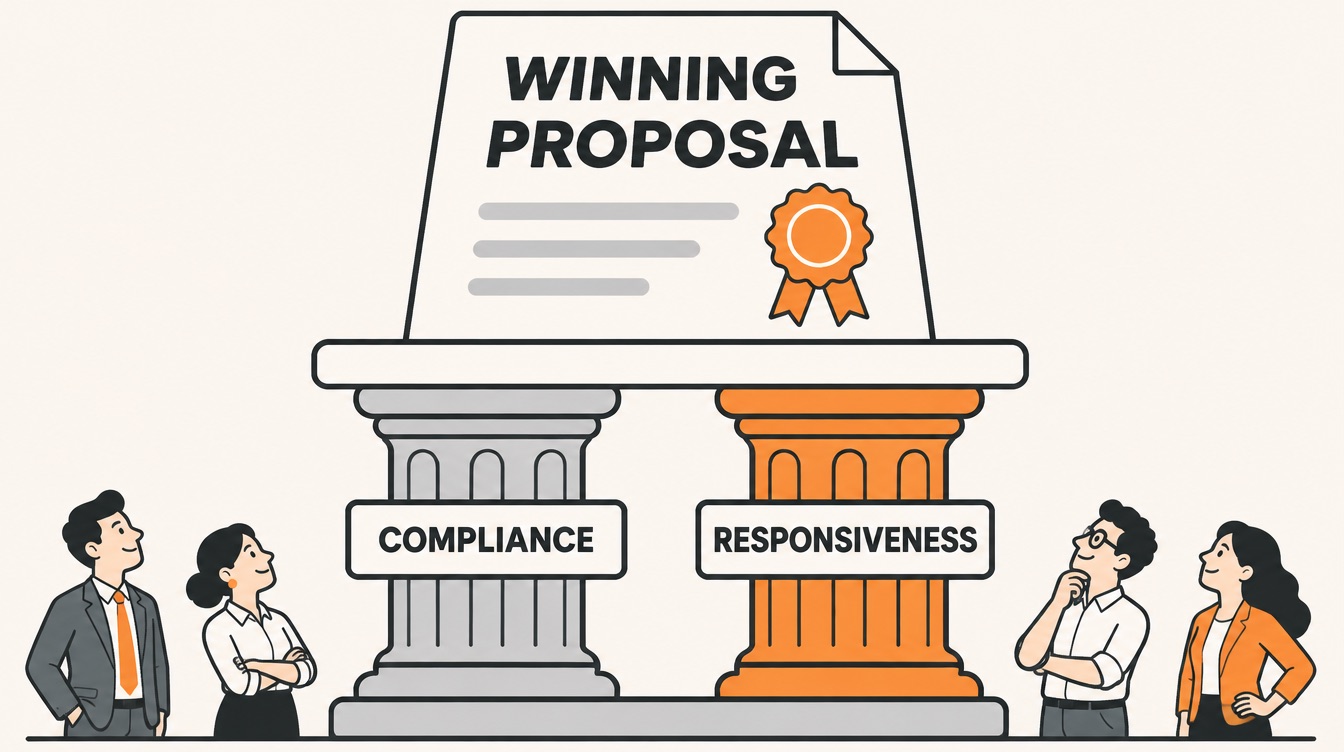
Two separate jobs: compliant and responsive
The Body of Knowledge opens this topic with a simple claim: a winning proposal is both compliant and responsive. These are two separate, equally important tasks. One is identifying and meeting the customer's requirements. The other is responding to the customer's business needs.
| Compliance | Responsiveness | |
|---|---|---|
| What it is | Meeting the customer's stated requirements and instructions | Addressing the goals, concerns and values behind those requirements |
| Source | Mostly the solicitation: requirements, instructions, questions, specifications | Mostly outside the solicitation: what you learned about the customer before and during the bid |
| Without it | Your proposal is likely rejected | You compete on price |
| With it | You stay in the race | You get ahead of the other bidders |
One question shows why you need both. Suppose your bid and a competitor's bid are both 100% compliant, and neither is responsive. How does the customer choose? Usually on the lowest price, or on something outside the proposal entirely. Compliance gets you into the final round. It doesn't decide the winner. You want to win because you are the best choice, not because you were the cheapest.
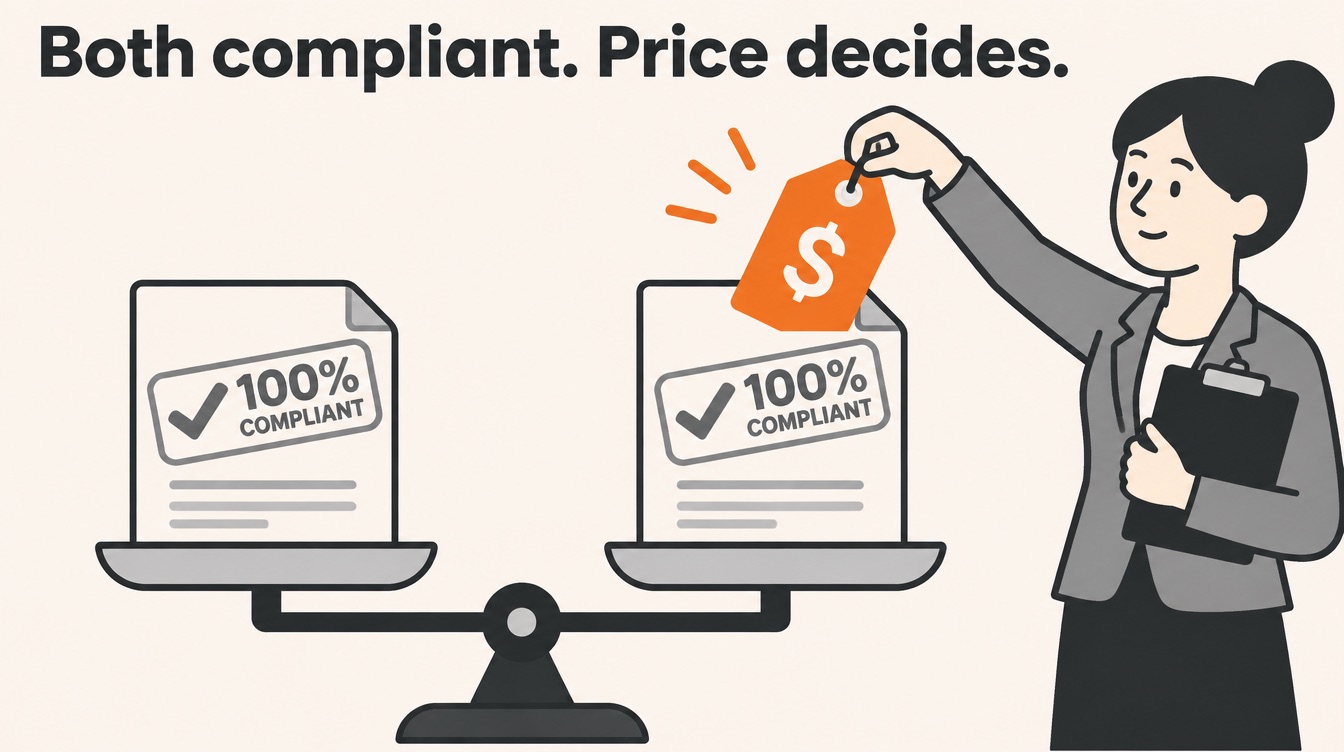
Compliance keeps you from being eliminated. Responsiveness is what wins.
Compliance: nothing more, nothing less
In APMP terms, a compliant proposal meets the customer's requirements and submission instructions, answers their questions and addresses their specifications. It does exactly that much, no less and no more. In practice compliance has four parts:
- Structure. Organize the proposal exactly as the customer instructs: their outline, their section order, their numbering.
- Length. Stay within the page limits.
- Format. Follow the formatting rules: font, size, margins, file type.
- Coverage. Meet every requirement in the RFP.
The "nothing more" half catches a lot of capable teams. Sending 60 pages against a 50-page limit doesn't show extra effort. It breaks an instruction, and evaluators may stop reading at page 50 or set the bid aside. The same goes for attaching material nobody asked for. A non-compliant proposal will likely be rejected. In government markets there is a further risk: if a non-compliant proposal wins, a competitor can protest the award.
Requirements come from more than the RFP
One idea in the Body of Knowledge is easy to miss: requirements are not limited to what the solicitation says. Customers share requirements throughout the opportunity, in meetings before the RFP comes out, in Q&A sessions and in passing remarks. Some requirements are only implied, but they still matter to the customer. APMP's guidance is to identify, collect and organize all of them in one compliance matrix, whether or not they appear in the solicitation.
This matters even more for unsolicited proposals. There is no RFP to work from, so how well you document the customer's requirements and issues largely decides whether the proposal can win.
Where requirements hide in a real RFP
Many solicitations, especially in the public sector, don't hand you a single checklist. The requirements are spread across several parts of the package, and you have to collect them yourself:
- Eligibility conditions: licenses, certifications, financial thresholds and past performance. If you miss one, you can't bid at all.
- Mandatory requirements: the "shall" and "must" statements about scope, functions and performance. If you miss one, expect disqualification or a heavy deduction.
- Submission instructions: page counts, templates, outline, fonts, file formats and delivery method. If you miss one, you lose points or the bid is rejected on form.
- Amendments and Q&A responses: these can quietly change any of the above after you have started writing.
Compliance means meeting all of them together. When the customer doesn't provide a checklist, you still need one, so build it yourself.
Responsiveness: show that you get it
Responsiveness goes beyond compliance. A responsive proposal addresses the customer's goals, underlying concerns, key issues and values, many of which never appear in the solicitation. It helps the customer reach their business goals, not just finish a procurement. According to the Body of Knowledge, responsiveness includes:
- Understanding the customer's stated and implied needs, and addressing both
- Showing you know why each requirement matters to them
- Describing the benefits the customer will get from your solution
- Writing in the customer's language and using their terms
- Pricing within the customer's budget
- Showing that you share the customer's beliefs and culture
- Giving evidence that the customer is safe in your hands
One requirement, two answers
The Study Guide uses a deliberately ordinary example. Say the requirement is to supply yellow cardboard boxes. Here are two ways to answer it:
Compliant only
"We will supply yellow cardboard boxes."
This meets the requirement exactly, and that's all it does.
Compliant and responsive
This answer starts the same way, then explains why the boxes matter: they hold valuable products. It adds what the bidder learned from similar customers, that the boxes also need to be light and easy for staff to carry. It explains how its boxes meet both needs and points to independent test results in an annex as proof.
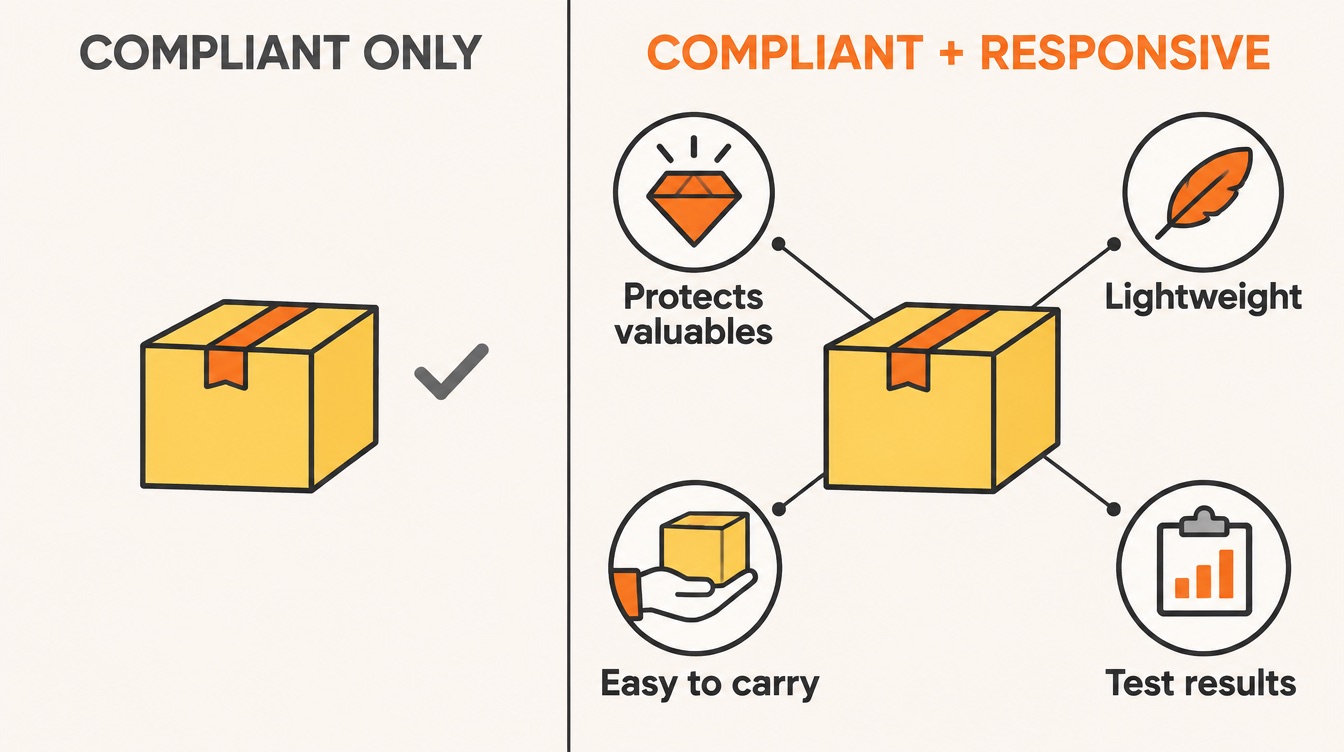
Both answers are compliant. Only the second shows the customer that the bidder understands their operation. The second answer follows a pattern you can use for almost any requirement:
- Confirm you will deliver what was asked.
- Explain why it matters to this customer, in their terms.
- Add what you know from similar customers that they may not have written down.
- Prove it with test results, references or metrics.
From product story to customer story
The most common way proposals fall short on responsiveness is that they talk mostly about the bidder. Take a requirement for 24/7 uninterrupted service. A typical answer reads like a product sheet:
Product story
"Our platform uses a redundant architecture with automatic failover to deliver 99.99% availability, proven across twelve comparable deployments."
Customer story
"For your plant, one minute of downtime stops a production line, and a stopped line is lost output. So we commit to automatic recovery within one minute in the SLA, not just to an availability percentage."
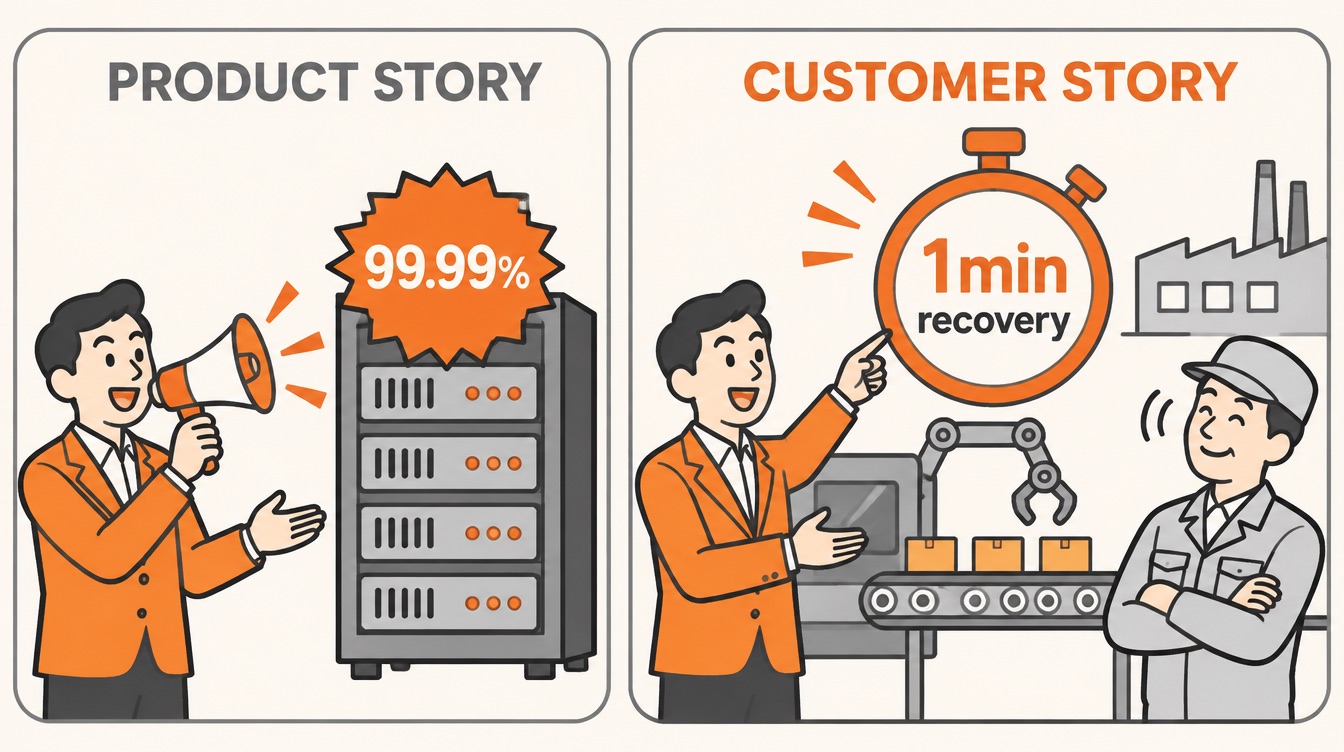
The technology is the same in both answers. The difference is where the answer starts. The first starts with what the bidder has. The second starts with why the customer asked, and it makes a commitment that matches that reason.
The compliance matrix and the response matrix
The Body of Knowledge describes two related tools, and the difference between them is worth getting right:
| Compliance matrix | Response matrix | |
|---|---|---|
| Audience | Your proposal team | The customer's evaluators |
| Purpose | Make sure no requirement is missed | Help evaluators find your answer to each requirement quickly |
| When | Built early in planning, before writing starts; updated after every amendment, clarification and outline change | Derived from the compliance matrix and submitted with the proposal |
| Submitted? | No | Yes, with every proposal |
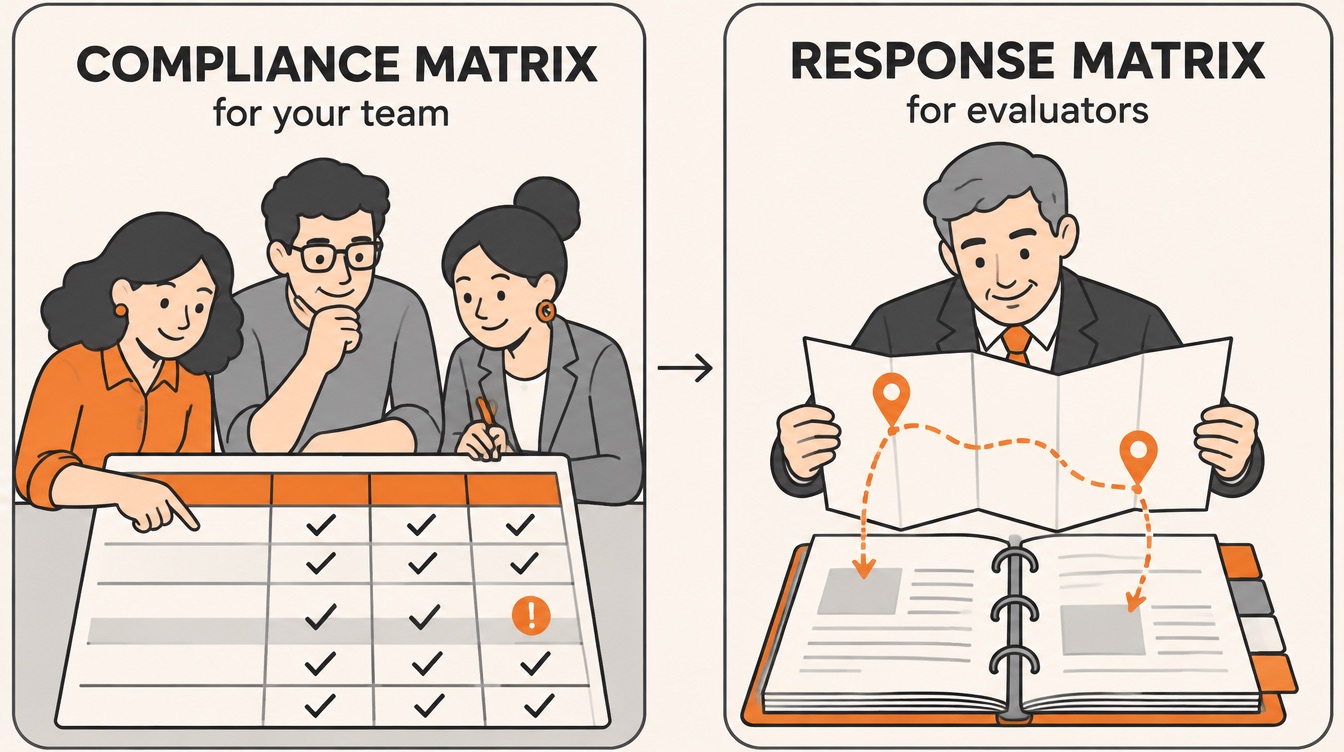
APMP's guidance is to build a compliance matrix for every bid, whatever its size or deadline. A workable compliance matrix has columns like these:
| ID | Requirement | Source | Owner | Proposal location | Compliance | Notes / justification |
|---|---|---|---|---|---|---|
| R-014 | System shall recover from failure automatically | RFP §4.2.1 | Solution architect | Vol. 2, §3.4 | Full | Commit to a 1-minute recovery in the SLA |
| R-022 | On-site support within 2 hours | RFP §5.1 | Service lead | Vol. 2, §6.2 | Partial | 2 hours in metro areas, 4 hours elsewhere; remote fix within 30 minutes |
| R-031 | Prefers vendors with prior work in the region | Pre-RFP meeting, 3 Sep | Capture lead | Exec. summary | Full | Implied requirement, not in the RFP |
The tool doesn't matter. A spreadsheet, a database or a mind map all work if the team keeps it up to date. What matters is that it exists before writing starts, that every requirement is in it, implied ones included, and that every writer works from the same version.
The response matrix comes from the compliance matrix. It is a roadmap for evaluators that shows where each requirement is answered. If page limits leave no room for a separate table, the Body of Knowledge suggests putting the same information in your section headings, for example "3.4 Automatic Recovery (RFP 4.2.1)". Evaluators are people, and they score more confidently when they can find the answer quickly.
Handling non-compliance honestly
Sometimes your solution doesn't meet a requirement. The tempting response is to mark everything "compliant" and work out the details later. The Body of Knowledge warns against that. Non-compliance is the easiest reason for a customer to eliminate a proposal, especially in government bids, and hiding it only postpones the problem. Instead:
- Record how far you comply. In the compliance matrix, note whether you comply fully or partly, and explain why you can't meet the requirement 100%. Customers want to understand the reason, and they need to.
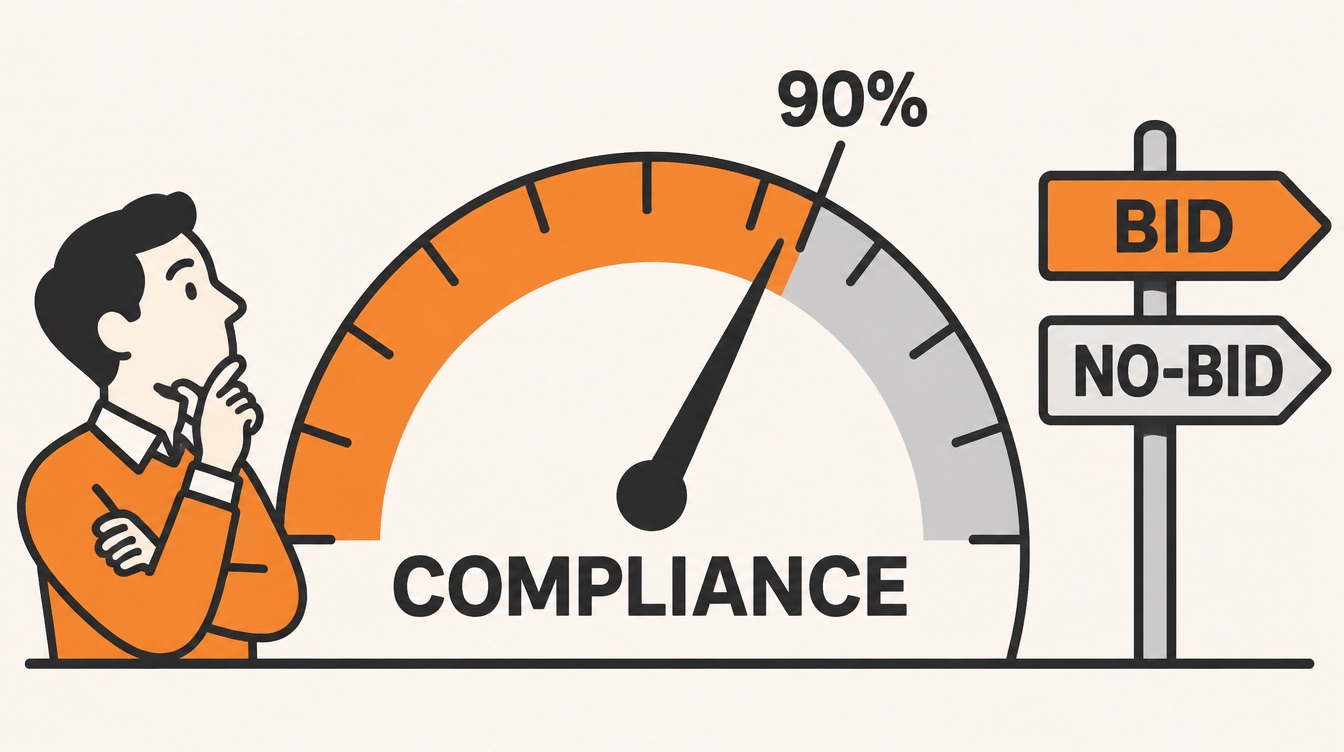
- Treat many gaps as a warning. If you are non-compliant or only partly compliant in many areas, question whether your organization should pursue the opportunity, and be willing to recommend not bidding.
- Watch for changing requirements. If amendments drop your overall compliance below about 90%, reopen the bid/no-bid decision.
How to state compliance clearly
Evaluators shouldn't have to work out whether you comply. The Body of Knowledge adjusts the approach to the type of solicitation:
- Question-and-answer RFPs: start each answer by restating the requirement and confirming that you will deliver it, then add the responsive detail.
- Proactive or unsolicited proposals, and others without a fixed list of questions: set out your understanding of the customer's key requirements and make an explicit compliance statement for each one.
- RFPs with stated requirements: use a compliance and response matrix.
Whether a requirement comes from the customer or from your own experience of what they need, list it and pair it with a responsive statement.
Keep the customer at the center
The last best practice ties the others together. Once you understand the customer, their stakeholders' hot buttons and the work being bought, show it. State their vision, goals and hot buttons in the executive summary, then carry matching theme statements through the proposal. If you don't understand what the customer wants, there is little reason for them to trust you with it.
The Body of Knowledge describes a customer-focused bidder through four habits:
- Name the customer before your own organization in each volume, section and paragraph.
- Name the customer more often than yourself.
- State the customer's vision and hot buttons explicitly.
- Present benefits before features.
The fourth habit matters most. A feature is only worth selling if it gives this customer a real benefit. The Study Guide gives a car-buying example: a powerful engine sounds like a good feature, but it is irrelevant to a safety-minded, environmentally conscious parent shopping for a family car. A feature your customer doesn't care about doesn't belong in the proposal.
Six practices to apply on every bid
- Start before the RFP. If you only start thinking about responsiveness after the solicitation is out, you are too late. Understanding a customer's real concerns takes trust, and trust takes time.
- Read the whole RFP, then read it again. Connections between requirements, answers to shared questions and small details are spread throughout. If anything is unclear, ask for clarification through the customer's official process.
- Build a compliance matrix for every bid, before writing starts, and update it as things change. Submit a response matrix, or put the references in your headings.
- Be honest about non-compliance. Explain why and offer alternatives. If compliance drops below about 90%, revisit bid/no-bid.
- State compliance explicitly, then add why the requirement matters.
- Write from the customer's point of view. Put the customer first, mention them more than yourself, and lead with benefits.
What this means when AI writes the draft
The two halves of this competency respond very differently to automation. Compliance is mostly mechanical: extract every requirement, instruction and amendment, and check that each one is answered. AI does this well, and it should. Nobody should lose a bid because a "shall" on page 147 was missed.
Responsiveness can't be generated from the RFP alone, because by definition it depends on what the RFP leaves out: why the customer is buying, what went wrong last time, and what the evaluators will worry about. If you give AI only the solicitation, you get a proposal that is fully compliant and reads like every other bid. That is exactly the scenario where the customer decides on price. The right split is for AI to handle the compliance work while people supply the understanding of the customer. Then the AI can write with that understanding.
Where Contrl fits
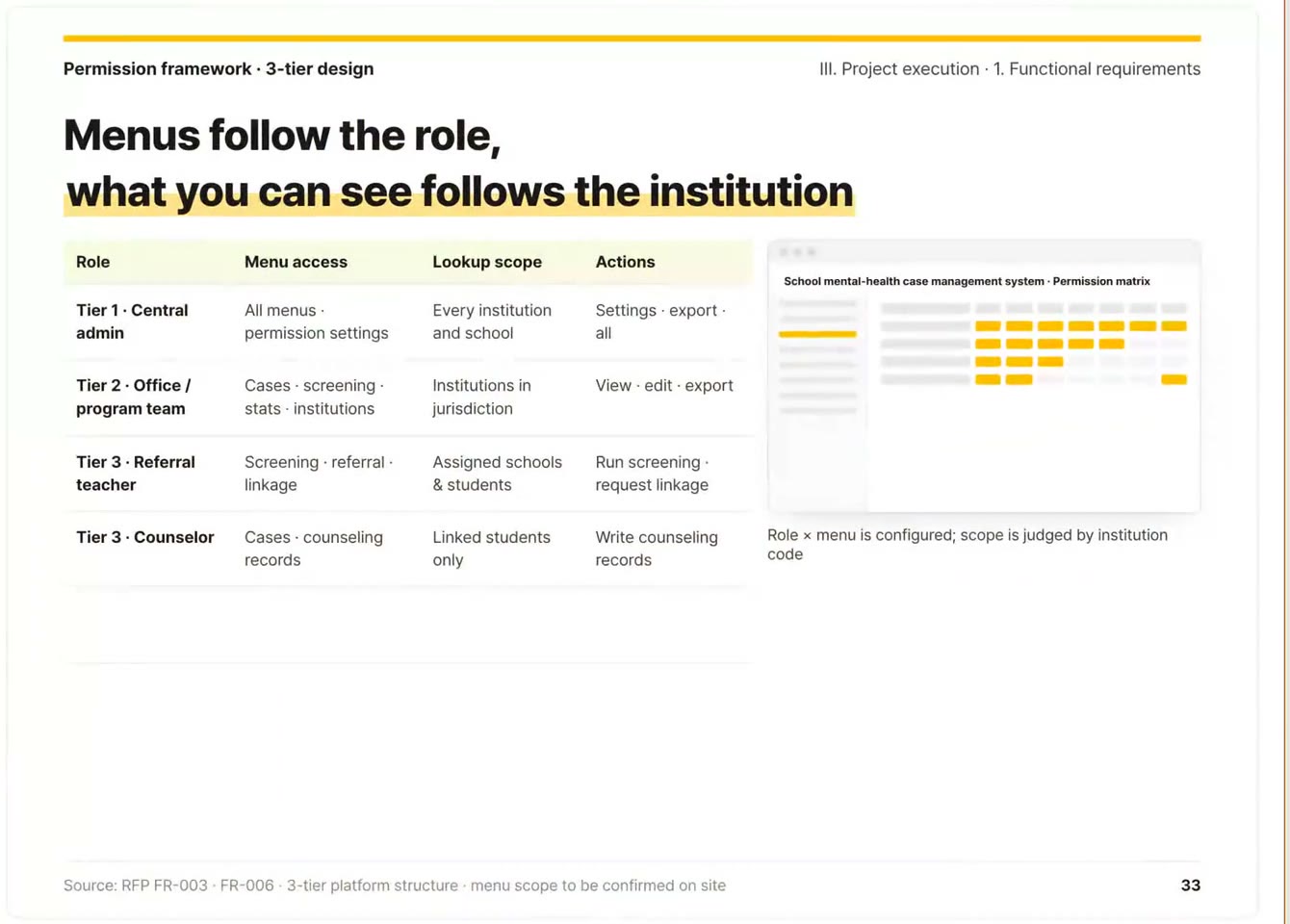
Contrl, the proposal writer we build, does the compliance work for you: before anyone writes, it pulls every requirement out of the RFP and maps it to a section of the proposal. The responsive part it leaves with you. In a short strategy interview it asks about the client, your company and the competition, then proposes win themes that each spell out the client need, your edge and the benefit. You pick one, and every section is written from it.
Next in the series
The Body of Knowledge also points out that responsiveness varies a lot across markets and cultures, and that it starts early in the business development lifecycle, well before any RFP. That leads to the next competency, Customer Relationship Management. Customers have to follow formal evaluation rules, but across industries they still tend to choose people they know, like and trust. Episode 2 looks at how to earn that before the bid.
This article is an independent study companion based on the APMP Foundation Study Guide, version 4.2 (© 2025 APMP), which summarizes the APMP Body of Knowledge. It paraphrases and comments on that material and is not endorsed by APMP. The compliance matrix rows and the uptime example are illustrations written for this article. For the authoritative text and certification information, see apmp.org.