Here is this episode's question: can you explain how you earn a customer's trust before a bid? Short answer, from the APMP Body of Knowledge: customers tend to pick bidders they know, like and trust, and customer relationship management (CRM) is the planned, documented work of getting there before your competitors do. It is a system you run, not chemistry you hope for.
In Episode 1 we saw that compliance keeps a proposal in the race and responsiveness wins it. Responsiveness depends on knowing what the RFP leaves out, and you can only learn that from the customer. So the APMP Foundation's Focus on the Customer area moves straight on to the competency called Customer Relationship Management Systems.
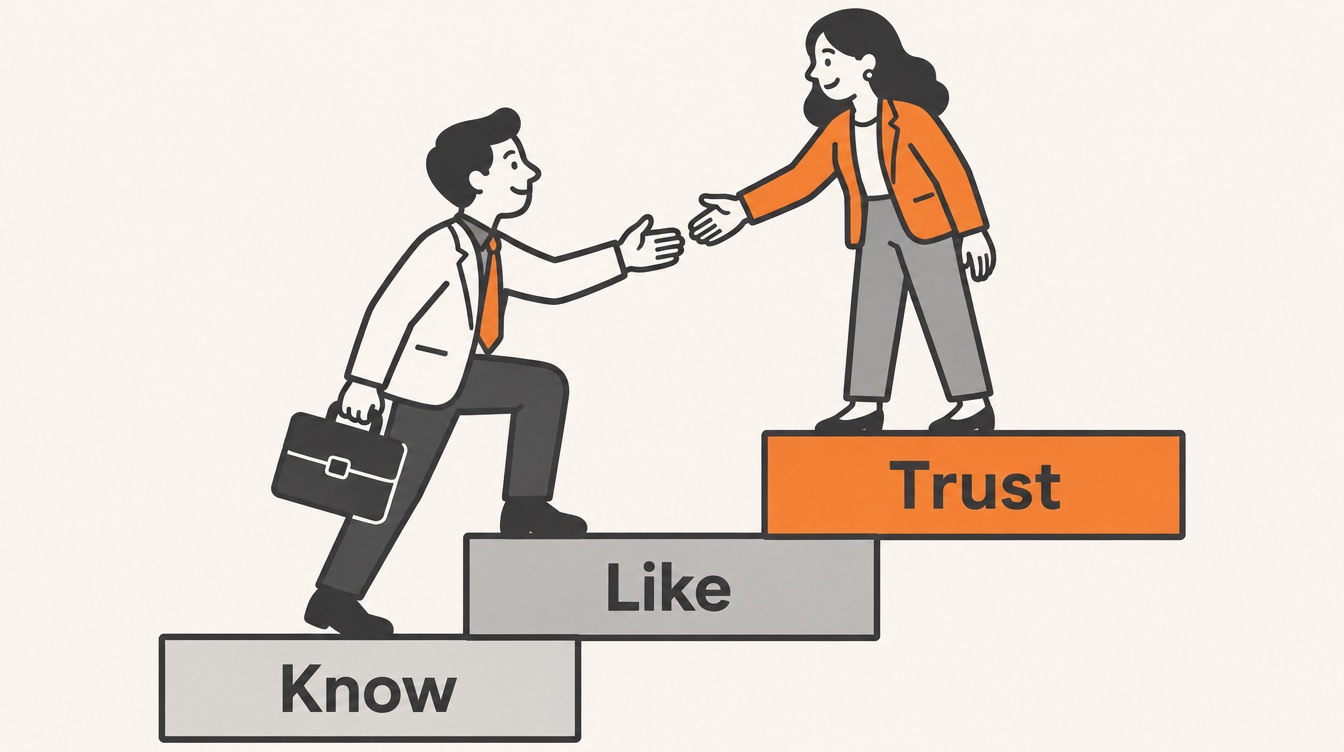
Customers choose people they know, like and trust
The Body of Knowledge starts from an observation about buyers that holds across industries and regions. Yes, customers must follow procurement rules and score each bid against formal evaluation criteria. But inside those rules they behave predictably: they prefer to work with suppliers they know, like and trust. When that trust exists, evaluators tend to find a way to choose you. When it doesn't, they tend to find a way not to.
That is uncomfortable for teams who believe the document alone decides. The evaluation criteria are real, but scoring is done by people, and people read a familiar bidder's claims differently from a stranger's. Here is what each of the three levels sounds like from the customer's side:
| Level | What the customer thinks | How you earn it |
|---|---|---|
| Know | "I've heard of them. I know what they do." | Being visible where the customer looks: events, published insight, introductions, early meetings |
| Like | "Meeting them is worth my time." | Listening more than pitching, bringing useful ideas, being easy to work with |
| Trust | "If they say it, it will happen." | Doing what you said you would, staying consistent over time, introducing the actual delivery team |
To get there, the Study Guide says you have to understand where the customer is really coming from: their pressures, their history and what they are afraid of. That is the material a responsive proposal is built on.
CRM is managed, not improvised
The Body of Knowledge defines CRM simply. It is managing every part of your relationship with a customer so that they understand who you are and how you can help, feel good about working with your team, and believe in you enough to select you over the competition. It then points to the word that matters: management. CRM shouldn't be done on the fly. It should follow a considered plan that the team carries out well.
Many teams already "do relationships". They meet often, take clients to lunch and talk about their products. The difference between that and managed CRM isn't how friendly you are. It is whether anything is planned, recorded or connected to a goal.
Ad hoc relationship building
Meet whoever is available, when there's a reason to. Talk mostly about your company. Information lives in one salesperson's head. Success means "the meeting went well". The outcome is left to luck.
Managed CRM
Meetings follow a contact plan with a purpose for each one. You listen first, and work on the customer's problem with them. Every meeting is documented and followed up. The message is the same from everyone. The outcome is intended.
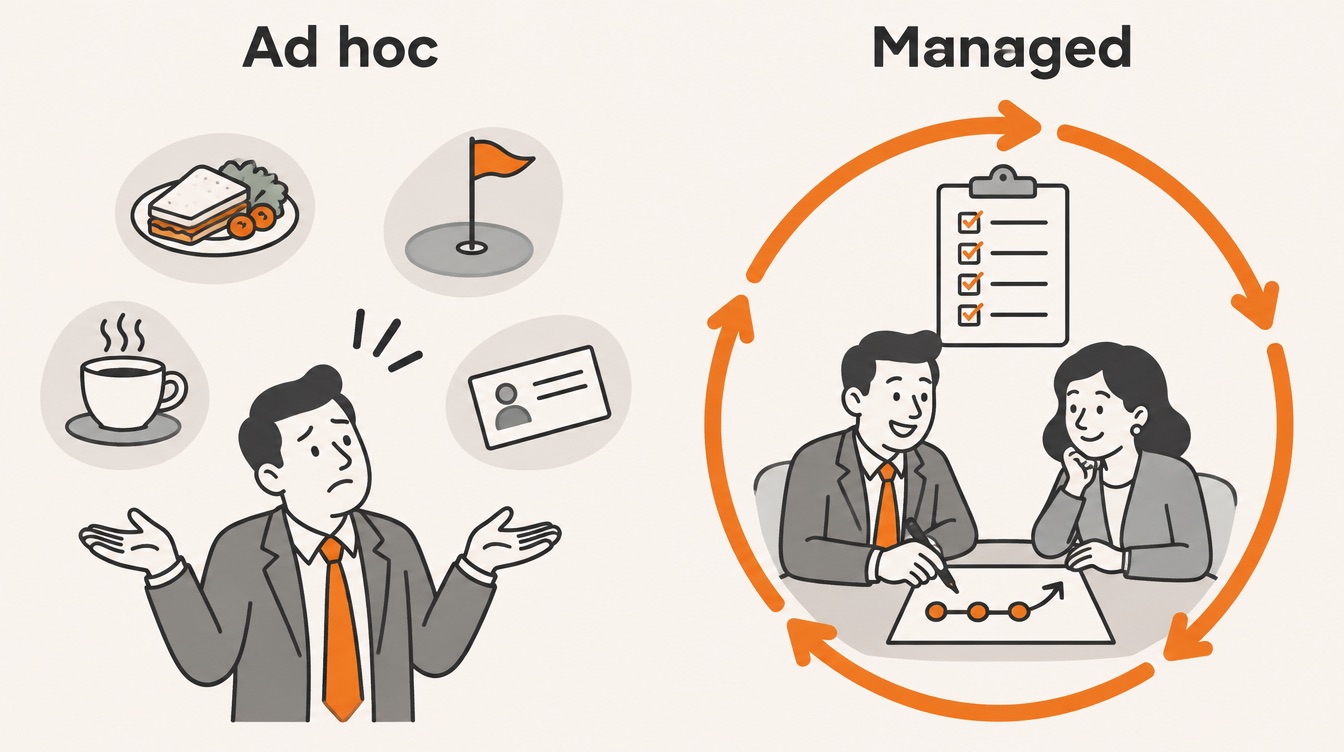
The Study Guide also notes why this pays off twice. With tight budgets and crowded markets, the companies that do CRM well tend to come out ahead. And because the customer is already understood, the later capture and proposal effort gets easier: the win themes are clearer and fewer guesses go into the draft.
Start early: the shaping window
The first best practice is timing. The Body of Knowledge is clear that it is both permitted and recommended for suppliers to talk with customers before and during the proposal process, within the customer's rules. The aim of those conversations is to listen to the customer's needs and show how your approach could solve their problem. That gives the customer the chance to know, like and trust you.
Before the RFP is released you can also attempt RFP shaping: influencing the customer's thinking so that elements of the upcoming RFP reflect your key discriminators. If you have helped the customer see that a particular risk matters, the RFP may ask how bidders will handle that risk, and your answer is already the strongest.
The window closes in stages. As the release date approaches, shaping gets harder. Many customers stop open contact, often called the cone of silence, at the draft RFP or well before it, and some never release a draft at all. After that you lose most of your insight into what the customer really wants from the program.
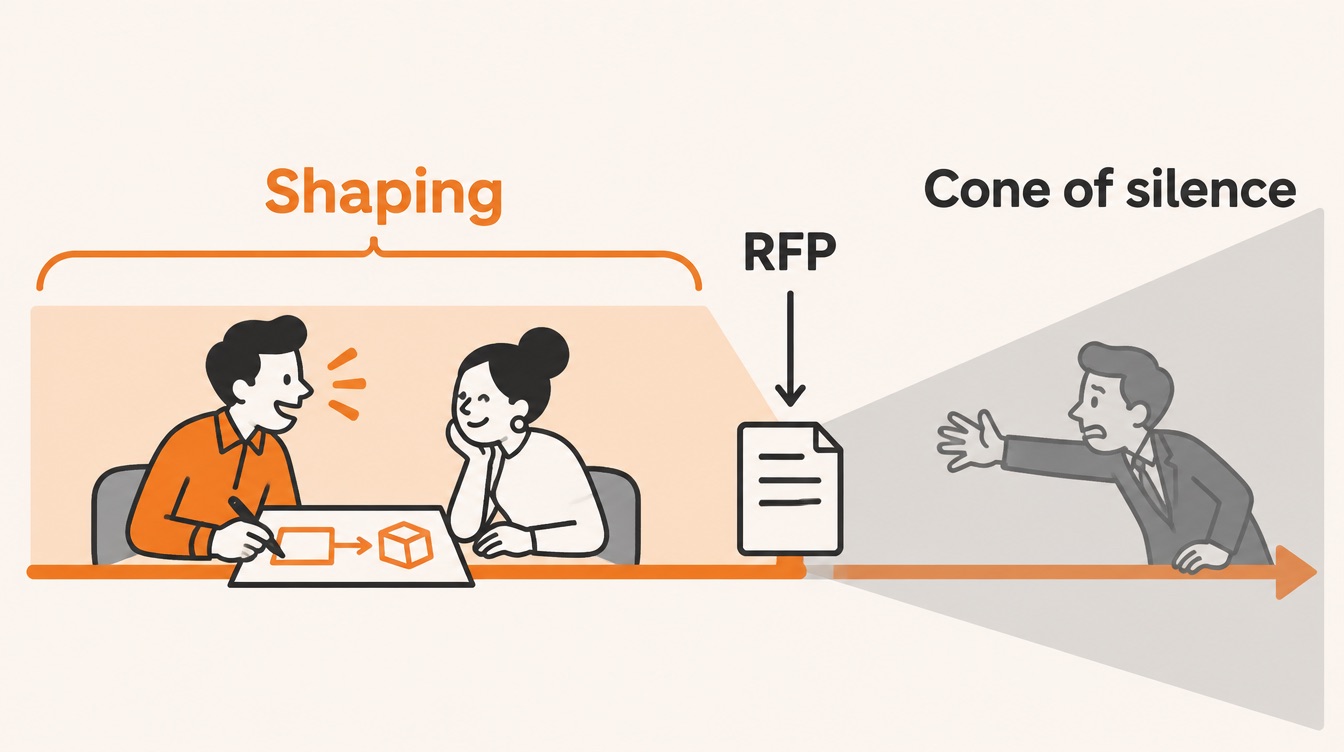
In practice this means planning backward from the expected release date. The exact lead time varies by market and contract size, so treat the stages below as an illustration rather than a rule:
- Discovery (often 6 to 12 months out): get known. Industry events, first introductions, a clear view of who the decision makers and influencers are.
- Engagement: regular meetings with key stakeholders, sharing insight that's useful to them, learning their priorities and pain points.
- Co-creation: working on the problem together, for example a joint workshop or a short assessment whose findings you interpret with the customer.
- Final shaping: reading the draft RFP if there is one and raising points through the customer's official channels.
- Cone of silence: contact limited to the formal process. Your relationship now speaks through the proposal.
Two common forms of co-creation are worth naming, because both start with giving before asking. A larger firm might host an industry workshop where potential customers share their real problems, with very little selling. A smaller technology firm might offer a short no-cost assessment and then review the findings together with the customer. Either way, the customer's thinking about the problem starts to include yours. (Check the customer's procurement and ethics rules before offering anything of value.)
Build and run a contact plan
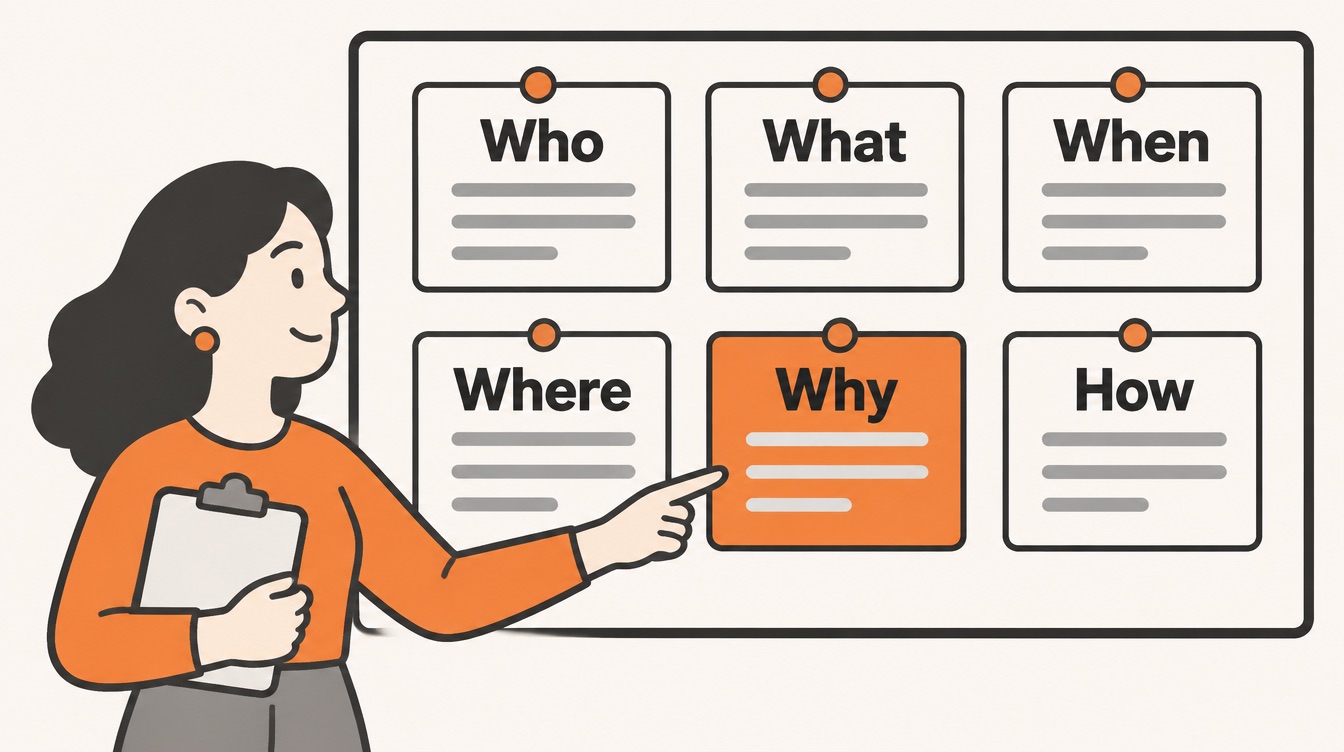
The tool at the center of CRM is the contact plan: a record of which customers you plan to contact and how. The Body of Knowledge says it should cover six things at minimum, which map neatly onto the reporter's questions:
| Question | What the contact plan records |
|---|---|
| Who | The customer people you will meet, and who from your side will attend |
| What | What you want to find out, and what message you want to leave with them |
| When | The timing of each meeting. Sometimes you want meetings at different levels of the customer at the same time, so you can compare what you hear. |
| Where | Your office, theirs, a teaming partner's, or somewhere else |
| Why | The purpose of meeting this person: what you hope to accomplish |
| How | How you will deliver the message: presentation, demonstration, workshop, informal conversation |
Here is what a few rows can look like for a single opportunity:
| Who (customer / ours) | Why and what to learn | Message | When / where | Status |
|---|---|---|---|---|
| IT director / our account executive and solution architect | Learn what failed in the current system; test whether downtime is the top concern | We design for recovery, not just availability | Mid-March, customer office | Done. Downtime confirmed; budget cycle starts in July |
| Operations manager / our delivery manager | Understand how users actually work today and what they would refuse to change | Our rollouts don't stop daily operations | Same week, on site | Done. Night-shift users are the risk |
| Procurement officer / our bid manager | Expected timeline, draft RFP plans, contract type | None. Listen only. | April, by phone | Planned |
The plan can be as simple or as elaborate as you like. The Study Guide's point is that you write one, act on it, and keep it up to date. Notice the first two rows: meeting the director and the operations manager in the same week lets you compare two views of the same problem.
Run customer meetings strategically
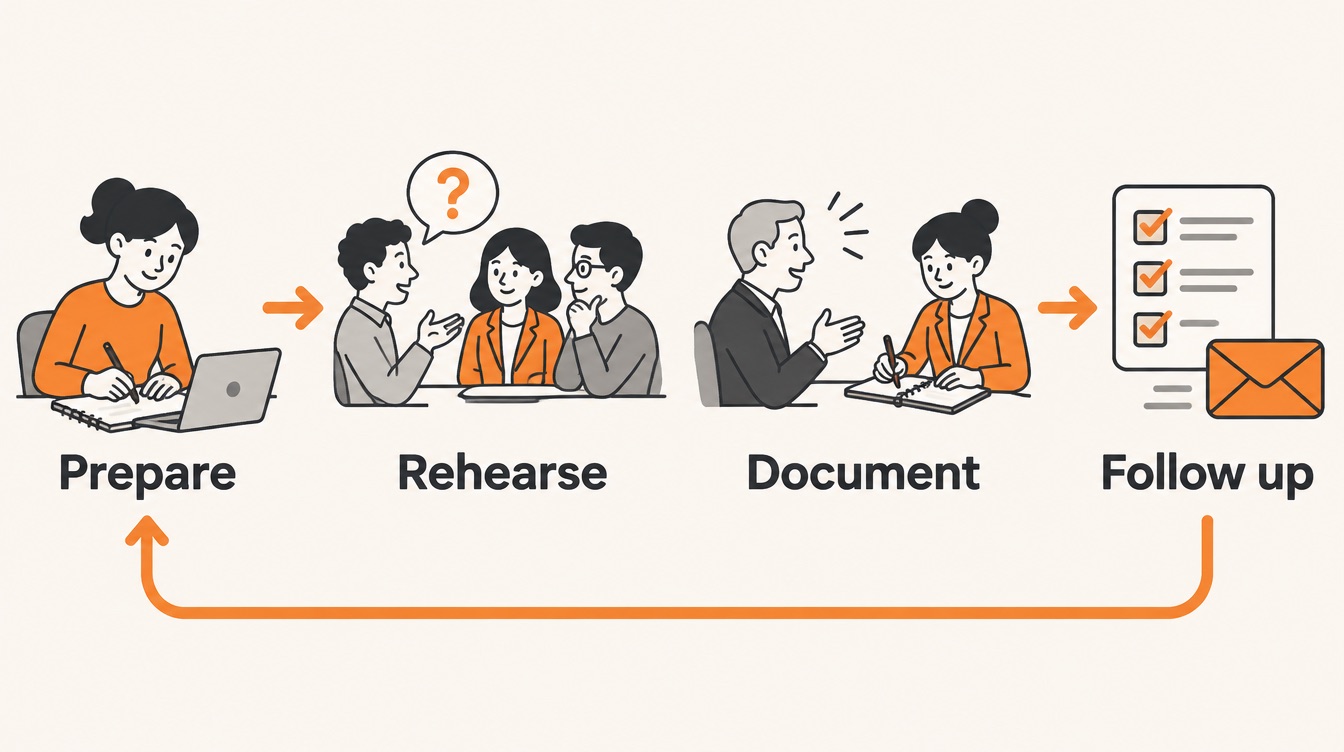
A meeting with a customer is expensive for both sides, so the Body of Knowledge asks you to run each one in an organized way. It comes down to four steps:
- Prepare. Decide what you want to say, who will say it and how. Decide what you want to find out.
- Rehearse. Run through it with the team. Role-play the customer to anticipate their questions.
- Document. Record what happened and check it against the list of things you wanted to learn. Note how the customer reacted to what you shared and what next steps were discussed.
- Follow up. Assign action items, write them down and check on them regularly.
Step 3 is where most teams fall short. "It went well" or "good atmosphere" is an impression, not a result. A useful meeting record answers three questions: what did we learn, what message did the customer hear, and what happens next, and who owns it? If you can't fill in all three, the meeting didn't turn into anything you can use.
One message, every channel
Customers meet you in many places: your meetings, your conference talks, your website, your articles, your emails. If each of these says something different, the inconsistency erodes trust. The Body of Knowledge's answer is a marketing communications plan:
- Hold win strategy and value proposition sessions to decide what you want to say to this customer.
- Agree who will deliver the message, how, and when.
- Write short elevator speeches into the contact plan, so everyone who meets the customer says the same thing in their own words.
- Plan the message across social and traditional media as well as in person.
The point isn't volume. It is that the account executive, the engineer at a conference and the article the customer reads all point the same way. That consistency is part of what turns "I've heard of them" into "I trust them".
Two common misconceptions
"Only the senior people matter"
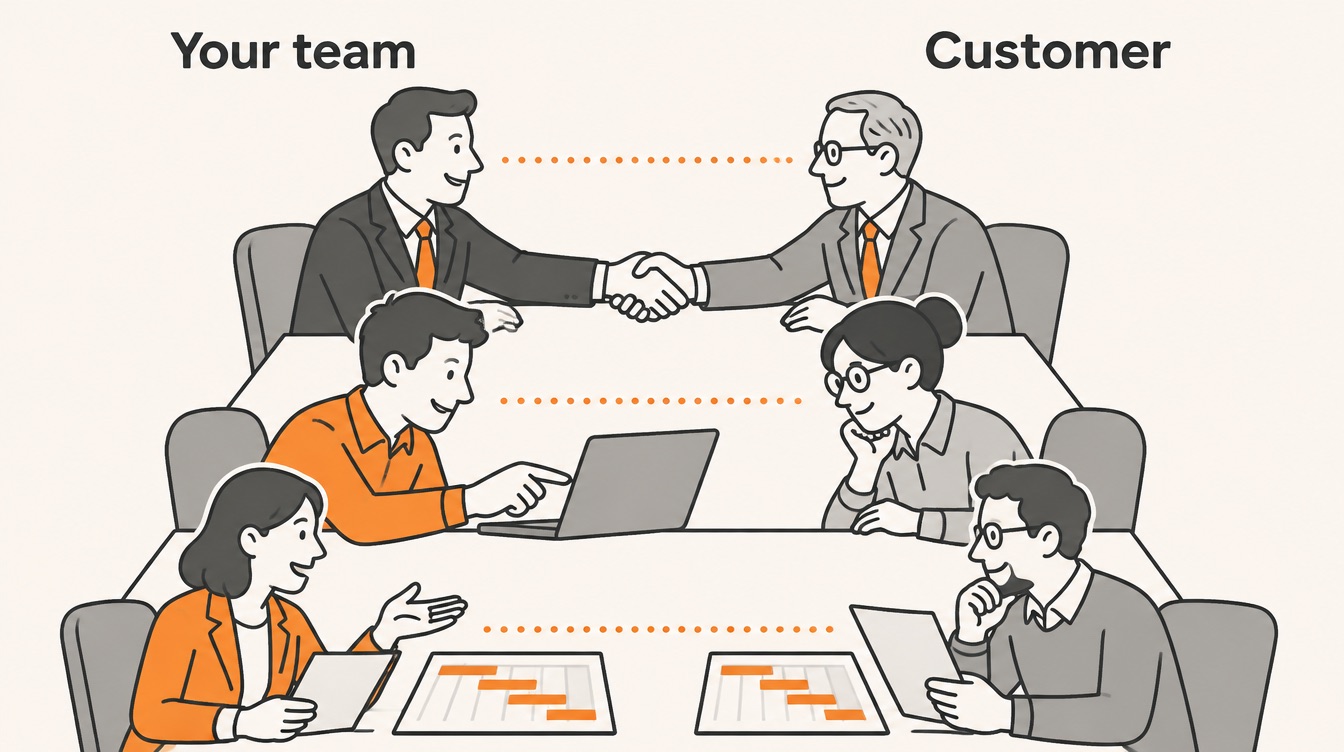
It is tempting to spend all your contact time on the customer's most senior executives. The Body of Knowledge recommends matching your people to their counterparts instead: executives with executives, engineers with engineers, project managers with project managers. The customer then meets the people they would actually work with if they chose you, and each of those people forms their own view.
"CRM is the tracking software"
The competency is called Customer Relationship Management Systems, and there are plenty of software tools that help. But the Body of Knowledge is clear that CRM isn't just tracking an opportunity and its logistics. It is also planning and carrying out how you will meet and listen to the customer. The tools support that work. They don't replace it.
One part of the record deserves special care: the history of the relationship. Who met whom, what the customer said and what was promised gives essential context to the people who will manage the account after the contract is signed. When that history lives only in one salesperson's memory, it leaves when they do.
A practical CRM checklist
- List your target opportunities and when each RFP is expected, then plan backward. If the release is close, be realistic about how much shaping is still possible.
- Write a contact plan covering who, what, when, where, why and how for every key customer contact.
- Match counterparts at each level of the customer, not just the top.
- Prepare and rehearse every meeting, including likely customer questions.
- Document each meeting against what you wanted to learn: what you learned, what message they heard, next steps and owners.
- Follow up on action items on a regular schedule, and update the contact plan.
- Agree on one message from your win strategy sessions and use it in meetings, events and published content.
- Keep the relationship history where the whole team, and the future delivery team, can find it.
Where Contrl fits
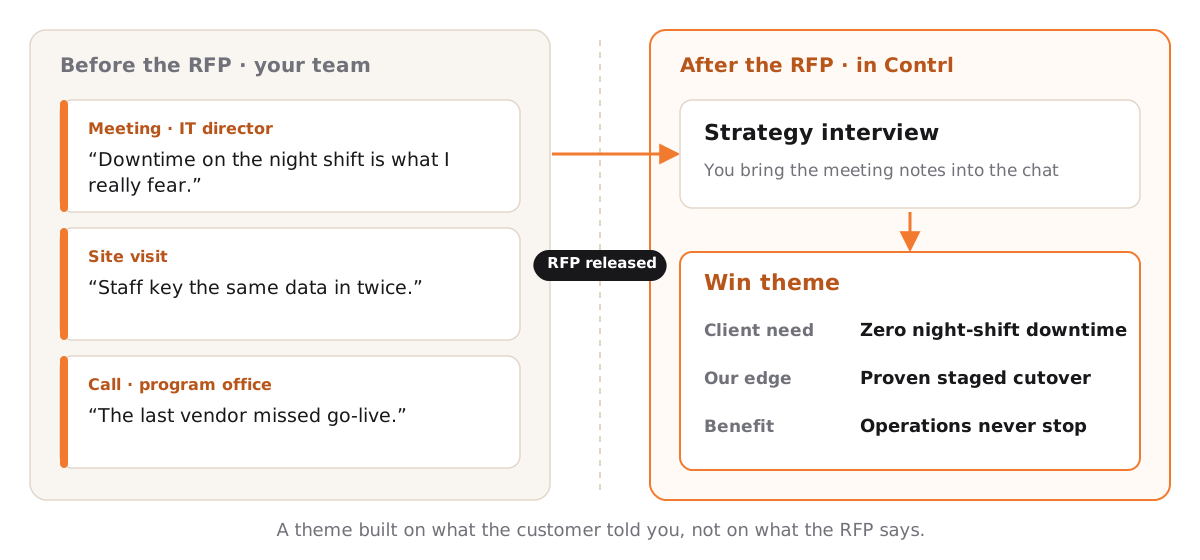
The point that maps to Contrl is that responsiveness depends on what you learned from the customer before the RFP. After you upload an RFP, Contrl runs a strategy interview in chat about the client, your company and the competition, then proposes win themes that each state a client need, your edge and the benefit. A note like "the IT director's real fear is downtime on the night shift" is exactly what that interview needs, so keep your meeting records in a form you can bring to it.
Next in the series
The Body of Knowledge closes this topic with a reminder: successful companies are good at listening. Relationships tell you which customers trust you. The next question is which opportunities to pursue, and how to organize a team to win one. That is Developing an Opportunity/Capture Management Strategy, the subject of Episode 3.
This article is an independent study companion based on the APMP Foundation Study Guide, version 4.2 (© 2025 APMP), which summarizes the APMP Body of Knowledge. It paraphrases and comments on that material and is not endorsed by APMP. The know/like/trust table, the timeline stages, the co-creation examples, the contact plan rows and the three-question meeting record are illustrations written for this article. For the authoritative text and certification information, see apmp.org.