Imagine an evaluator scoring the key personnel section of two proposals for the same contract. The first offers a service desk lead "to be identified after award" and attaches a job description. The second names a person, says she can start on day one, and gives a one-page resume showing that she has run a desk of the required size, holds the required certification and cut a similar customer's ticket backlog. The evaluator has nothing to score in the first. The second is easy to score, and easy to score well.
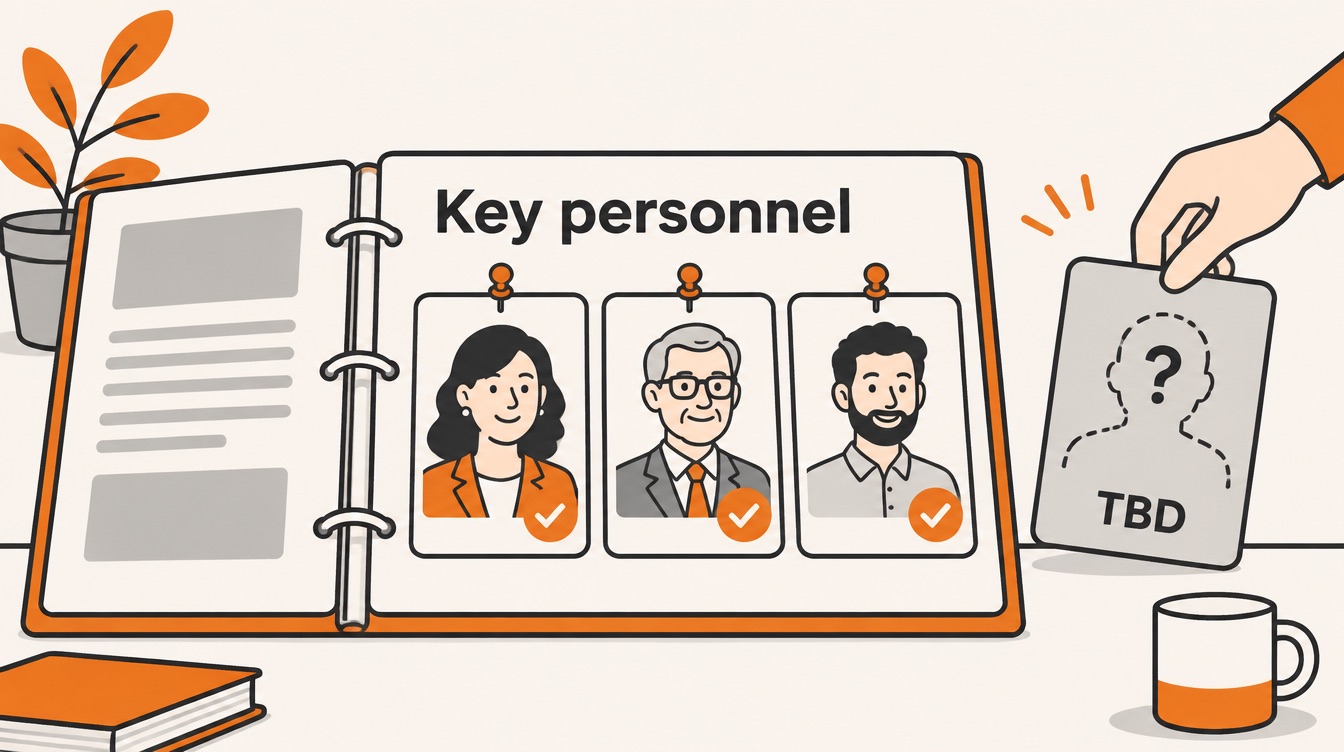
A proposal resume is a short, tailored record showing that a named person, available when the contract starts, meets the RFP's requirements for a specific role. In the APMP Body of Knowledge, resumes are how you position the people who will deliver the service you propose. Their roles, skills and experience can be a deciding reason the customer chooses you, so they deserve the same strategy and care as any other part of the proposal.
This series works through the APMP Body of Knowledge as summarized in the APMP Foundation Study Guide. Resumes follow naturally from relevant past performance (episode 22): past performance proves your organization has done the work, and resumes prove the individuals assigned this time can do it.
What a proposal resume has to prove
Public agency or private company, every customer wants to see that you either employ, or can quickly bring in, people whose experience matches the work. The Study Guide reduces the goal of every resume to three claims. The person is:
| Claim | The evaluator's doubt | What answers it |
|---|---|---|
| Real | Does this person exist and work for you, or is it a placeholder? | A named individual with a resume, never "to be hired" |
| Available | Will they actually be on this contract from the start, or are they committed elsewhere? | A clear statement of the role and full availability from the first day |
| Better qualified | Are they stronger than the people other bidders will propose? | Directly relevant experience and measured results that match the RFP's requirements |
The first claim is where many bids lose points without noticing. A promise to recruit qualified staff after award gives the customer nothing to evaluate and signals risk. If you don't have the person yet, the work before submission is to find and commit them, not to describe the kind of person you will look for.
A street resume is not a proposal resume
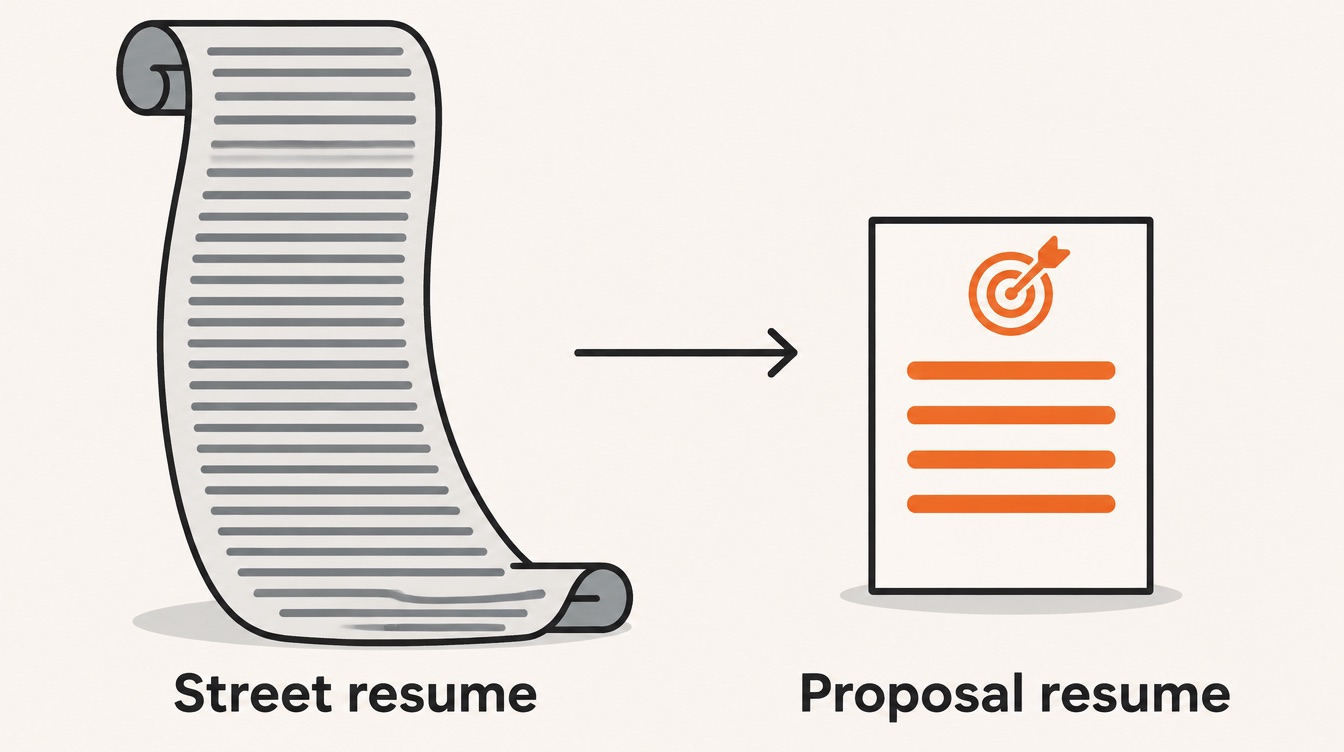
Most people already have a resume. It is usually the wrong document. The resume someone uses to apply for jobs, which the Study Guide calls a street resume, is written to sell the person to any employer. A proposal resume is written to sell this person, in this role, to this customer.
| Street resume | Proposal resume | |
|---|---|---|
| Purpose | Get the person a job | Win a contract for the organization |
| Organized around | The person's career, usually in date order | The role in the proposed solution and the RFP's requirements for it |
| Content | Everything the person has done | Only the experience and qualifications the RFP asks for |
| Written by | The person | A proposal writer, checked by the person |
| Format | Whatever the person likes | One template that follows the RFP's instructions |
| Lines read as | Duties and job titles | Accomplishments with measurable benefits to customers |
Choose the team on purpose
Resume writing starts with a staffing decision, and that decision is part of your strategy. The Study Guide suggests weighing four things when you decide who is best placed to support the customer:
- The customer's world: its market sector, vision, values, motivations and current issues.
- The customer's own team: the people your staff will work with, their personalities and their hot buttons.
- The requirements: what the RFP demands of each role.
- Your available people: their hard skills and experience, and their soft skills.
The second point is easy to overlook. A technically perfect lead who clashes with the customer's style, or who has never worked in the customer's sector, is a weaker choice than the paper suggests. What you learned in capture (episode 3) belongs in this decision.
Gather the raw material, then screen it
Once you know who you are proposing, contact each person early, explain why you need their help and give them the resume timeline, so they can fit it around their day job. Then ask for more than whatever sits in your company's files:
- The corporate resume on file, which they should review and update if it is more than about a year old.
- Their street resume, if they have used one in the past year. Long-standing employees often won't have one.
- Reuse resumes: versions already tailored for recent proposals with similar requirements.
- A photo and signature, in high resolution, if the RFP requires them.
- Solution-specific examples: results, stories or customer testimonials relevant to this opportunity that don't yet appear in any version of their resume.
Now screen what you have against the RFP's hard requirements: education, certifications, security clearance, how many years of experience, and any specific experience it names, such as hands-on use of a particular software tool. If a candidate misses a requirement, replace them now. Discovering the gap while the resume is being written costs time you won't have later, and discovering it after submission can cost the bid.

Use one compliant template
Every resume in the proposal should share one master template that complies with the RFP and is easy to skim. Set it up before anyone writes, so the style, font, size and colors are right from the first draft and nobody reformats twenty resumes the night before submission.
RFPs often set a page limit per resume or per volume, a font and size, and margins. If yours doesn't, agree on a standard with the bid or proposal manager. For page length, scale to the bid: a short, simple proposal might use one-page resumes, while a large technical one can justify resumes of up to about three pages.
Unless the RFP prescribes something else, a structure like this works well:
- Role first. State the person's position in the proposed solution or the labor category, and reference the RFP sections that define it in the template headings.
- Key qualifications summary at the top, so a skimming evaluator sees the fit in seconds.
- Relevant experience: what the person has done for comparable customers or in comparable situations.
- Education, training and certifications, placed after the relevant experience, not before it.
- Testimonials and awards from customers, where you have them.
- Personal references, only if the RFP asks for them.
The order follows the same logic as good headings (episode 18) and page design (episode 20): put what the evaluator is scoring where the eye lands first.
Let a writer draft, and write results
The Study Guide is specific about authorship: a writer, not the person the resume describes, should produce the first draft of every resume. The candidate's time is expensive and usually committed to other work, and people describing themselves tend to drift into their own vocabulary and their own idea of what matters. A writer produces resumes that read consistently across the whole team. The candidate's job is to fill gaps the writer flags, such as missing keywords, specific experience or compliance details, and to confirm the draft is accurate.

What makes the content persuasive is the same thing that makes any benefit persuasive. Every bullet or paragraph should carry a benefit to a customer that can be measured. Keep sentences short and words plain (episode 17), even when the work was complex. Above all, describe accomplishments, not responsibilities: a job title says what the person was supposed to do, while a result shows what they actually did.
Responsibilities
"Responsible for managing service desk operations. Duties included staff supervision, process improvement and stakeholder communication. Excellent leadership and communication skills."
No size, no result, nothing tied to this RFP.
Results tied to the role
"Led a 30-agent, 24/7 service desk for a city agency (RFP 4.2.1, 4.2.3). Reorganized ticket triage and cut the open backlog by 40% in six months while first-call resolution rose to 78%. ITIL certified (RFP 4.2.2)."
Scale, measured benefit and the requirement each fact answers.
The example is invented for this article; the habit it shows is the point. Tailoring also means leaving things out. Include only the experience and qualifications the RFP specifies. A long, untailored career history makes the evaluator hunt for the evidence, and a hunting evaluator is not a generous one.
Build a resume database
All of this is much faster when the raw material already exists in one place. Any organization that bids regularly should keep a corporate resume database, one that writers can search for current employees with the skills and experience a proposal requires. Two habits keep it useful:
- Keep it current. One practical method is to make updating your resume part of the regular performance review.
- Feed proposal versions back in. Each tailored resume you write should go into the database, or into a separate store of reuse material, so the next proposal starts from a version that already speaks to similar requirements.

A database is also how you avoid a common trap: grabbing an old proposal resume and submitting it unchanged. Reuse material is a starting point. It still has to be tailored to this RFP.
Common mistakes
- Proposing roles instead of people, or promising to hire after award.
- Naming people who won't be available when the contract starts.
- Submitting street resumes or old proposal resumes without tailoring them to this RFP.
- Finding a missing clearance or certification late, during writing or after submission.
- Letting each person write their own, so twenty resumes read twenty different ways.
- Breaking the RFP's format rules: page limits, fonts, margins or required headings.
- Listing duties instead of results, with no numbers and no benefit to a customer.
- Leading with education and burying the relevant experience the evaluator is scoring.
Checklist for your next RFP
- List every personnel requirement in the RFP: roles, labor categories, qualifications, format rules and page limits.
- Choose people deliberately, considering the customer's sector and issues, the customer's team and hot buttons, the requirements, and each person's hard and soft skills.
- Confirm each person is real, committed and available from the start of the contract.
- Contact each candidate early with the timeline, and collect their corporate, street and reuse resumes, any photo or signature required, and solution-specific examples.
- Screen against the hard requirements (clearance, education, certifications, years, specific experience) and replace anyone who falls short now.
- Set up one compliant template before drafting: role and RFP references first, key qualifications summary, relevant experience, then education.
- Have a writer draft every resume, and ask candidates only for gaps and a final accuracy check.
- Make every line a measurable result for a customer, in short sentences, and cut what the RFP doesn't ask for.
- Save the tailored versions to your resume database or reuse library after submission.
Where Contrl fits
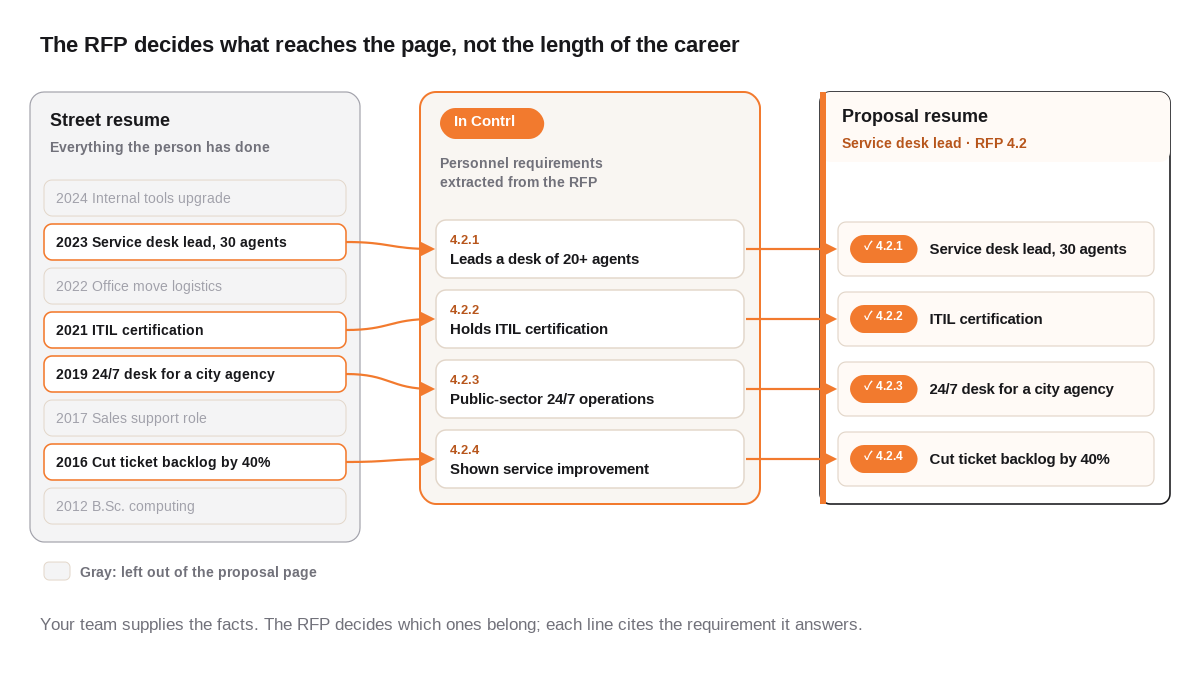
A proposal resume goes wrong when it answers the person's career instead of the RFP, and the requirements for a role are rarely all in one place: the role description, the evaluation criteria and the format instructions each add something. When you upload an RFP to Contrl, it extracts the requirements, the required outline and the evaluation criteria and maps each requirement to a proposal section, so what the customer asks of each role sits in one list, in the customer's own words. The pages Contrl writes cite the requirements they answer, which makes a line that answers nothing easy to spot, and one line of chat feedback rewrites the page. The facts about your people still come from your team; Contrl keeps the page pointed at what this RFP asks.
Next in the series
Resumes close the run of episodes on individual proposal pieces. Episode 24 opens the process side of the Body of Knowledge with the End-to-End Process: the defined phases, bid decisions and reviews that take an opportunity from first sight to a submitted offer, and why organizations that follow one consistently tend to win more.
This article is an independent study companion based on the APMP Foundation Study Guide, version 4.2 (© 2025 APMP), which summarizes the APMP Body of Knowledge. It paraphrases and comments on that material and is not endorsed by APMP. The opening scenario, the claims table, the street-versus-proposal comparison, the example resume lines, the common mistakes list, the diagram and the illustrations were written for this article, and their figures are illustrative; no customer or person is named. For the authoritative text and certification information, see apmp.org.