About 15 years ago I bid on kiosks for a well-known shopping mall in Singapore. However many times I read the RFP, I could not see where the client actually hurt. So I went to the site myself. By chance, I noticed that the small display in each restroom was broken. So we said that when we supplied the kiosks, we would get those dead displays working as well, all in one go. Putting a finger on the sore spot worked. Our price was well above our competitors', and we still won.
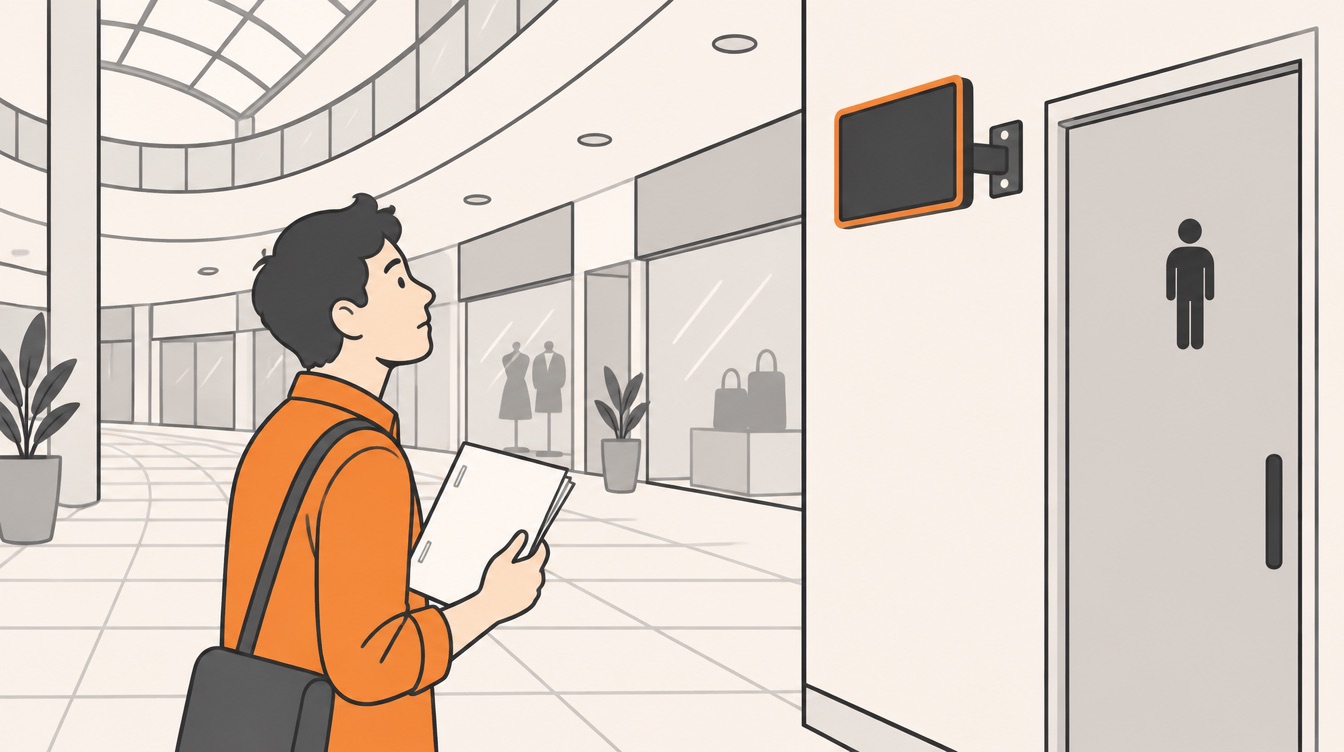
That story carries the argument of this episode and of the APMP Body of Knowledge's chapter on persuasive writing. Persuasion starts from what the reader needs, not from what you sell, and urgency comes from the reader's real pain. The Study Guide's advice on urgency is to present your solution as the alternative to a pain the reader actually has. We came to sell kiosks; what got us chosen at a higher price was naming something that was bothering the client.
This series works through the APMP Body of Knowledge as summarized in the APMP Foundation Study Guide. Episode 10 covered the evidence behind your claims and episode 15 covered where things go on the page. This one is about what makes a reader say yes once they get there.
What persuasive writing is
The Body of Knowledge treats a proposal as an argument on paper. You are asking a reader to agree with you and to work with you on their problem, and you are telling a story meant to convince them of three things: you really understand the problem, your solution is the best one for it, and you have their interests at heart.
Three traits set this kind of writing apart:
| Trait | What it means | Test for your draft |
|---|---|---|
| Personal | It is mainly about this reader's needs and preferences | Could this paragraph go to any other customer unchanged? |
| About probabilities | A rival's solution may look attractive too; you show that yours is more likely to succeed | Do you say why yours is the safer bet, or only that it is good? |
| Conclusive | The reader finishes with no doubt about what to do | After the last line, is the next step obvious? |
The Study Guide also separates persuasive from clear writing. Clear writing keeps each sentence connected to the subject. Persuasive writing runs each sentence through the audience as well. A sentence can pass the first test and fail the second: "The system supports role-based access control" is perfectly clear, and it tells the reader nothing about why they should care.
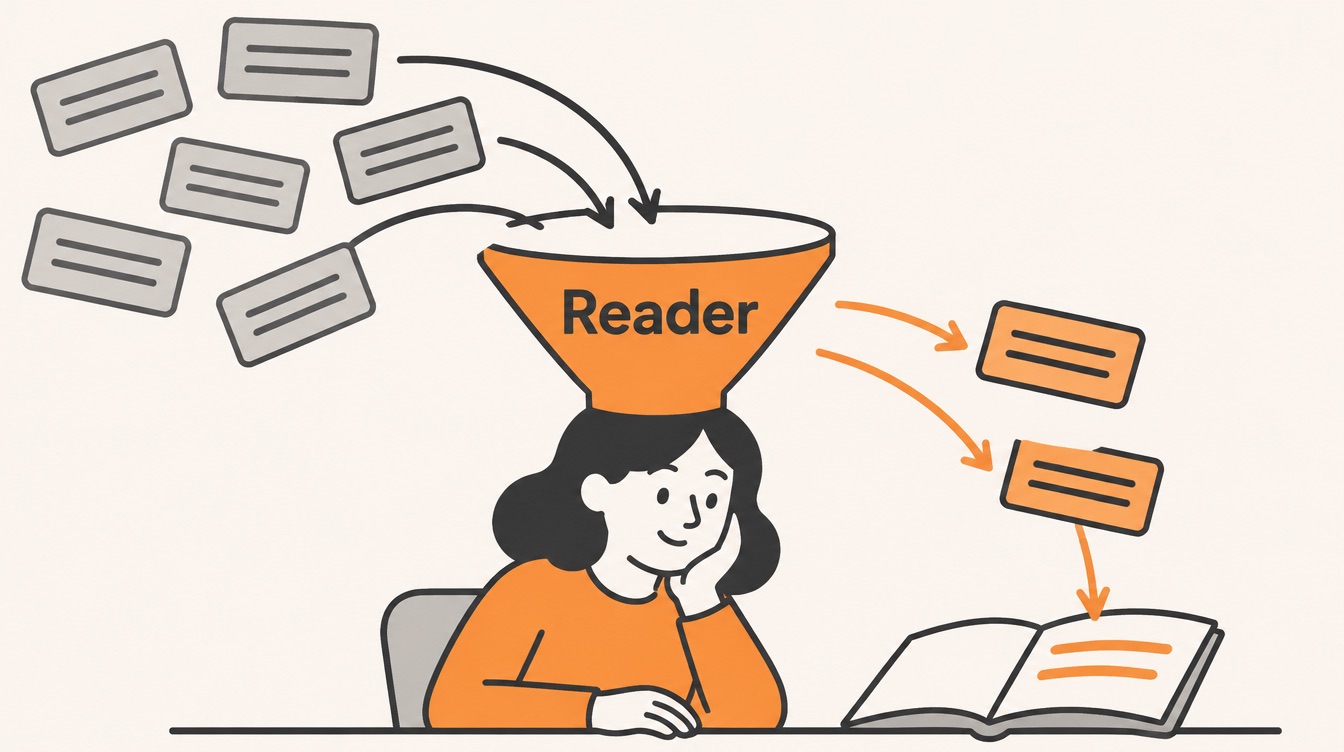
Filter everything through the reader
Knowing your audience is the first best practice in the chapter, and it comes down to three habits.
| Habit | What to do | Weak version |
|---|---|---|
| Be specific | Show how a past success carries over to this customer's situation. Use real scenarios and exact measures, and check that your solution truly fits. | "We have solved this problem for many organizations." |
| Make it personal | Find what worries this reader most. Think through what doing nothing, or doing the wrong thing, would cost the organization and the people responsible. | "Modernization is essential in today's environment." |
| Find common values | Learn where the customer and its people stand on business, social and environmental questions, and look for real common ground. People warm to those who care about the same things. | "We share your commitment to excellence." |
My Singapore bid is a case of the second habit, and it adds one lesson of my own: the RFP is not always where the pain is written down. An RFP says what the client wants to buy. It may not say what is bothering them. I found those displays by chance, but going there to look was a decision. When the document doesn't show you the pain, go and find it: visit the site, use the service yourself, talk to the people who live with the problem. Episode 2 and episode 5 cover how to build that knowledge before the RFP arrives.
Here is the same point as a pair of openings, written for this article:
Starts from the product
"Our platform processes permit applications through an advanced workflow engine with 24 configurable modules."
Starts from the pain
"Residents wait 14 days for a permit, and your counter staff take the complaints. Most of that wait is one manual completeness check. We remove it."
Know the limit
None of this means telling readers what they want to hear. A proposal leads to a contract, so you have to be able to deliver what you claim and really hold the concerns you profess. An offer to fix something you noticed is also a promise. The Study Guide frames the goal as a true argument for a relationship that benefits both sides, and that test should settle most temptations to overreach.
Find the real pain, then promise only what you can do about it.
Structure the proposal like an argument
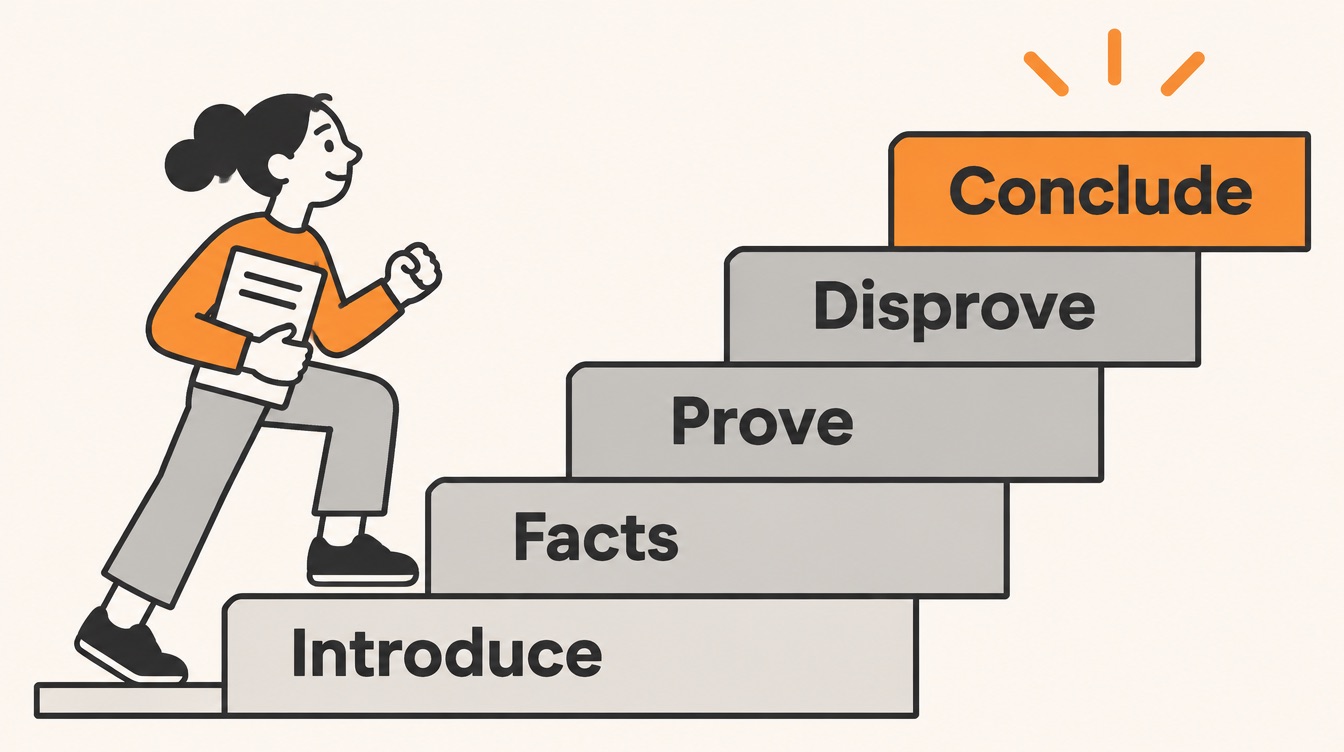
The tools of argument are thousands of years old, and the Body of Knowledge's view is that they still work once adapted to busy business readers. A proposal has its own logic, but even a simple unsolicited one echoes the classic structure:
| Step of the argument | Its job | Where it appears in a simple proposal |
|---|---|---|
| Introduction | Say why you are here, earn interest and credibility | Executive summary: purpose, approach and the offer in brief |
| Statement of fact | Lay out the situation and its context | Current environment: the problem, the context, what is needed |
| Confirmation | Take a position and back it up | Recommendation: the solution, its proof, its benefits |
| Disproving | Deal with gaps and opposing views | Cost proposal: what it costs and why that is good value |
| Conclusion | Reinforce the case and raise urgency | Implementation: commitments, timeline, who is responsible |
When an RFP prescribes the outline, follow it, as episode 15 explains. The sequence still works inside each section: introduce, state facts, prove, disprove, conclude. Opening sections with summaries that echo this order reinforces the logic at both the large and the small scale.
A worked case: the pricing section
Plenty of evaluators turn straight to the price, so the pricing section has to make the argument on its own. The Study Guide walks through it paragraph by paragraph. In my words:
- Restate the main idea, angled toward the financial value to come.
- Recap needs and benefits, in a table or short list, in the order used earlier, with the financial gain beside each one.
- State the full cost simply and directly, in the customer's required format. Give the bottom line here and leave the line items to an attachment.
- Prove the value with total cost of ownership, return on investment or payback period, in a chart if you can.
- Answer likely objections to the price, the reasoning or the approach.
- Close on overall value, including what the customer gains beyond the price.
For how to build the numbers behind this, see episode 13.
Logic: every claim gets a proof
Proposals work by stating claims and supporting them, and the more objective the support, the stronger the case. Proof runs from the hard end, such as specifications and test results, to the softer end, such as testimonials. Episode 10 covers how to collect it. This chapter adds a requirement: it isn't enough to follow a claim with a proof. You also have to show how that proof applies where the reader is.
Claim and proof
"We keep services running during migration. We did it for a regional hospital group in 2024 with no unplanned downtime."
Claim, proof and the reader's world
"We keep services running during migration. We did it for a regional hospital group in 2024 with no unplanned downtime. Like them, you run around the clock across several sites, so we would move your 11 offices one at a time in the same way."
Emotion: make the stakes felt
Logic earns agreement, but people also decide with their feelings, and the Body of Knowledge names two techniques. One is telling a story about what could interrupt the reader's business, which raises awareness of the problem and its consequences and gives the decision urgency. The other is vivid language.
Abstract
"System failures may have a negative impact on payroll operations."
A story the reader can picture
"If the batch job fails on the night of the 24th, 6,000 employees don't get paid on the 25th, and your payroll team spends the morning answering their calls."
Both examples are written for this article. Use the technique honestly. The story has to describe something that could really happen to this reader, or a careful evaluator will take it as scare tactics.
Doubts: remove the reasons to say no
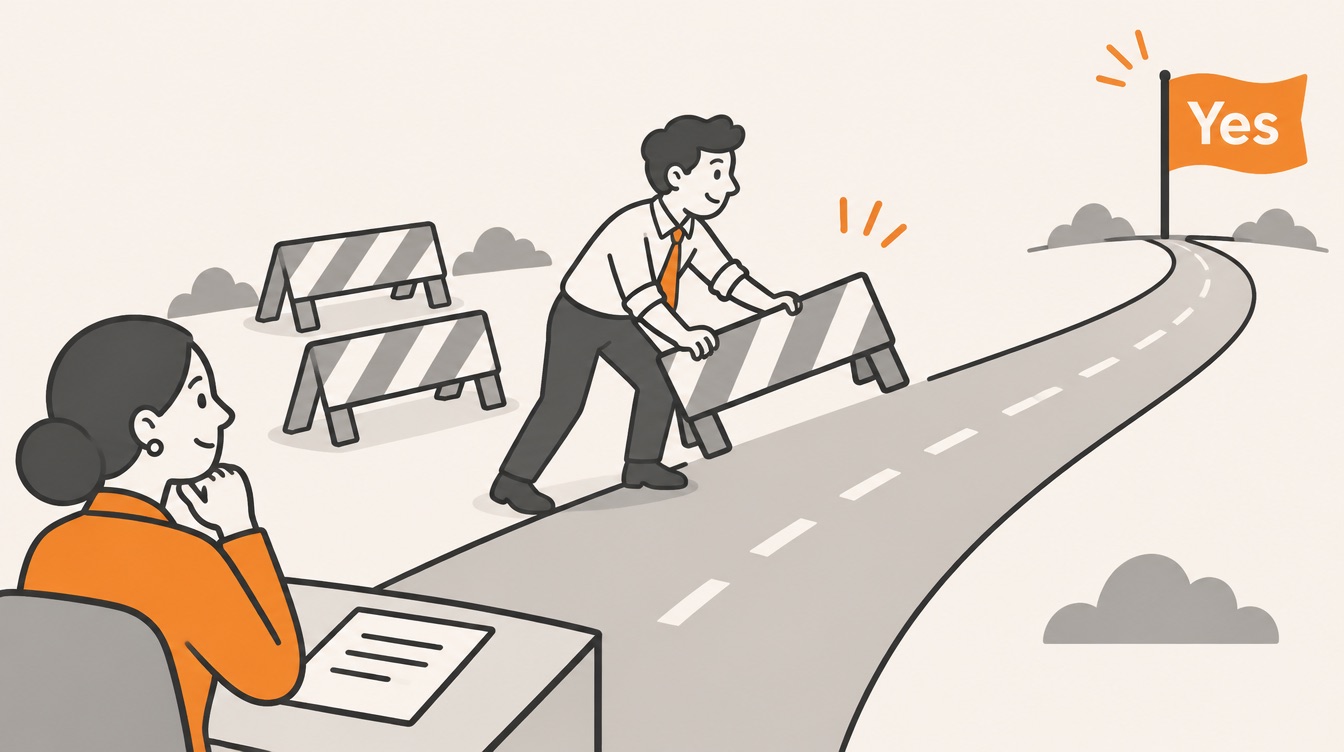
Some proposals lose because they make "no" easy. The Study Guide describes the writer's job as clearing the way to "yes" by predicting each moment when the reader might feel uneasy, skeptical or afraid, and answering it there.
| The doubt | The feeling behind it | What removes it |
|---|---|---|
| "Can a company this size handle it?" | Skeptical | State the size plainly, then show the work you have already done |
| "Has this worked anywhere like us?" | Skeptical | Proof from a similar customer and how it carries over |
| "What happens if it goes wrong?" | Afraid | A rollback plan and a named person responsible |
| "Why should we pay more?" | Uneasy | The value in money terms, next to the price |
| "Are we locked in afterwards?" | Uneasy | Clear handover and exit terms |
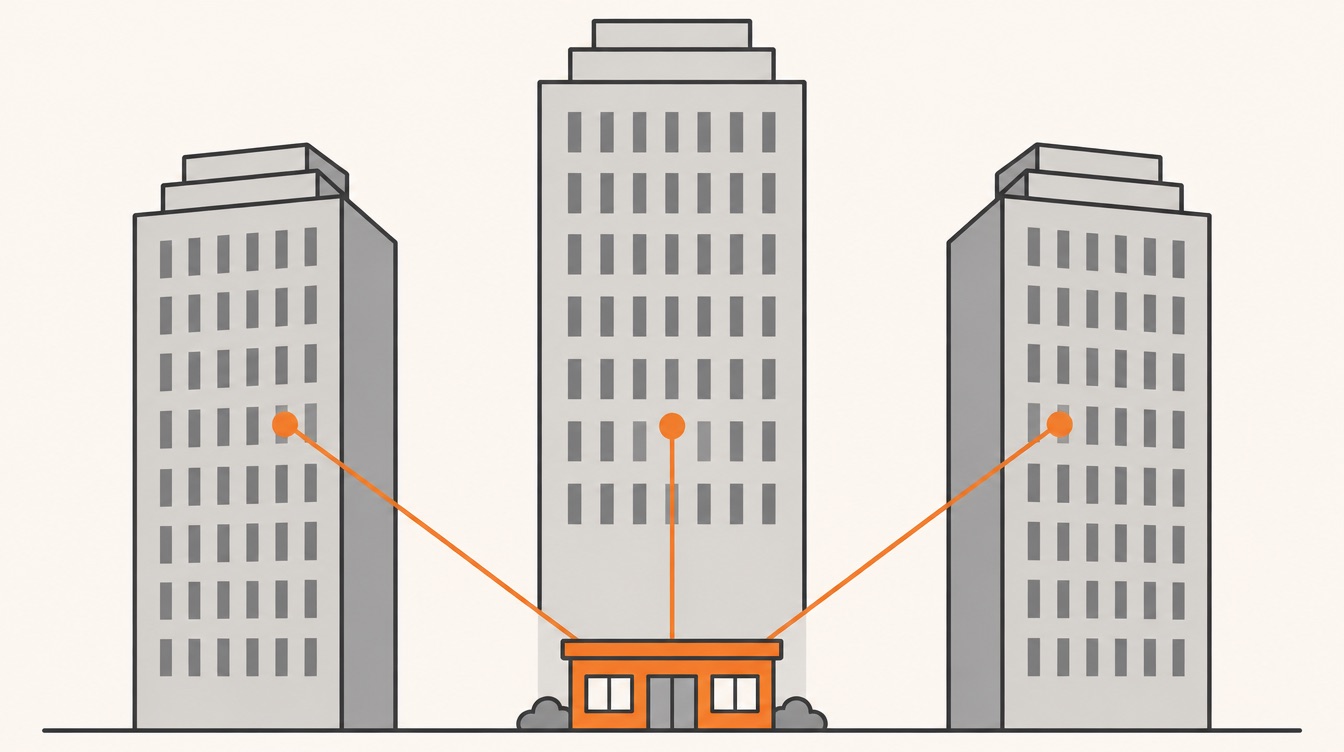
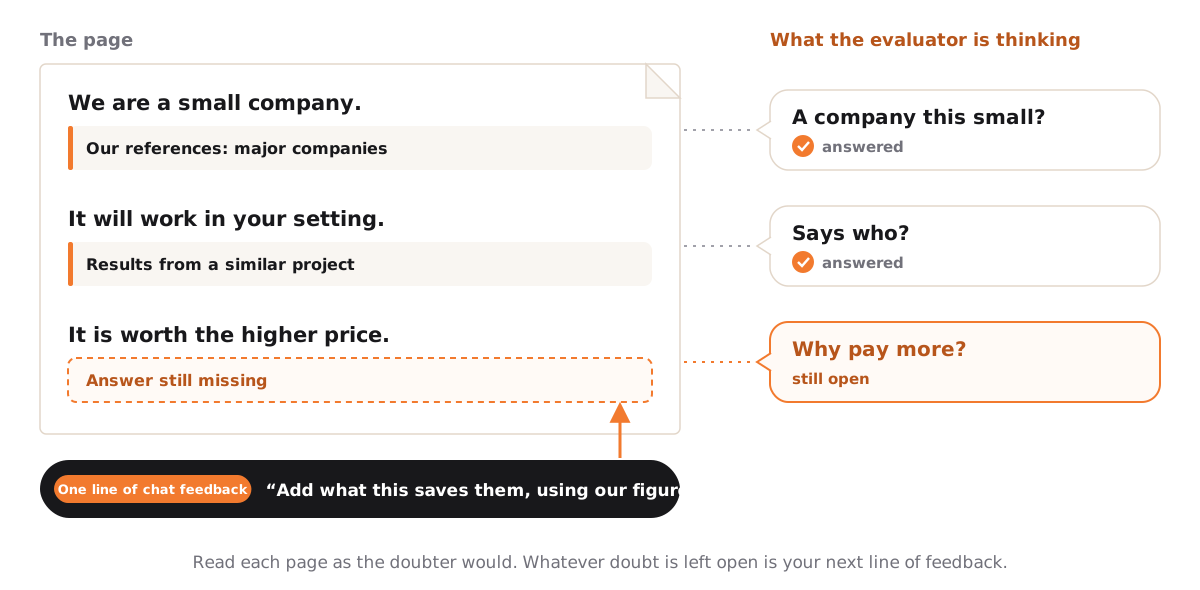
The first row is my own story. My company was small at first. And yet the fact that such a small company had worked with major companies in Korea, Japan and Southeast Asia ended up counting in our favor. In the proposal we stated as fact that we were small, and then, just as factually, we put our references forward. That made their effect look bigger than it would have otherwise.
The small size was the obvious reason to reject us. We put it on the page ourselves and let the references answer it. A reader who has just been told the company is small reads the next line differently. To show the shape of it, here is an illustrative rewrite, not what I wrote:
Illustrative: leaves the doubt open
"We are an experienced company with a strong track record across Asia."
Illustrative: answers the doubt
"We are a small company. We have worked with major companies in Korea, Japan and Southeast Asia."
This only works if both halves are true and the reader can check them. It is also not a formula for hiding a real capability gap: if a doubt is justified, the honest answers are to close the gap, for example with a partner, or to reconsider the bid.
Graphics, research and culture
The chapter's last tool is visual. People take in main points faster from images than from text, and images stir feeling more readily than words, so graphics and multimedia can help readers picture your solution working for them. Episode 14 applies the same idea to the presentation room.
The Study Guide's summary adds two adjustments. Classic techniques get stronger when paired with newer research into how people think and behave. And they have to be adapted to the cultural background of the audience, which matters to anyone bidding across borders: how directly you state a weakness or ask for the business should suit the people reading.
Two misconceptions
- Persuasion can replace asking. All the techniques above only raise the odds of a "yes". They do nothing if you never ask. Say clearly what you want the reader to do.
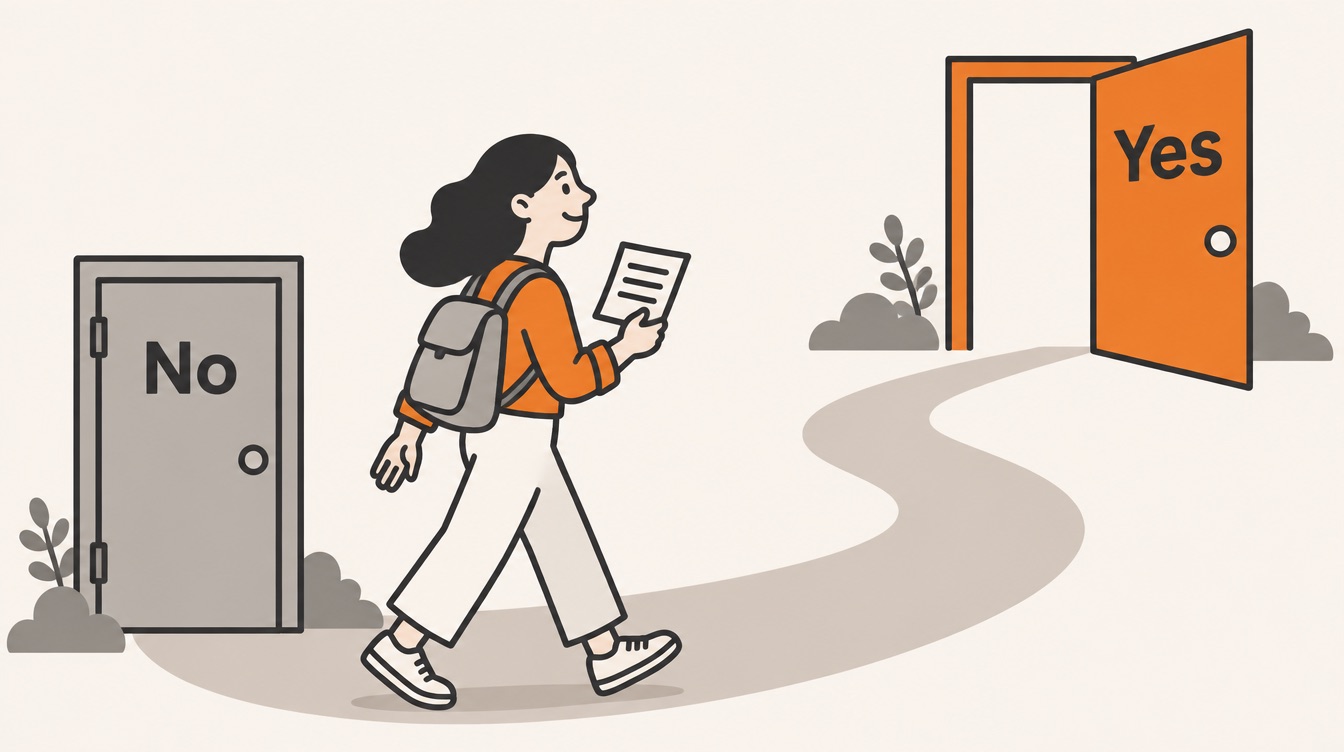
- "No" is the end. It may end this opportunity, but what it teaches you about this reader and about your own abilities gives you another chance later. A clear "no" also lets you go and find out why, which is how you make progress.
Checklist for your next proposal
- Name the reader's pain in one sentence. If the RFP doesn't show it, go and look: the site, the service, the people.
- Test each section: could it go to another customer unchanged? If so, make it specific.
- Write down what inaction would cost the organization and the person responsible.
- Promise only what you can deliver, and check the values you claim to share are real.
- Use the sequence inside sections: introduce, state facts, prove, disprove, conclude.
- Follow each claim with a proof, and with a line on how it applies in the reader's world.
- List every point where the reader may feel uneasy, skeptical or afraid, including your obvious weakness, and answer each one on the page.
- Add one honest story or graphic that lets the reader see what is at stake.
- Adjust for culture, ask clearly for the business, and if the answer is no, find out why.
Where Contrl fits
Contrl reads your RFP, but it cannot walk the site: what the RFP leaves out, it knows only if you tell it. What it can help with is the moment after a draft exists, when you read a page the way a doubtful evaluator would and look for the question left open. One line of chat feedback rewrites the page, so you can give it the answer, such as what the approach saves or which references to put right after a plain statement of your size. The doubts still have to come from you; the page then carries the claim and the fact that answers it, in your company's design system and citing the RFP requirements it responds to.
Next in the series
Persuasion decides what each sentence is for; the reader still has to understand it on the first pass. Episode 17 covers Writing Clearly.
This article is an independent study companion based on the APMP Foundation Study Guide, version 4.2 (© 2025 APMP), which summarizes the APMP Body of Knowledge. It paraphrases and comments on that material and is not endorsed by APMP. The Singapore kiosk bid and the small-company story are the author's own experience, not from the Study Guide; no customer is named. The tests in the traits table, the weak versions, the before-and-after examples, the table of doubts and the advice on finding pain outside the RFP were written for this article, and their figures are illustrative. For the authoritative text and certification information, see apmp.org.