Here is this episode's question: can your price be explained as value the customer accepts?
Many teams treat the price volume as the spreadsheet that follows the real proposal: totals, rates, a few required forms. The APMP Body of Knowledge takes a different view. Cost and pricing data are developed from two sources, your past performance and the customer's sense of what the solution is worth, and the way you present them is part of the persuasion. Showing what your price consists of proves you reached it logically, and that logic lends credibility to everything else you wrote. In one line: a price states a number, and a good price volume explains why that number is good value.
This series works through the APMP Body of Knowledge as summarized in the APMP Foundation Study Guide. Episode 11 covered Competitive Price to Win, the analysis that tells you where your price needs to land. This episode is about the next step: presenting that price so the evaluator understands and believes it.
A price volume is an argument, not a table
Compare two price volumes. The first gives a grand total and a rate table. The second gives the same total, then shows how it breaks down, what assumptions drive each part, and what the customer gets for each part. Both are compliant. Only the second gives the evaluator a reason to accept the number.
Numbers only
"Total price for the three-year contract: $4.8 million. See the attached rate tables."
Numbers with logic
"Total price: $4.8 million. Labor makes up 62%, set by the staffing plan in Volume II; transition is a fixed 8% because the staged cutover needs no parallel running; the rest is licences and support at last year's rates."
The Study Guide makes the same point for commercial bids: give some detail of what the price stands for, both as real figures and as a graphic, and you show that your pricing follows a method. It also asks you to go further than the figures themselves and explain the value you bring compared with your competitors. That explanation is what turns a quote into a case for awarding.
Know the rules of your setting first
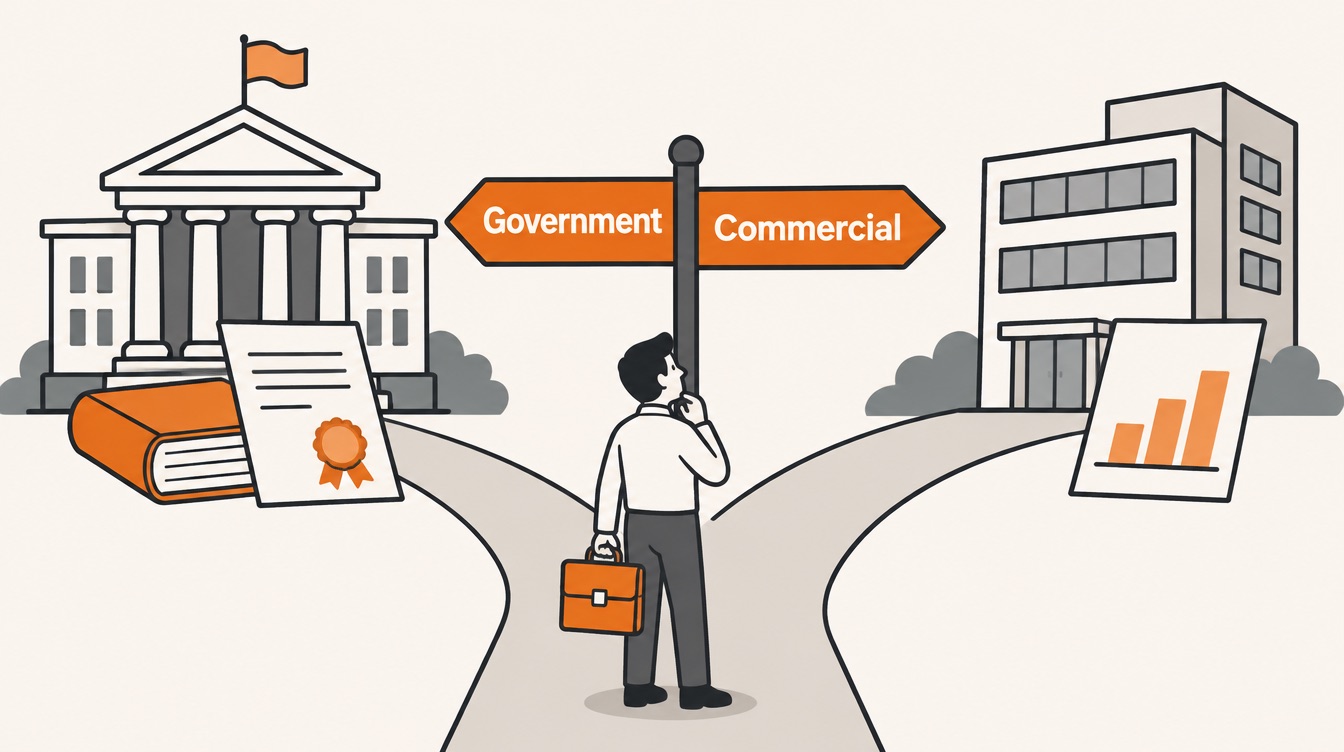
Of all the topics in business development, cost and pricing may differ most between government and commercial work. Government agencies and quasi-government bodies often regulate pricing data tightly; commercial buyers mostly leave the format to you and judge the logic.
| Government and public sector | Commercial | |
|---|---|---|
| Main concern | Following the acquisition regulations exactly | Making the price logic easy to follow and believe |
| Disclosure | May require certified cost or pricing data that was reasonably available when the price was agreed | Usually your choice how much to reveal |
| Subcontractors | If you must certify, you usually must obtain certified data from subcontractors and prospective ones too | Handled by your commercial agreements |
| Format | Often prescribed forms and breakdowns | Your own structure, with numbers and graphics |
| Risk of getting it wrong | Non-compliance, disqualification or later legal exposure | A price that looks arbitrary and loses trust |
The practical rule from the Body of Knowledge is simple: understand the acquisition rules before you decide to bid. Disclosure duties affect your partners as well as you, so a teaming partner who won't share certified data can become a problem late in the process. Settle it during capture, not the week before submission.
Price, value and added value
To reach a winning price, the Study Guide asks you to keep three ideas apart:
| Term | Definition | Whose view |
|---|---|---|
| Price | What you charge the customer for the product or service | Yours |
| Value | What the customer believes the product or service is worth | The customer's |
| Added value | The customer's perceived value minus what it pays: your price plus its own implementation costs | The customer's, measured against your price |
Those terms produce a chain that usually holds for a winning price:
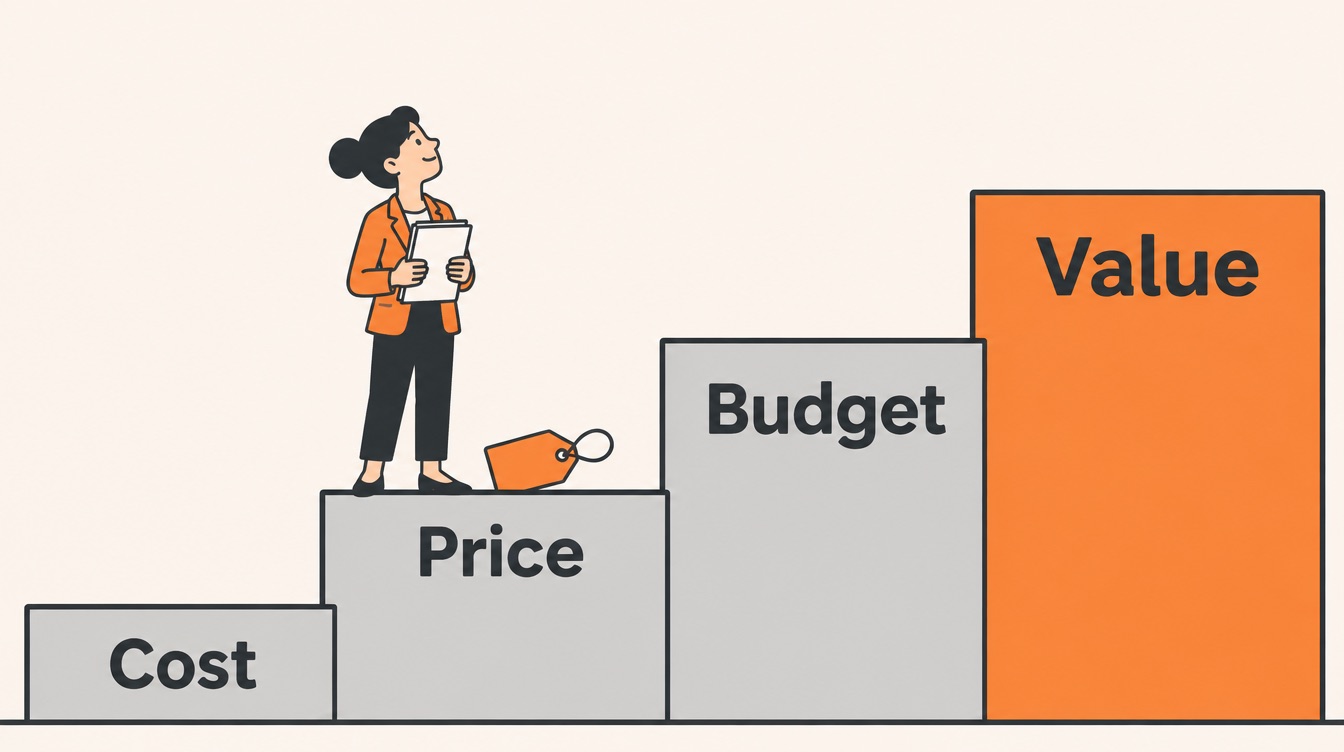
Value as the customer sees it ≥ the customer's budget ≥ your price ≥ your cost
Read it from the bottom. Price above cost means the work is worth doing. Price at or below budget means the customer can actually buy it. Budget below perceived value means the customer believes the purchase is worth making at all. Break any link and the bid fails: you lose money, the customer can't afford you, or the offer looks overpriced for what it delivers.
The most useful part of the chain is the top. The Body of Knowledge observes that customers tend to choose the solution with the largest added value, the widest gap between what they think it is worth and what it costs them. That is why the cheapest bid doesn't always win. A bidder who raises the customer's perceived value can widen the gap without cutting the price.
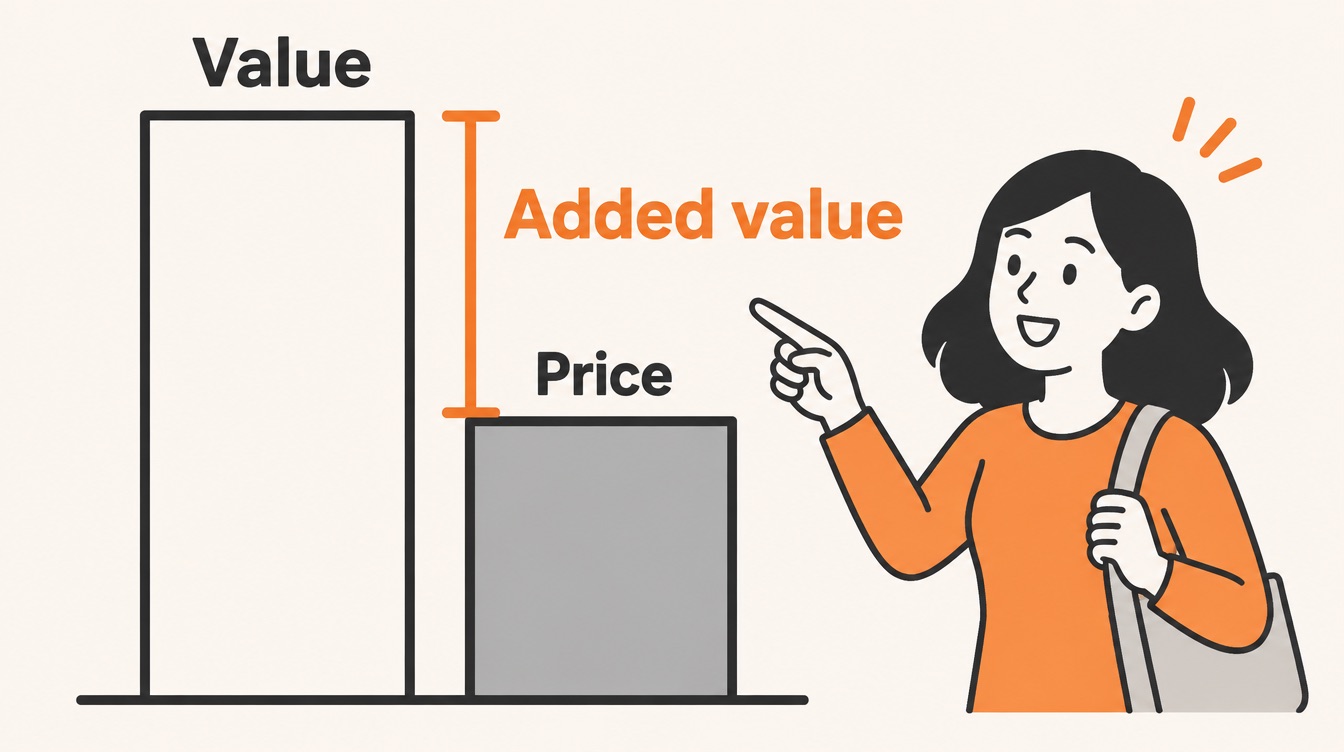
Note that implementation costs belong on the customer's side of the gap. A low price that leaves the customer with heavy training, migration or downtime costs may deliver less added value than a higher price that removes them. If your solution lowers the customer's own effort, say so and count it.
Quantify added value, or it doesn't count
Claiming added value is easy. The Study Guide is blunt about a claim with no measurable cost or benefit behind it: it is empty. Evaluators have read "we deliver added value" from every bidder, and they give it no weight.
Empty claim
"Our approach delivers significant added value to the agency."
Quantified claim
"The staged cutover shortens transition from ten weeks to eight. At the agency's own estimate of $45,000 a week in parallel running costs, that saves about $90,000."
The Body of Knowledge suggests a way to measure it: compare against the outcome without your benefit. What would the customer spend, lose or delay if it chose a solution that lacks what you offer? Show that difference in real money. The message to land is that choosing someone else could cost the customer time, money or its own effort.
You can only do this if you know what the customer values. That knowledge comes from customer meetings long before the RFP, the work covered in Episode 2 and Episode 5. Ask what a day of downtime costs, what staff time is worth, which penalties the customer pays today. Those answers become the basis of your monetary claim, and because they are the customer's own figures, they are hard to argue with.

Open the price volume with a cost summary
Episode 6 argued that the executive summary decides much of the evaluation. The Body of Knowledge applies the same idea to the price volume: open it with a summary aimed squarely at the price you propose and the benefits the customer gets for it. Doing so builds credibility and closes the loop between the value story in the technical volume and the numbers in the price volume.
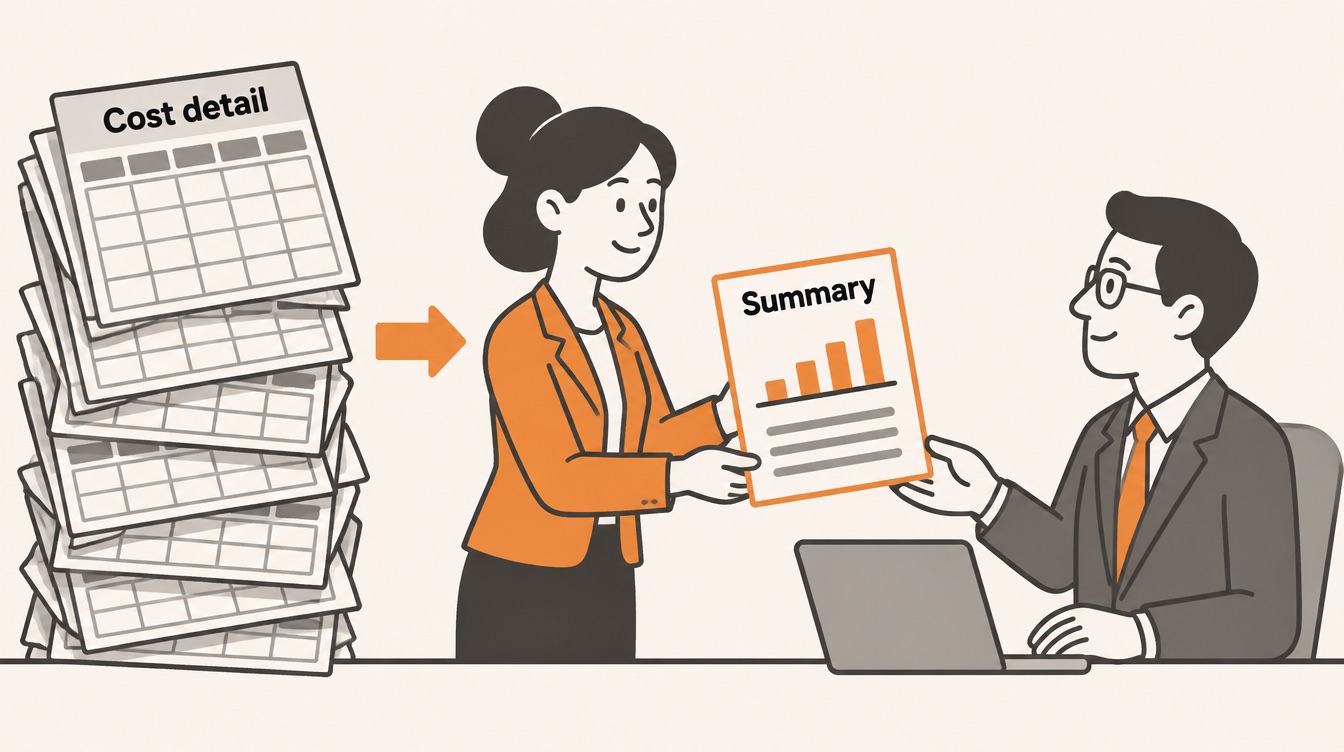
Think about who reads it. A cost analyst works through the detail and then reports to a decision maker who will not. The Study Guide's framing is useful here: treat the cost summary as the words you hope the price analyst will repeat to that decision maker. If the analyst can repeat your summary in two sentences, you wrote it well.
A good cost summary includes:
- The proposed price and how it is structured.
- The benefits to the customer, quantified, using the same win themes as the technical volume.
- A map of the detail that follows, so each figure can be found and checked.
- Your estimating guidelines: the bases and assumptions you used, usually adapted from earlier programs, with the adjustments explained.
Evaluators want both the overview and the trail behind it. A summary with no traceable detail looks like marketing; detail with no summary makes the analyst do your job. A cost volume that is easy to review gives the evaluator one more reason to recommend you.
Show the value in graphics
Rows of figures make the reader do the arithmetic before seeing the point. Graphics, tables and charts give a snapshot of the message at once, and the Study Guide notes they help with two audiences: the customer, and your own senior management, who must approve the price before it goes out.
| What you want to show | A graphic that fits |
|---|---|
| What the price is made of | A pie or stacked bar of the main cost elements |
| Savings over the contract | A line chart of the customer's cost with and without your solution |
| Price by phase or year | A bar chart, one bar per period |
| Why your price is better value | A features and benefits table with the monetary benefit of each |
| The whole value proposition | One picture of price against the benefits it buys, including the price discriminators |
Choose the graphic for the data, not the other way round. A pie chart of twelve thin slices is harder to read than the table it replaced.
Value can be argued; cost must be factual
Value is partly a matter of perception, and the proposal is allowed to shape it. Cost is not. The Body of Knowledge draws the line clearly: cost and pricing data rest on facts, not judgment. Every figure in the price volume should trace to a source, such as actual rates, historical effort on similar work, supplier quotes or the customer's own data.
Those facts do three jobs. They validate your claims, they make your company look credible, and they give both sides what they need to decide whether the price is right. Even though prices are set by the market, the facts let you tell a story that builds confidence in the solution. This is the pricing counterpart of the proof points in Episode 10: in the technical volume, proof makes a benefit believable; in the price volume, facts make a number believable.
Where should the price itself land? That is the job of customer and competitor intelligence and of the Competitive Price to Win analysis from Episode 11. To add value, you need to know both what this customer values and what your competitors will probably offer. This episode assumes you have that answer and focuses on presenting it.
Checklist for your next price volume
- Read the acquisition rules before the bid decision, including any certified cost or pricing data duties, and confirm subcontractors can meet them.
- Check the chain: perceived value ≥ budget ≥ price ≥ cost. Know where each link comes from.
- Count the customer's implementation costs, and show where your solution reduces them.
- Quantify added value in money, compared with the outcome without your benefit, using figures the customer gave you where you can.
- Write a cost summary that states the price, links it to the win themes, maps the detail and explains your estimating guidelines.
- Keep every figure traceable to a factual source.
- Use the right graphic for each message, and test it on your own management first.
- Read the technical and price volumes side by side. They should tell the same story.
Where Contrl fits
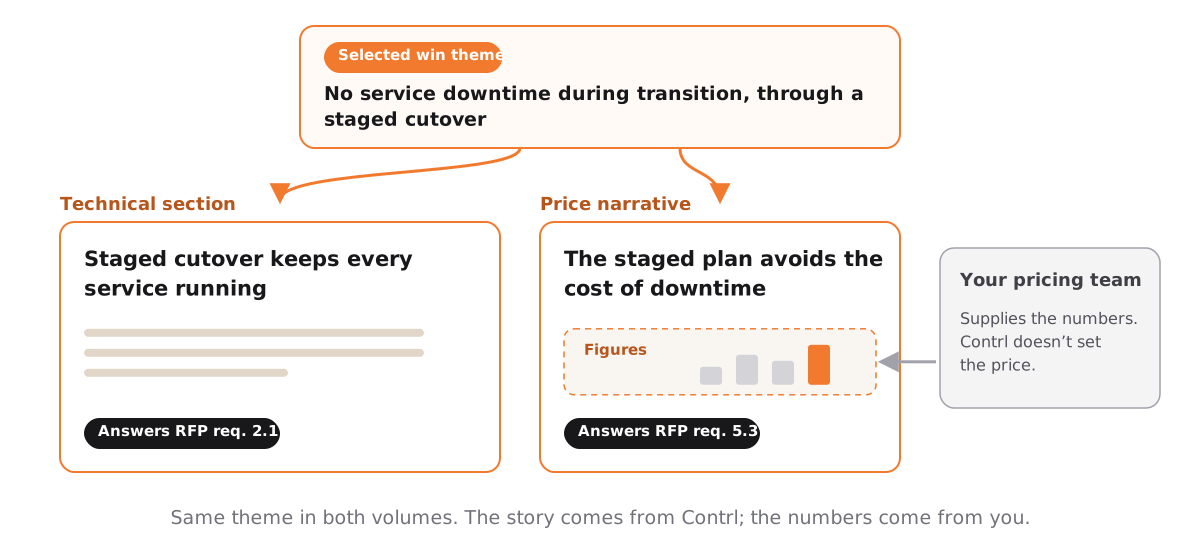
Contrl doesn't price your bid; the numbers come from your pricing team. What it can do is keep the price story attached to the rest of the proposal. When the RFP's required outline includes a price or cost narrative, that section's key sentence is reduced from the same win theme as every technical section, and each page cites the RFP requirements it answers. The value argument in the cost summary then matches the one evaluators read in the technical volume, and your team drops in the figures behind it.
Next in the series
The proposal is written and priced. Often, though, the customer wants to hear it from you in person. Episode 14 covers Developing and Delivering Effective Presentations: how to carry the same win themes into an oral presentation that the evaluators remember.
This article is an independent study companion based on the APMP Foundation Study Guide, version 4.2 (© 2025 APMP), which summarizes the APMP Body of Knowledge. It paraphrases and comments on that material and is not endorsed by APMP. The before-and-after price paragraphs, the government and commercial comparison table, the empty and quantified claims, the cost summary list and the graphics table were written for this article, and their figures are illustrative. Rules on certified cost or pricing data vary by country and agency; check the regulations that apply to your bid. For the authoritative text and certification information, see apmp.org.